
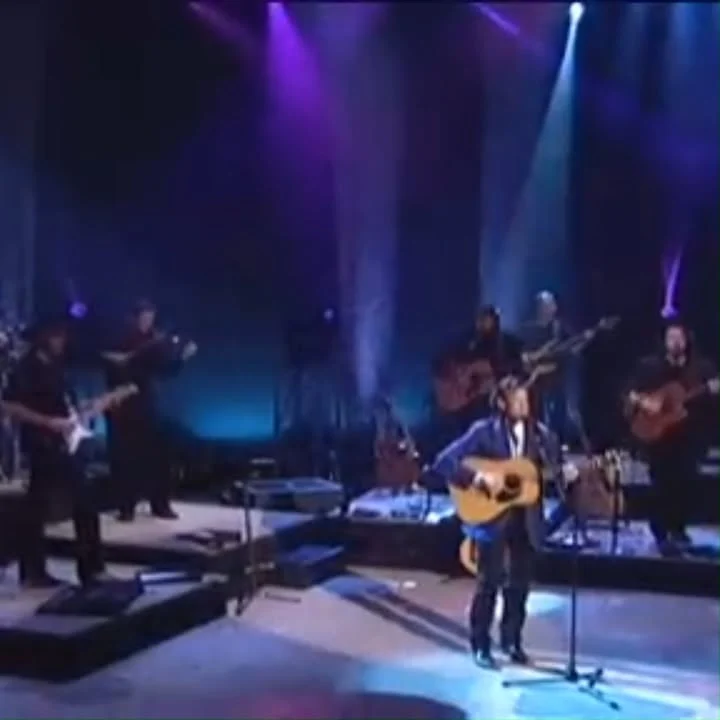
The ring. A thin circle of gold sits in a dusty barroom light, pulling against the gravity of desire. It is the quietest character in country music history, yet it sparkles with a power that changed everything. Randy Travis understood this weight. He sang about it with a baritone that felt like a secret whispered across a crowded room. The year was 1985, and Nashville was drowning in gloss. Synthesizers shimmered. Snare drums echoed with artificial reverb. The raw soul of Merle Haggard and George Jones had become a distant memory, buried under sequined pop crossovers. Then a murmur cut through the noise. It was not a shout. It was the sound of a man choosing loyalty over everything else.
The song was “On The Other Hand,” a composition by the legendary duo Paul Overstreet and Don Schlitz. At first, it barely registered. When it was released in 1985, the country radio machine found it too spare, too traditional, too country for the moment. But Warner Bros. had faith. After the success of Travis’s follow-up single “1982,” the label re-released the track a year later. This time it did not just climb the charts. It detonated a quiet bomb. It announced the arrival of the neotraditionalist movement and crowned its first king.
The genius of “On The Other Hand” lies in its central metaphor. A man sits alone at a bar. Across from him sits a new woman, tempting him with the promise of escape. But on that other hand, there is the ring. The entire song pivots on that image. It is a masterwork of lyrical tension, a drama of three minutes where the battlefield is a barstool and the only armor is a thin circle of gold. Kyle Lehning, the producer, understood that less is more. While his contemporaries layered sound upon sound, Lehning peeled layers away. The recording breathes. There is space between the notes, an intentional quiet that allows the gravity of the lyric to fill the room.
The song opens with a foundational acoustic guitar, a simple figure that feels like a man nervously tapping his fingers on a bar top. Then comes the steel guitar, played by Paul Franklin. It is not an accent. It is the narrator’s conscience, sighing with regret and longing. It is the sound of a heart being pulled in two directions. Listening back on quality headphones reveals the clarity of Lehning’s vision. You can hear the subtle woodiness of the bass, the gentle brushwork on the snare, the sparse foundational chords of the piano. Each instrument has its place. No element crowds another. This was not a wall of sound. It was a carefully arranged diorama of heartache.
It’s a quiet war waged in three minutes, where the battlefield is a barstool and the only armor is a thin circle of gold.
At the center of it all is the voice of Randy Travis. He was in his mid-twenties, but he sang with the gravitas of a man twice his age. His baritone is not forceful. It is resonant. There is a natural, unhurried cadence to his delivery, a slight North Carolina drawl that sands the edges off each word. He does not oversell the drama. He lets the words do the work, inhabiting the character with a sincerity that was profoundly absent from the airwaves. When he sings “there’s a golden band” in the chorus, the line lands like a physical object. The song pivots entirely on that phrase, turning from a story of temptation into a story of loyalty.
Imagine a traveling salesman in a lonely motel room, the glow of the television painting the walls blue. He hears the song on a late-night radio station, and the simple story cuts right through his exhaustion. He glances at the indentation on his own ring finger, a silent testament to the life waiting for him hundreds of miles away. The song does not judge him. It understands him. Or think of a young couple swaying on a dance floor in a small town VFW hall. The song comes on, and they pull each other a little closer. They have had their own storms, their own moments of doubt. But the song’s resolution—“I’m going home to be a family man”—reaffirms the choice they make every day. It is a quiet celebration of the unglamorous essential work of keeping a promise.
The entire album, Storms of Life, is built on this foundation of authenticity. It was a commercial and critical titan, establishing Travis as a genuine superstar and setting the sonic template for the next decade of mainstream country. The influence of “On The Other Hand” is immeasurable. It kicked open the doors for artists like Alan Jackson, Travis Tritt, and Clint Black. It made acoustic instruments and sincere story driven lyrics commercially viable again. It reminded Nashville that the genre’s strength was not in its ability to mimic pop, but in its courage to stand apart. For anyone who appreciates true premium audio fidelity, this recording remains a benchmark for clean emotionally direct production.
To listen to “On The Other Hand” today is to be transported. It is a reminder of a time when a song could change the direction of an entire genre not with bombast but with quiet conviction. It is the sound of a man choosing not what he wants in the moment but who he wants to be forever. Go back and listen again. Do not just hear the melody. Feel the weight of the choice being made in the silence between the chords.
For further listening, explore these tracks that share the same spirit of emotional clarity and masterful restraint. George Strait with “The Chair” offers a similar narrative cleverness built around a single inanimate object. Keith Whitley with “Don’t Close Your Eyes” captures profound baritone led vulnerability. Vince Gill with “When I Call Your Name” features a powerful emotionally pure vocal performance over a classic steel drenched arrangement. Alan Jackson with “Here in the Real World” is a direct descendant of the neotraditional sound Travis pioneered. The Judds with “Grandpa Tell Me Bout the Good Old Days” evokes a similar sense of nostalgia and longing. Don Williams with “I Believe in You” showcases the immense power of a gentle sincere vocal delivery and beautifully understated production. Each of these songs echoes the quiet revolution sparked by a single ring and a voice that refused to shout.