
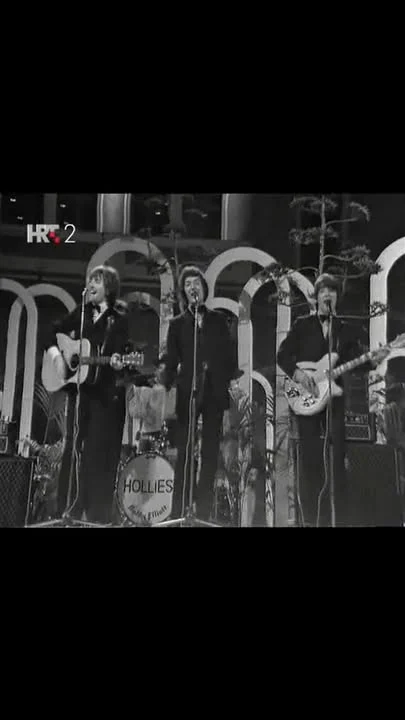
Picture yourself at a golden hour fairground, the sound of a fair organ spinning into the distance, but instead of calliope wheezes, a chiming guitar and three voices lifting in tight harmony take over the air. That is the world of The Hollies and their 1967 single “On a Carousel,” a track that captures the giddy, almost dizzying sensation of chasing a crush under carnival lights. Released in February of that year, the song was a collective effort from Allan Clarke, Graham Nash, and Tony Hicks, and it remains a shimmering artifact of mid-60s British pop at its most irresistible.
“Riding along on a carousel… wasn’t intended to be philosophy; it was pop poetry built for airwaves and jukeboxes.” – Graham Nash
The band’s confidence in the track was immediate. They knew they had a hit. That assurance pulses through every crisp guitar line and every stacked vocal. The single soared to No. 4 in the UK and reached No. 11 on the US Billboard Hot 100, proving that the Hollies’ gleaming harmonies and tight arrangements could cross the Atlantic with ease. Yet what makes “On a Carousel” so special is how it blends Merseybeat punch with the pastel psychedelia that was hovering over 1967.
Listen closely to the opening bars and the ride begins. Tony Hicks’s lead guitar sets a looping, lyrical figure that circles back on itself, a musical metaphor for the carousel. Graham Nash’s rhythm guitar fills the midrange with a breathy strum. Allan Clarke’s harmonica darts in with small flashes of color. The rhythm section, anchored by drummer Bobby Elliott and bassist Bernie Calvert (who replaced Eric Haydock in mid-1966), provides crisp propulsion. Elliott’s snare snaps and ride cymbal locks with the bass, and his fills lift the band into each chorus with a sense of floating upward.
The real magic lies above that foundation. The Hollies were meticulous about their harmonies, tracking and retracking until every consonant aligned. On “On a Carousel,” Nash takes the first verse lead, his voice carrying a lighter, yearning quality. When the chorus arrives, the voices stack in thirds and sixths, rounding the melody into a shimmering circle. It is a carousel of voices, perfectly executed. The production keeps adornments spare—a tambourine flick here, handclaps buried in the mono soundstage—so that the guitar shimmer and vocal sheen remain front and center.
Lyrically, the carousel becomes an elegant metaphor for the thrill and frustration of young love. The narrator is always in motion, always almost reaching the object of his affection, but never quite connecting. The “round and round” refrain mimics the cycle of pursuit and near miss. It is pop poetry, light but truthful. Nash himself admitted the simplicity was intentional: the words were built for radio and jukeboxes, not for philosophy books.
A curious twist surrounds the song’s album placement. In the UK, “On a Carousel” was released only as a stand-alone single. It was not included on the band’s 1967 album Evolution, even though it was recorded during the same sessions. That album instead featured gems like “Carrie Anne” and “Ye Olde Toffee Shoppe.” In North America, the single anchored the compilation The Hollies’ Greatest Hits (Imperial/Capitol, 1967), which became the group’s highest-charting US album at that time. For American listeners, the song lived alongside “Bus Stop” and “Look Through Any Window” in a narrative of the band’s evolution from beat-group punch to baroque pop.
What ensures the track’s lasting appeal is its balance between replayability and depth. The hook is immediate, but the interior is filled with subtle details—a harmony inversion, a carefully placed drum fill—that reward repeated listens. It sits at a hinge moment in 1967, when British pop was absorbing psychedelic color without losing radio-friendly concision. The song hints at the technicolor textures of the summer of love while staying proudly commercial.
For new listeners, “On a Carousel” is an ideal entry point into the Hollies’ catalog. It showcases their vocal clarity, their instrumental precision, and their ability to craft a hook that feels both effortless and inevitable. It is also a study piece for anyone interested in harmony arrangement, illustrating how to build lift without density or volume. And it is simply great fun to sing along to.
The Hollies hallmark was their refusal to coast on their vocal blend. They married harmony to rigorous songcraft. “On a Carousel” is a small masterclass in arrangement: guitars glimmer, bass grounds, drums articulate, voices soar. It is radiant pop, generous with hooks, rich in vocal color, executed with understated discipline. Whether you first encounter it on a vintage 45, a 1967 US compilation, or through a streaming service, the track remains a spinning, gleaming invitation to take another ride.
If you love this song, explore these companions:
The Hollies – “Carrie Anne” (1967): Another harmony-rich gem from the same sunny, slightly psychedelic period.
The Hollies – “Bus Stop” (1966): Jangly guitars and everyday romance turned into pop magic.
The Hollies – “Have You Ever Loved Somebody” (1966/67): A tougher showcase for Allan Clarke’s vocal presence, featured on Evolution.
The Beatles – “Penny Lane” (1967): For more color-drenched British pop with brass sparkle.
The Byrds – “Mr. Tambourine Man” (1965): The chiming guitar sound at its zenith.
The Turtles – “Happy Together” (1967): Hugely singable and harmony-forward, sharing the same pop architecture.
Whether you stream or drop the needle, the 1967 US compilation The Hollies’ Greatest Hits offers an easy survey of the era’s essentials. Then climb aboard and let the song spin you around again.