
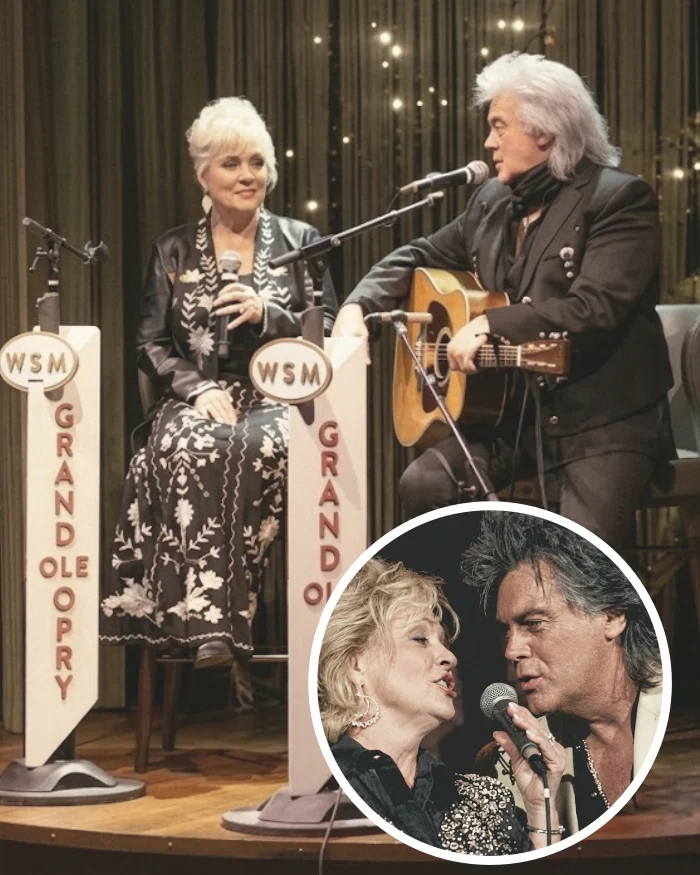
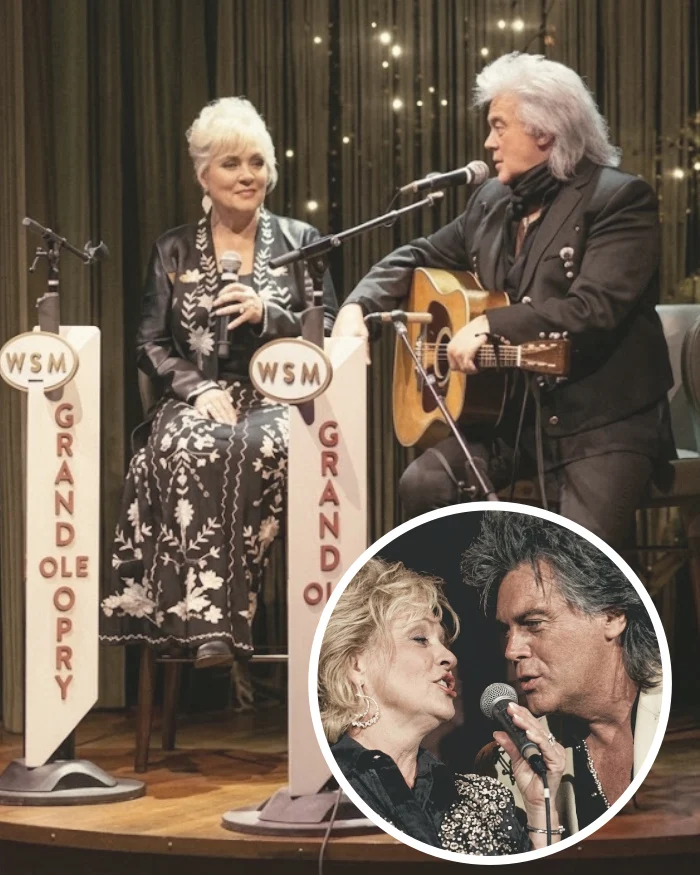
The most powerful move Marty Stuart makes on the Grand Ole Opry stage is a half step backward. When he walks into the historic six-foot circle of oak beside Connie Smith, he settles behind her left shoulder, plugs in his vintage 1954 Fender Telecaster once owned by Clarence White, and fixes his attention on the back of her hair. Both are full members of country music’s most celebrated institution. Connie was inducted in 1965 and became known as one of the finest vocalists in the genre’s history. Marty joined in 1992 after decades as a master instrumentalist and bandleader.
On other nights Marty commands the room with his band the Fabulous Superlatives, driving through sharp bluegrass tempos and confident showmanship. When Connie steps to the center broadcast microphone, he deliberately gives up that role. Clutching the worn Telecaster, he folds himself into the rhythm section and devotes his playing to her vocal phrasing. Subtle fills and quiet harmonies support her without pulling the spotlight away. Video clips of these Opry appearances circulate among fans not because of theatrical staging but because of the steady gaze Marty keeps on his wife as she reaches for the high notes.
That unspoken discipline took root long before they married on the Pine Ridge Indian Reservation in South Dakota on July 8, 1997. Connie had joined the Opry in 1965 on the strength of her debut single Once a Day, which spent eight weeks atop the Billboard country charts. Marty was an eleven-year-old standing in line for her autograph at the Choctaw Indian Fair in Mississippi in 1970. When they reunited professionally in 1996 to write and record her self-titled comeback album, he had to show that his childhood admiration had grown into genuine musical respect.
In the studio Marty pushed for traditional arrangements that turned away from 1990s pop-country trends, surrounding Connie with acoustic instruments and live room tracking. That shared creative focus quickly bridged the seventeen-year age gap between them. When they brought the material back to the Opry in the late 1990s, producers saw that the pairing carried natural authority. They were not a novelty act. They were two seasoned performers who treated traditional country music as sacred ground.
He lets the world look at Connie first
Over the decades their Opry appearances settled into a private ritual. Backstage in the dressing rooms off the backstage corridor, Marty tunes Connie’s acoustic guitar by ear, checks her microphone cables, and goes over the sequence of the set. While younger acts cycle through entourage-filled green rooms, the couple prefers quiet corners and conversations with veteran stagehands who worked the Opry during its historic tenure at the Ryman Auditorium.
On the stage boards Marty’s guitar work moves like an extension of Connie’s breath. If her voice lingers on a low syllable, his fingers answer with a muted chord swell. When she reaches for a high sustained passage, he pulls back completely and lets the natural acoustics of the house showcase her power. Other musicians on the Opry roster note how Marty reads Connie’s shoulder movements to anticipate tempo shifts, making sure she never has to compete with the band.
Away from the weekend broadcasts the same steady balance defines their everyday life in Hendersonville, Tennessee. At their restored brick home Connie manages an active family household that has grown to include five adult children, nine grandchildren, and multiple great-grandchildren. The kitchen table serves as the main meeting spot, where Connie cooks scratch meals and coordinates family gatherings far from the pressures of commercial radio.
Marty spends weekdays working across the property, cataloging what has become one of the world’s most extensive private archives of country music artifacts. His collection spans more than twenty thousand items, including handwritten lyric manuscripts, stage costumes designed by Nudie Cohn, and historic instruments once played by Hank Williams, Patsy Cline, and Johnny Cash. Connie provides the steady domestic grounding that keeps Marty from being completely consumed by the archives, reminding him when to close the cataloging ledgers and come to supper.
That domestic calm feeds their public appearances. When the red broadcast lights illuminate the Opry house on Friday and Saturday nights, there is no need for rehearsal between them. Connie steps to the center to sing the songs that defined her six-decade career, and Marty remains right where he chose to be decades ago, one quiet step back, holding the rhythm steady, and letting the woman he promised to marry have the floor.