
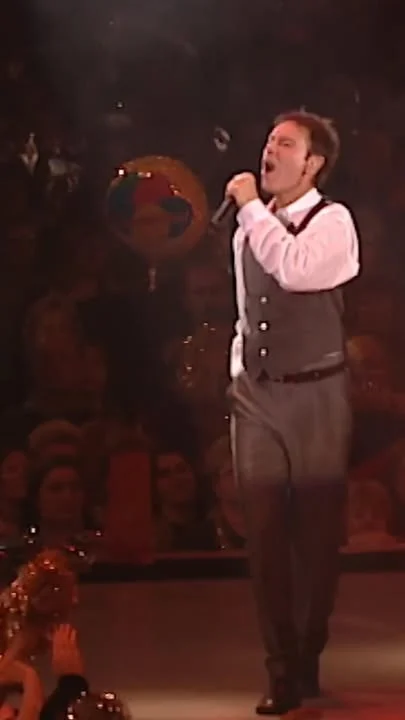
Every December, as the nights draw in and the first frost appears, a familiar voice drifts through the airwaves and something inside us softens. It is not just a song but a quiet invitation to pause, to remember, and to believe again. For more than three decades, Cliff Richard’s “Saviour’s Day” has been that voice for millions of listeners around the world. Its gentle yet soaring melody carries a warmth that cuts through the cold, reminding us that even in the darkest winter moments, hope is never far away.
Released on November 26, 1990, as part of the album “From a Distance: The Event,” this festive anthem quickly climbed its way into the hearts of the British public and beyond. It became Cliff Richard’s 13th number-one single in the UK, a remarkable achievement that secured his place in music history as the only artist to top the charts across five consecutive decades. But the song’s success was never about chart positions or records. It was about something far deeper, a connection to the true spirit of Christmas that continues to resonate with each passing year.
The story behind the song is as beautiful as the music itself. Songwriter Chris Eaton found his inspiration during a Christmas Eve party in 1989, when a sudden spark of creativity led him to a simple yet profound melody. He wanted to write something that captured the joy and meaning of the season without losing sight of its spiritual heart. When Cliff Richard first heard the demo, he knew immediately that it was something special. Having already enjoyed a massive hit with “Mistletoe and Wine” in 1988, Richard recognised the song’s potential to become a modern classic. He recorded it in August of 1990, and the rest, as they say, is history.
At its core, “Saviour’s Day” is a meditation on peace, unity, and renewal. It gently steers away from the tinsel and gift wrap that often dominate the holiday season, instead focusing on the deeper reasons we come together. The opening line, “Now we have been through the harvest, winter has truly begun,” paints a vivid picture of the season’s starkness, yet it also carries a quiet optimism. It acknowledges the harshness of winter while promising that light and warmth are on the way. The lyrics urge us to open our eyes, to look beyond our differences, and to embrace the love that surrounds us.
“Open your eyes on Saviour’s Day, don’t look back or turn away.”
These words, repeated with heartfelt conviction, have become a mantra for many who listen each year. They remind us that Christmas is not just about receiving but about giving, not just about celebrating but about reflecting. The chorus, with its uplifting call to “give thanks and celebrate,” transforms the song into an anthem of gratitude, one that invites everyone to take part in a shared moment of joy and togetherness.
The song’s impact was felt immediately upon its release. It dominated the airwaves in the weeks leading up to Christmas 1990, and its music video, filmed against the dramatic cliffs of Dorset, added a layer of visual poetry to the track. In the video, Richard stands alone against a backdrop of sweeping coastline and clear winter skies, his voice carrying across the landscape as if reaching out to the world. The simplicity of the imagery perfectly complemented the song’s honest and sincere delivery, making it a favourite on music channels and a fixture of holiday programming.
What makes “Saviour’s Day” truly timeless is its ability to speak to people of all ages and backgrounds. In an era where Christmas has become increasingly commercialised, the song serves as a gentle reminder of what the holiday is really about. It asks us to look beyond the hustle and bustle, to find moments of stillness and reflection, and to remember the hope that the birth of Christ represents. It is a song that does not judge or divide but instead brings people together in a shared celebration of love and faith.
Over the years, the song has only grown in stature. It has become a staple of festive playlists, radio shows, and church services, and it continues to introduce itself to new generations of listeners. Parents who first heard it in 1990 now share it with their children, passing down not just a melody but the values it embodies. In a world that often feels fractured and uncertain, the message of “Saviour’s Day” feels more relevant than ever. It encourages us to be kinder to one another, to hold onto hope even when times are tough, and to remember that we are all part of something larger than ourselves.
The legacy of Cliff Richard’s “Saviour’s Day” is not measured in gold discs or chart milestones alone. It lives on in the quiet moments of the season, in the carols sung by candlelight, and in the hearts of everyone who has ever felt a little warmer when they hear its opening chords. It stands as a testament to the enduring power of music to heal, to inspire, and to connect us all. As long as there are people searching for meaning and connection during the holiday season, this beautiful song will remain a cherished part of Christmas, a timeless reminder that the true spirit of the season is always within our reach.