
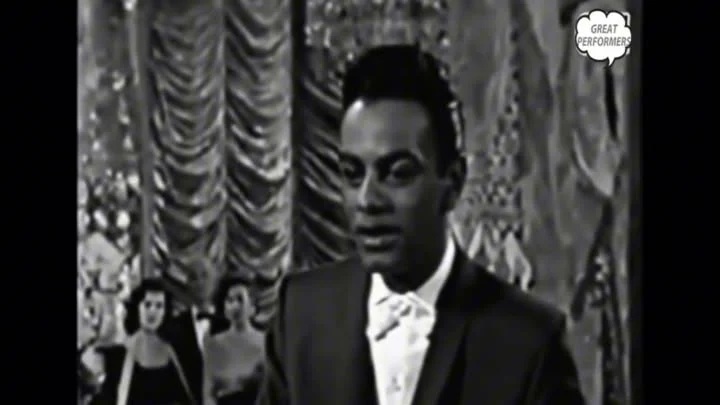
There is a moment in A Certain Smile when Johnny Mathis’s voice seems to float above the orchestra, a whisper of velvet turned into a confession. In a world where emotional pop often equates power with volume, this 1958 recording stands as a quiet rebellion. It is the sound of a memory held so tightly that it becomes a monument. For decades, listeners have discovered this track in quiet hours—through vintage radio static or streaming on modern headphones—and felt the same hush fall over the room. The song does not demand attention; it simply earns it, note by fragile note.
Written by Sammy Fain and Paul Francis Webster for the 20th Century Fox film of the same name, A Certain Smile arrived at a pivotal moment in pop history. Johnny Mathis was already a phenomenon on Columbia Records, guided by producers Mitch Miller and Al Ham, who understood how to frame his voice with orchestral grace. The arrangement, conducted by Ray Ellis, became a blueprint for romantic balladry. Though released as a single, it quickly found a home on the 1959 compilation More: Johnny’s Greatest Hits, solidifying Mathis’s reign as the king of the adult pop ballad. On both sides of the Atlantic, the track charted impressively—a Top 20 hit in the United States and a Top 5 success in the United Kingdom—proving that sophisticated sentiment could still command commercial force even as youth culture began to shake the foundations of popular music.
To understand the architecture of this piece is to step inside a mid-century dream of elegance. Ray Ellis builds the arrangement with restraint, then lets it bloom. It opens with woodwinds—flutes and clarinets that sound like half-sighed breaths—weaving through a rhythm section led by a deep, unhurried upright bass. The piano enters as a melodic suggestion, high and clear, like light on glass. There is no aggressive drumming; the pulse is carried by touch, not force. When Mathis’s tenor enters, it does not break the mood—it becomes the mood. His timbre is pure, almost impossibly smooth, yet carries a fragile vulnerability that prevents the entire experience from turning saccharine. He does not belt; he confides. His control of dynamics is astonishing, especially in the way he holds a soft note, letting his distinctive, slightly quavering vibrato bloom at the peak of sustain, before gently pulling back. The microphone placement—likely a classic ribbon mic in a large, reflective room—captures this intimacy with a depth that feels remarkably present even on vintage home audio equipment.
As the song moves into the chorus, the arrangement executes a classic sweep. Strings—violins and violas—rise in a magnificent swell, not as wallpaper but as an emotional amplifier, a burnished wave that carries the vocal effortlessly. Yet Mathis refuses to be overwhelmed. He rides the orchestral tide with the same careful phrasing, a masterclass in discipline. There is a brief instrumental break where the strings take center stage, punctuated by a delicate, almost jazzy riff from an uncredited guitar. That fleeting moment of bluesy warmth against the cool sheen of the orchestra grounds the piece in popular song, preventing it from floating away into pure classical ornamentation.
The lyrics, focusing on a tiny, habitual gesture—a certain smile, a certain way of speaking—mirror the music’s structure perfectly. The verses are private, cherished thoughts. The choruses become grand, public declarations, complete with cinematic scale. This dual nature is what secures the song’s place in the pantheon: the contrast between lush, Hollywood-sized production and Mathis’s almost unbearably intimate performance. He sings as if the orchestra were miles away, his voice a close secret meant for only one listener. It is this duality that keeps the track perpetually relevant.
The greatest vocal performances aren’t about volume. They are about precision, a velvet knife cutting to the core of an emotion.
In the decades that followed, pop music often equated emotional power with sheer volume, but A Certain Smile stands as proof that true catharsis lies in control, in the suggestion of feeling held barely in check. This song, like many of its era, occupied a crucial middle ground: technically demanding enough for serious musicianship, yet emotionally direct enough to move the masses. It remains a testament to the time when the chanson d’amour was a major commercial force. For Mathis, it was another critical brick in the mansion of his Columbia Records legacy. The track charted well on both sides of the Atlantic, becoming a Top 20 hit in the US and a Top 5 success in the UK—a quiet triumph in a noisy decade.
A Certain Smile is the sound of a promise kept, a memory preserved in amber. It invites the listener to sit down, slow down, and truly hear the romance woven into its fabric. Even with a massive orchestra, it feels as private as a whispered confession, proving that the most powerful voices are those that know exactly when to whisper.
Listening Recommendations
Misty – Johnny Mathis (1959): Shares the same intimate orchestral balladry and a classic vocal peak.
Chances Are – Johnny Mathis (1957): Another signature early hit from the same producer/arranger partnership that defined the velvet pop sound.
Love Is a Many-Splendored Thing – The Four Aces (1955): Written by the same Fain/Webster team, capturing mid-50s movie-theme elegance.
Moon River – Andy Williams (1961): Similar elegant, understated arrangement and cinematic nostalgia within the sophisticated adult pop genre.
When I Fall in Love – Nat King Cole (1957): Comparable blend of smooth vocal delivery against a restrained, beautiful orchestral sweep.
Theme from a Summer Place – Percy Faith (1960): An instrumental complement that shares the plush, soaring string textures of the best Ray Ellis arrangements.