
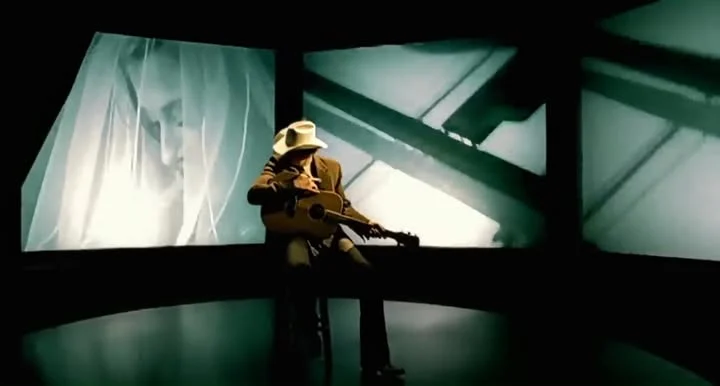
The opening notes of a single acoustic guitar drift through a quiet living room. For the couple seated on the worn sofa, the fingerpicked pattern is not just music; it is the sound of their own history unfolding. The song fades as softly as it began, leaving a profound silence that speaks louder than any applause. This is the magic Alan Jackson captured in a track that refuses to announce its importance yet becomes impossible to forget.
Jackson’s baritone enters with a warmth that feels less like a performance and more like a confession. The lyrics are disarmingly simple. He sings of youth and time standing still, of love as the only known thing. The recording is so intimate you can almost feel the room around him. That intimacy is deliberate, a masterclass in restraint from producer Keith Stegall. The arrangement grows as the story moves from courtship to marriage, with a soft piano entering as a supportive hand. Then the pedal steel guitar cries gently, a sigh of pure country heartache. The full band joins only when children’s laughter fills the narrative, but the rhythm section never overpowers. The drums shuffle, the bass pulses. Stegall understood that the song’s power lies in what is left out.
It’s a song built not for the spectacle of the wedding, but for the quiet dignity of the 50th anniversary.
Released in 2003, “Remember When” arrived at a fascinating moment. Jackson was at the height of his influence, a neotraditional titan who two years earlier had written the definitive cultural response to a national tragedy with “Where Were You (When the World Stopped Turning).” He had nothing to prove. The song was not part of a new studio album but one of two fresh tracks on his Greatest Hits Volume II compilation. It served as a glance in the rearview mirror, a musical exhale after years of shaping mainstream country. It was a quiet summary statement, a personal accounting of a life well lived.
The narrative arc of the song mirrors the arc of any lasting relationship. The first verse speaks of vows and wedding rings. The second introduces children. The bridge faces the future with all its fragility, the gray hair, the finality. Just as the lyrics confront the most difficult truths, a quiet orchestra of strings rises in the mix. These are not saccharine strings. They give voice to the unspoken depth of a lifetime shared. They represent gravity, beauty, and the bittersweet reality of watching seasons turn. Listening with quality headphones reveals faint scrapes of fingers on guitar strings, the soft decay of piano notes. Every element occupies its own space, contributing to a whole that is profoundly moving.
Consider the young couple hearing this song for the first time while painting the walls of their first home. To them, the later verses are a distant abstraction, a blueprint for a life they hope to build. Now imagine that same couple forty years later, the house quiet, the children gone. They put the song on again, and the verses about gray hair are no longer abstract. The song becomes a photograph album set to music. Jackson understands this duality. He builds the song as skillfully as he deconstructs it. In the final verse, as he sings of being the lucky ones who will be together until the end, the instruments begin to peel away. The strings recede. The rhythm section fades. We are left with one man, his voice, and his acoustic guitar. The story comes full circle in the same intimate space where it began.
For listeners who cherish songs about lifelong love, this track stands alongside other great reflections. George Strait delivered a similar vow with “I Cross My Heart,” wrapped in classic nineties country production. Vince Gill offered an upbeat yet reflective celebration in “Look At Us.” Brad Paisley followed a relationship timeline with “Then,” building instrumentally as the story unfolded. Tim McGraw explored the passage of time from a father’s perspective with “My Little Girl.” Garth Brooks examined the value of every moment in “The Dance.” And Anne Murray captured the beginning of a lifelong promise with the timeless waltz “Could I Have This Dance.” All share the same gentle, enduring spirit.
There is no call to action in “Remember When.” No grand finale. The song simply fades into a profound silence. It does not ask for an encore. It only invites you to press play again and take the journey one more time. And every time you do, the song shapes itself anew around your own memories, becoming your story as much as it is Jackson’s. That is the measure of a truly enduring piece of art.