
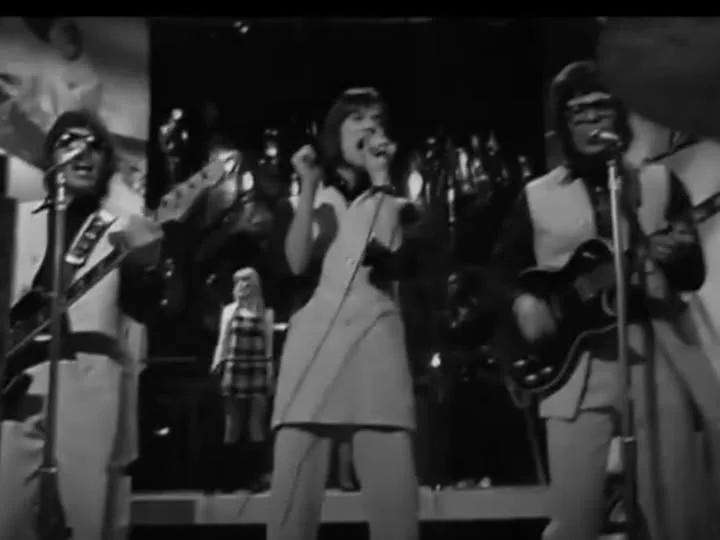
There is something about a song that sounds like the road itself. Not the destination, but the act of moving forward, the hum of asphalt, the flicker of passing headlights, and the strange comfort of having nothing but a melody in your head. For millions of listeners, that perfect traveling companion arrived in early 1970 wearing a deceptively cheerful face. It opened with two chirping recorders, of all things, and told a story of being broke and nameless. Yet within its three minutes, it captured a feeling so universal that it crossed oceans and generations.
The track was Hitchin A Ride by the English band Vanity Fare. And though many remember it as a sunny pop relic from a specific moment, its creation was a carefully engineered piece of craft. The group came from Kent, originally school friends who had already found modest success with I Live for the Sun and a 1969 hit Early in the Morning on both sides of the Atlantic. Signed to Larry Page’s Page One Records, they were a tight unit but not yet a household name. That changed when the songwriting duo of Mitch Murray and Peter Callander delivered a composition designed to stick. The song was chosen deliberately as the A-side, and to bring it to life, the band made a crucial addition just before recording
Keyboardist Barry Landeman joined the lineup and his presence became integral to the sound. The production team of Des Champ and manager Roger Easterby aimed for clarity. They built a recording that sparkled with polished midrange detail, a stark contrast to the heavier psychedelic rock that dominated much of the era. What they created was a pop song that felt timeless even as it emerged from a specific moment.
The introduction is a masterstroke of misdirection. Instead of a roaring guitar or pounding drum, two small recorders play a high pitched counterpoint. This baroque touch makes a song about destitution seem almost joyful. The lyrics admit Got no money and Got no family name yet the music tells you everything will be fine.
The real engine of the track lies in its relentless rhythm. The drums are simple but effective, driven by a crisp cowbell that adds an infectious metallic pulse. The central instrumental hook arrives midway through the song. The instruments lock into a syncopated loop. An electric piano plays a low riff that borders on funky, echoing the soul grooves of the approaching decade. The bass guitar and a tightly micd electric guitar double that line, while the piano adds higher accents. Four elements interlock into a dense wall of rhythm that is nearly impossible to resist.
Lead vocalist Trevor Brice delivers the melody with a smooth, earnest tone and a slight English lilt. The layered background harmonies are sweet and polished, lifting the chorus into what can only be called an earworm. Listening to the track on modern home audio equipment reveals just how much detail the producers tucked into the midrange. Every percussive hit, every vocal stack, every keyboard note has its place.
The song traveled a curious path across the Atlantic. In the United Kingdom it peaked in the top twenty on the UK Singles Chart early in 1970. That was a solid achievement but not earth shattering. In the United States it became a phenomenon. It soared into the top five on the Billboard Hot 100, defining the sound of the year for many American listeners. The contrast reflects a subtle cultural calibration. British charts were moving toward grittier rock and introspective singer songwriters. American radio still hungered for optimistic, well crafted pop in the tradition of the British Invasion. Hitchin A Ride fit that slot perfectly.
The success elevated the band virtually overnight. They formally added Barry Landeman to the performing lineup to replicate the intricate keyboard parts on stage. Their contemporary album Early in the Morning released in 1970 capitalized on the momentum and included the track both on long play and as its defining seven inch. But the song s real legacy remains as a standalone single, a perfect snapshot of motion and possibility
What makes the track outlive so many of its era is its delicate balance. It is too well arranged to be dismissed as bubblegum and too cheerful to be mistaken for serious rock. It occupies a happy middle ground where precise execution meets uncomplicated joy. The song connects with the timeless theme of escape. It belongs to the open road for the young and unencumbered, a story that never ages even as methods of travel change. It feels timeless not because it broke the mold but because it perfectly filled it
The record has occasionally been overshadowed by covers and by the frequent misspelling of the band s name as Vanity Fair. Yet the original recording remains pristine. The next time those twin recorders chirp in the introduction, listen closely to the way the bass, drums, and keyboard lock into that pulsing hypnotic riff. What you hear is a band at its commercial peak, capturing the hopeful spirit of a generation about to cross into the tumultuous 1970s
For those who want to explore adjacent sounds, the same bright melodic pop can be found in tracks like Love Grows Where My Rosemary Goes by Edison Lighthouse from 1970, or the driving beat of Gimme Gimme Good Lovin by Crazy Elephant from 1969. The baroque rock instrumentation appears in Walk Away Renee by The Left Banke from 1966. The earnest storytelling in the verses echoes in I d Love You to Want Me by Lobo from 1972. And for that memorable riff based hook with prominent percussion, Norman Greenbaum s Spirit in the Sky from 1969 stands as a companion piece. Even Stevie Wonder s My Cherie Amour from the same year showcases the polished vocal arrangement and detailed studio work that defined this golden moment of pop music.