
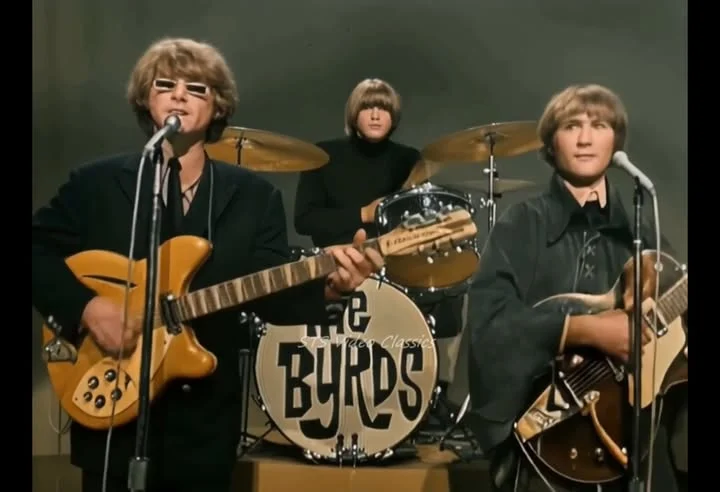
The moment David Crosby tried to walk out of the studio, the entire session teetered on the edge of collapse. The backing track for The Byrds’ cover of Bob Dylan’s “Chimes Of Freedom” had just been laid down, and now one of the vocalists refused to sing his harmony part. A confrontation with manager and producer Jim Dickson escalated, reportedly even turning physical. But then something remarkable happened. Crosby relented, and the harmony he delivered is said to have been among his finest—a cathartic, crystalline blend that elevated the track into legend. You cannot pinpoint which syllable carries the emotion of that fight, but the combined vocal texture on lines like “As the echo of the thunder / rolled out of the doorway” possesses a painful, shimmering perfection. That human friction, captured forever on tape, is what transforms a simple cover into a definitive statement.
But to understand why that friction mattered, you must first hear what they were chasing. The first time you encounter Roger McGuinn’s Rickenbacker 12-string, it is not just a sound. It is a weather system. A sudden, glorious summer downpour, light refracted through every droplet. Yes, there is the jangle, but more importantly there is the velocity—the sense of an idea rushing toward you before the sky fully clears. That sensation is what pulls you back to the needle drop on The Byrds’ rendition of Dylan’s epic poem, a piece of music that feels both sheltering and liberating.
Dylan’s original “Chimes Of Freedom,” from his 1964 album Another Side of Bob Dylan, is a sprawling, almost biblical protest piece—seven minutes of dense imagery listing “the unfortunate,” “the refugees,” “the insulted and the scorned.” The Byrds did not simply cover it; they illuminated it. They cut its length, sharpened its focus, and turned raw scripture into electric cathedral glass. By the time they finished, the song became a masterclass in sonic contrast: a driving folk-rock pulse from Michael Clarke’s drums and Chris Hillman’s muscular, melodic bassline, all overlaid by McGuinn’s relentless twelve-string electric guitar—a bright, celestial cascade that defines the very timbre of “jangle-pop.”
The true power of this song rests not in its political message, but in the shimmering, almost unreal quality of its optimism.
That optimism is carried most powerfully by the vocal blend. Lead vocalist Gene Clark delivers his part with earnest, slightly fragile awe, perfectly capturing the spiritual awakening in Dylan’s verses. Then David Crosby and Jim McGuinn envelop him with soaring, immaculate harmonies—a layered, almost choral sound that gives the piece its immense emotional weight. The voices rise and fall together, a perfect representation of the shared struggle Dylan described. There is no piano, no orchestral flourish; the harmonic complexity comes solely from those three distinct voices and the drone of the Rickenbacker. This focus gives the song a timeless quality, sounding as immediate on modern studio headphones as it did on a 1965 AM radio.
This definitive reading closes The Byrds’ 1965 debut album, Mr. Tambourine Man. At that moment, the Los Angeles quintet—McGuinn, Clark, Crosby, Hillman, and Clarke—cemented their revolutionary synthesis. Their label, Columbia, and producer Terry Melcher wisely allowed them to pursue a sound that merged the lyrical depth of Greenwich Village folk with the propulsive energy of the British Invasion. The result was a sonic affirmation that even when sheltering from the storm, we are never truly alone.
Think about listening to this while driving late at night. The high, sustaining notes of the guitar seem to pierce the darkness, pulling the song toward some unseen horizon. It connects to those moments in life—a breakup, a lost job, a cultural turning point—where the world feels chaotic, but a clear, bright sound cuts through to offer a thread of hope. The chiming is for all of us. That is why The Byrds, and this glorious piece of music, remain so universally beloved.
Today, while sifting through endless playlists on a music streaming subscription, this track is a deliberate destination. It anchors the listener in a moment where poetry, electric sound, and cultural upheaval met to create something pure. The Byrds took a six-page poem and turned it into an anthem that rings with empathetic clarity—a perfect meeting of two giants of 20th-century songwriting. It invites, quietly but firmly, repeated listening.
Listening Recommendations
Bob Dylan – “Mr. Tambourine Man” The original track that established the folk-rock template by The Byrds, utilizing the same core instrumentation and production.
Simon & Garfunkel – “The Sound of Silence” (Electric Version) Features a similar folk-to-electric transformation and an emphasis on close, ethereal vocal harmony over a steady rock beat.
The Beach Boys – “Sloop John B” An example of another iconic mid-60s group taking an established folk tune and re-imagining it with complex, soaring pop harmonies and production sheen.
Buffalo Springfield – “For What It’s Worth” Carries the same sense of a poignant, socially aware commentary delivered with a distinctive electric guitar chime and a mood of quiet unrest.
The Mamas & The Papas – “California Dreamin’” Shares the lush, intricate vocal arrangements and the general mood of introspective, era-defining Los Angeles folk-pop.