
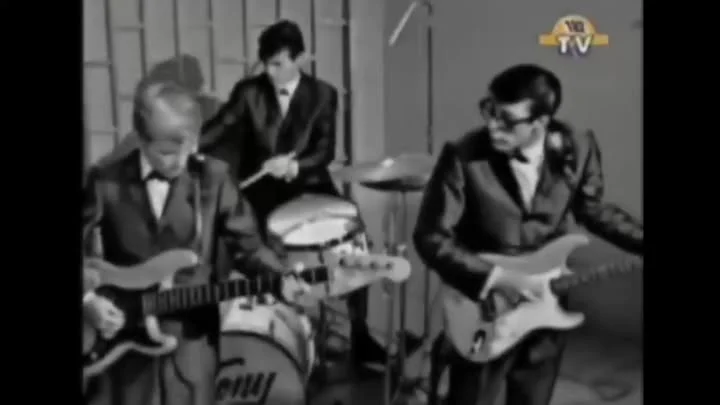
The transistor radio crackled beneath a teenager’s pillow. He was supposed to be asleep, but he was listening to the soundtrack of an adult world he was just beginning to fear and admire. The sound that spilled out wasn’t the cheerful innocence of pop. It was darker, moodier, like a shadowy figure disappearing around a corner. That sound was The Frightened City, a two-minute, twenty-two-second instrumental masterpiece by The Shadows.
It is April 1961. Forget the blinding California surf rock. In London, the neon lights spill rain-streaked colors across cobblestones. The atmosphere is trench coats and shadow. That is the birthplace of this piece of music. It is not a travelogue for a carefree summer. It is the theme for a noir film, which it happens to be. Released by Columbia (EMI) on April 28, 1961, the single shows a band stepping confidently away from the celebrity of Cliff Richard. The Shadows — Hank Marvin, Bruce Welch, Jet Harris, and Tony Meehan — are no longer backing musicians. They are instrumental rock royalty, following the colossal 1960 hit Apache and the chart success of F.B.I. earlier that year.
The song was written by their long-time producer and arranger, Norrie Paramor, for a film of the same name. Paramor had recorded an orchestral version, but the group persuaded him to let them interpret the tune. They imbued it with their signature electric grit. This creative friction — a stately cinematic theme reimagined by a band with raw energy — is what makes the track compelling. The final single version, recorded at EMI Studios, London, on February 18, 1961, perfectly balances Paramor’s compositional elegance with the band’s instrumental swagger.
“The best instrumental songs don’t need lyrics. They are simply films for the mind.”
The sonic architecture of The Frightened City is built on stark contrast and deliberate echo. It opens not with a flourish, but with a deep, echoing throb — a rhythm laid down by Jet Harris‘s bass and Tony Meehan‘s precise drumming. The rhythm section acts as a heartbeat, slow and tense, a relentless walk down a deserted alleyway. Then Hank Marvin‘s lead electric guitar enters. This is not the bright twang of Apache. This tone is darker, thicker, dripping with reverb. It creates a vast, empty space around the melody. The opening figure — a descending, modal melody — sounds like a question mark hanging in the damp night air.
The instrumentation is lean and purposeful: Hank Marvin on electric lead guitar, Bruce Welch on acoustic rhythm guitar, Jet Harris on electric bass, and Tony Meehan on drums. Notice the acoustic rhythm guitar — it adds a brittle, percussive texture that cuts through the electric haze without muddying the mid-range. The dynamic shifts are subtle but powerful. The verses maintain a tight, controlled intensity. The middle section momentarily opens into a more major-key resolution before returning to the dominant minor-key tension.
Marvin‘s playing is a clinic in economy. Every note is weighted with dramatic intent. His vibrato is slow and wide, giving the melody a mournful, almost vocal quality. He uses echo and delay not as effects, but as another instrument. For any aspiring musician taking online guitar lessons, this track is essential listening for mastering tone and space. It teaches that what you don’t play is as important as what you do.
The Frightened City was a high point for The Shadows. It demonstrated their versatility with sophisticated film themes. It quickly followed F.B.I. into the upper echelons of the UK Singles Chart, reportedly peaking in the top three. This successful run confirmed the group as a commercial force separate from Cliff Richard. Their rise helped pave the way for the beat groups that would follow. Before The Beatles arrived, The Shadows were the undisputed kings of the UK singles chart, redefining the electric guitar in popular music.
The song’s dark tonality tapped into something deeper in the British pop consciousness. Unlike the cheerful innocence of early rock, this tune felt dangerous and grown-up. It evoked the smoky, gritty world of B‑movies and post-war anxieties. Listen closely, and you can hear a distant cousin of its minor-key urgency in much of what would become the British Invasion’s darker, R&B‑infused side.
The band’s early personnel — Marvin, Welch, Harris, and Meehan — are all present on this recording. It represents the peak configuration of The Shadows’ first line‑up. Tony Meehan would depart later in 1961, making this single a pivotal recording of the classic quartet. The group, known for instrumental work, kept the arrangement focused squarely on the electric four‑piece power. For those seeking revealing playback experiences, listening to an original mono pressing on a high‑end home audio system can uncover astonishing depth. The way the spring reverb decays and the bass resonates suggests the massive natural room sound of Abbey Road engineering.
The Frightened City may not have the instant recall of Apache, but it has far greater staying power for its sheer atmosphere. It remains a definitive statement: a testament to The Shadows’ skill in building narrative and mood without a single word. It is a haunting two minutes that still holds a mirror to the darkness lurking just beneath the surface of the swinging sixties. Give it a deep listen, and let the city lights grow dim.
For listeners who want more of this mood, consider Man of Mystery by The Shadows, which shares the same suspenseful minor‑key film theme origin. Telstar by The Tornados uses distinct sonic texture and production. Peter Gunn Theme by Duane Eddy exemplifies the low‑register, reverb‑heavy cinematic rock sound that influenced The Shadows. Jet Harris‘s solo work, such as The Wild One, maintains heavy basslines and clean instrumentation. Theme From ‘The V.I.P.’s’ by The Shadows shows their evolution toward richer, string‑supported arrangements. And Green Onions by Booker T. and the M.G.’s offers a contrasting soul‑funk take on the essential four‑piece instrumental format.