
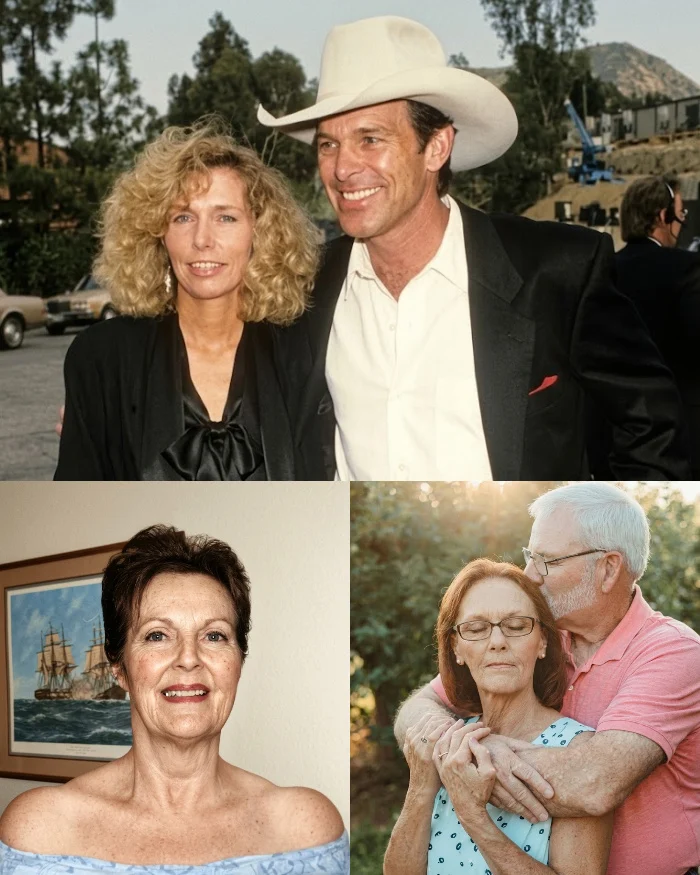
Every champion has a story hidden behind the trophy. For Chris LeDoux the gold buckle he won in 1976 was not earned alone. The true architect of that victory was Peggy LeDoux who kept a broken cowboy standing when every muscle and every bank account said stop.
The first half of the 1970s was a brutal apprenticeship. Chris rode bareback broncs on the professional rodeo circuit and the animals dismantled him piece by piece. He broke collarbones. He dislocated knees. He tore ligaments. He traveled across the American West in a cramped truck camper with barely enough gas money to reach the next town. After one long summer of dust and pain his total earnings added up to $250.
Desperate and exhausted he wanted to quit. He wanted to toss away his rigging and find a regular job. Peggy refused to hear it. She did not deliver a lecture or an ultimatum. Instead she turned their battered camper into a mobile medical unit. She packed ice around his swollen joints. She cleaned dirt from his cuts. She taped his ribs in sweltering parking lots and sent him back toward the chute.
Quitting would have been the easiest choice. Peggy made it impossible.
The pain did not disappear but it became manageable because he was never carrying it alone. That steady support carried him to December 1976 where he captured the PRCA Bareback Bronc Riding World Championship at the National Finals Rodeo in Oklahoma City. The gold buckle carried his name but her fingerprints were on every strap.
Winning the title did not open the gates of Nashville. Chris spent more than a decade outside the mainstream country music industry. He created his own label called Lucky Man Music and sold cassette tapes from the back of his pickup truck. Fans bought them because he lived the stories he sang.
By 1979 he and Peggy needed a permanent home for their growing family which would include Clay, Ned, Will, Beau, and Cindy. They purchased land near the Powder River and built a life on the 700-acre Haywire Ranch in Kaycee, Wyoming. The ranch became the silence after the roar of the arena.
That quiet life shattered in 1989 when Garth Brooks name-checked Chris in his debut single Much Too Young (To Feel This Damn Old). The song introduced the Wyoming cowboy to the mainstream and Capitol Records came calling. Chris signed the contract but he declined to move to Nashville. He stayed on the ranch.
The 1990s brought spectacular weekend shows with pyrotechnics, lights, and a mechanical bull. Yet when the final chords faded he flew home to Wyoming. Monday mornings found him feeding cattle, running a tractor, and fixing fence. He saw music as a reliable job that funded his ranching life, not as a path to celebrity.
Chris LeDoux died on March 9, 2005 at age 56 after a rare bile duct cancer. Five years later Kaycee unveiled a bronze statue of him riding a bucking horse. The memorial park sits on a dirt lot that Chris and Peggy bought decades earlier to keep a bar from taking over their main street.
His son Ned still carries the family sound to stages across the country, and the Haywire Ranch remains rooted in Wyoming. Chris achieved worldwide fame and sold millions of albums but the real trophy was always the road back home to the woman who stood beside him when all they owned was a camper and enough faith to try again.