
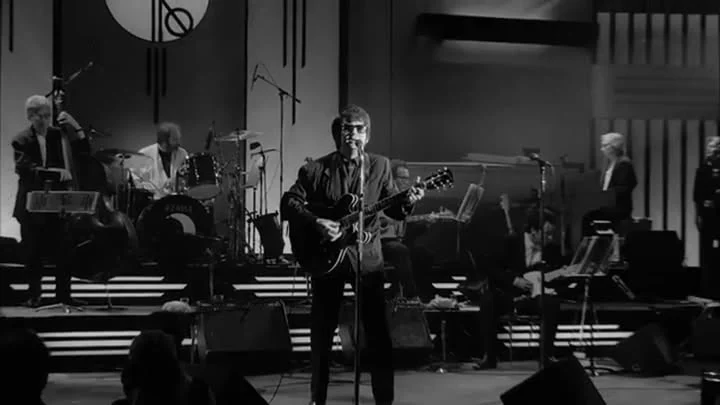
There is a moment in Roy Orbison‘s “Running Scared” when the music swells into a towering wave of sound and the singer clings to a single high note with breathtaking control. That moment captures the fragile heart of a song that has outlasted the era it was born in. It came from the 1961 album Crying, a record that turned a boy from Texas into an architect of the American ballad.
Orbison had already tasted fame with “Only the Lonely” but the Crying album pushed him into a different class. The record arrived when rock and roll was all about simple hooks and teenage energy, yet Orbison chose a more complicated path. He sang about despair and longing with an operatic voice, surrounded by orchestral strings and careful production. Songs like the title track “Crying” and “Love Hurts” showed a songwriter unafraid to explore painful emotions, and “Running Scared” became the crown jewel of that emotional journey.
The album was a statement of artistic ambition. It blended country storytelling with classical elegance and pop accessibility, a combination that felt revolutionary at the time. Orbison and producer Fred Foster created a lush, cinematic soundscape that stood far from the stripped-down rockabilly that dominated the charts. Every track felt like a small drama, and none more so than “Running Scared.”
The structure of “Running Scared” defied every commercial expectation. There was no repeated chorus, no catchy hook to sing along with after one listen. Instead, the song built its power through repetition and elevation. Each verse raised the emotional stakes, and the instruments followed. A gentle acoustic guitar opens the tale, and a soft piano adds a layer of melancholy. Soon, strings begin to enter, and a timpani rolls like a worried pulse. The arrangement mirrors the narrator’s growing panic, and by the end, the listener is caught inside a full-scale emotional storm.
Orbison’s vocal performance turns this song into something close to a theatrical monologue. He starts in an almost conversational tone, as if confessing a secret, and gradually lets the power of his voice take over. Known for his operatic range, he holds notes that other singers could only dream of, but the real genius lies in his restraint. He waits for the right moment to unleash the full force of his voice, and when that moment arrives, it feels like the breaking of a dam. The closing high note is not just a technical achievement but a release of every fear and hope the song has explored.
The lyrics of “Running Scared” tell a story of love threatened by a rival. The narrator lives in constant fear that his lover will leave him for someone from the past. Every glance, every silence, every small moment holds the possibility of loss. When the rival finally appears, the story reaches its most painful point. But then comes an unexpected twist. The lover turns and walks away with the narrator, and the joy of that choice is as sudden as it is overwhelming. It is a story about insecurity and the strange, irrational nature of the human heart, and it still connects with anyone who has ever feared losing someone important.
If “Running Scared” has found a permanent place in your heart, there are other songs that share its emotional and musical DNA. Orbison’s own “Crying” is an essential companion piece, with a vocal performance just as devastating. “Blue Bayou” offers a more wistful kind of longing, carried by a melody that feels like a memory. Ray Charles turned “I Can’t Stop Loving You” into an aching, soulful ballad that bridges country and classical music. The Righteous Brothers immortalized “Unchained Melody” with its sweeping strings and raw, vulnerable delivery. And Neil Young’s “Only Love Can Break Your Heart” brings a folk-inflected intimacy that will resonate with Orbison fans looking for a quieter take on similar feelings.
More than six decades after it first arrived, “Running Scared” remains a landmark in popular music. Its unconventional structure, imaginative instrumentation, and unforgettable vocal performance continue to inspire musicians and move listeners. The themes of love and doubt are timeless, and Orbison’s voice remains one of the most remarkable instruments in the history of recorded sound. For anyone who has not yet surrendered to its spell, the song waits with open arms.
Put on a good pair of headphones, close your eyes, and let Roy Orbison take you through a journey of fear, hope, and final triumph. The Crying album is a treasure, and “Running Scared” is its most radiant jewel. You will not be the same after you hear it.
For those who want to follow every word, the lyrics to “Running Scared” are below.
Just runnin’ scared each place we go
So afraid that he might show
Yeah, runnin’ scared, what would I do
If he came back and wanted youJust runnin’ scared, feelin’ low
Runnin’ scared, you love him so
Just runnin’ scared, afraid to lose
If he came back which one would you chooseThen all at once he was standing there
So sure of himself, his head in the air
My heart was breaking, which one would it be
You turned around and walked away with me.