
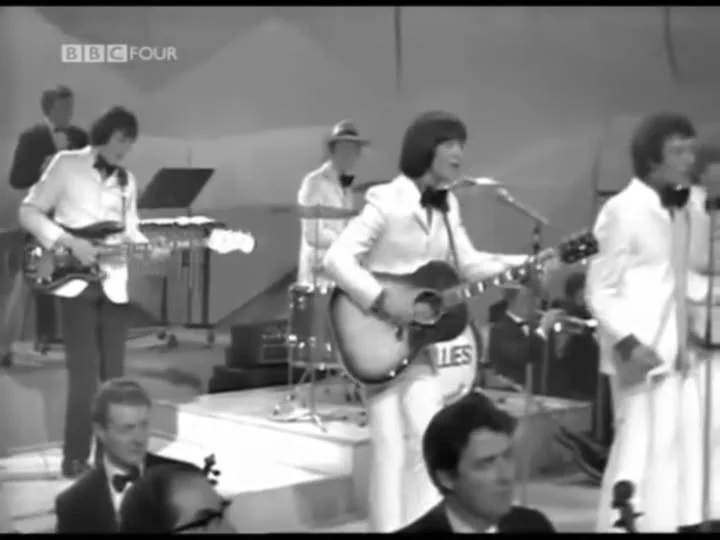
There is a moment inside The Hollies recording of Mighty Quinn where the voices stop being mere harmonies and become a single shimmering vector of sound. It arrives during the chorus, a crystalline wall of defiance rising out of a drum beat that sounds like an engine hitting top gear. This was not just a great pop single. It was the sound of a band refusing to buckle, a vibrant sonic declaration that their story was far from over.
The year 1969 found The Hollies at a critical juncture. The psychedelic dust was settling and their own ranks had just been shattered. Graham Nash, a founding member and the third spoke of their legendary vocal wheel, had left for the West Coast. The future looked less like a golden highway and more like a closing door. How does a band so defined by their specific architecture survive the loss of a foundational block?
The answer was a masterstroke of confident vulnerability. The band retreated, regrouped, and emerged with a cover album dedicated to the most revered songwriter of the decade. Hollies Sing Dylan was a high stakes gamble. It placed the new lineup of Terry Sylvester, Allan Clarke, and Tony Hicks directly in the shadow of a giant to prove they still had the vocal chops to shine. The flagship track was Quinn the Eskimo, a song already steered to the top of the charts by Manfred Mann.
I first discovered this version late at night on a borrowed turntable. The room was dark, the receiver glowing amber, and the record hissed through the speakers. But the sound that cut through the static was pure defiant energy. It was lighter and faster than Manfred Mann’s version, stripped of the heavy blues grit and refitted with a breezy urgent pop brilliance. This was a reclamation project. The band was taking a well known tune and stamping their own DNA back onto the narrative, proving that their identity was not lost but evolving.
The architecture of the track is a marvel of pop engineering. Produced by Ron Richards and arranged by Lou Warburton, the mix is bright and aggressive. Bobby Elliott’s drumming is sharp and compressed, pushing the song forward with relentless momentum. Tony Hicks plays acoustic guitar with a frantic, precise energy that forms a folk rock backbone. The piano, played in short honky tonk bursts, softens the drive with a playful carnival flair. Bernie Calvert’s bass line is confident and fluid, actively driving the rhythm rather than just hanging back in the pocket. This is a band that had just navigated the dense fog of psychedelic experimentation and emerged with a sharper sense of purpose.
Yet the true engine of this song is the human voice. The verses are carried by Allan Clarke with a warm whimsical tone. But the chorus is where the new lineup sells its soul. Sylvester, Hicks, and Clarke lock into a harmony so tight it sounds like a single instrument. They take Dylan’s famously cryptic lyrics and turn them into a pop anthem of pure ecstatic joy. It is a masterclass in melodic prioritization. Instead of navel gazing or mourning their loss, they chose to sing. They chose the high wire act of unguarded optimism.
It is a testament to The Hollies’ structural integrity that even in the face of a crisis they instinctively prioritized melody and vocal shimmer over existential naval gazing.
This single was not merely a placeholder. It functioned as a brilliant high stakes audition for the post Nash era, proving that the band could not only survive but thrive. The track performed strongly, keeping their name alive during the transition, and built a bridge between their baroque pop past and the adult contemporary power they would harness later that year with He Ain’t Heavy He’s My Brother. It is a kinetic warm up, a five minute sugar rush of pop confidence.
For listeners chasing this specific high, the early months of 1969 offer a rich vein of similar sonic gold. Manfred Mann’s original take is essential for its contrasting bluesy groove and famous flute line. The Byrds were mining a similar bright vein of Dylan interpretation with You Ain’t Goin’ Nowhere. Herman’s Hermits delivered a similar British pop sensibility, while The Tremeloes offered crisp high energy pop rock. For a soulful punch, The Box Tops with The Letter and The Grass Roots with Midnight Confessions share the same driving bass and layered vocal attack. All of these tracks share the DNA of a moment when pop music was at its most sophisticated and its most purely joyful.
We still need the spirit of Quinn. We need the idea of a figure arriving in the midst of despair to sweep it away with good cheer. The Hollies version of this myth is a perfect unadulterated capsule of that energy. It is a sonic artifact from a year of radical change, a reminder that the best way to solve a crisis is sometimes to play the most joyful music you can possibly make. It is a bright bold and brilliant statement of resilience. The band did not just survive the change. They soared.