
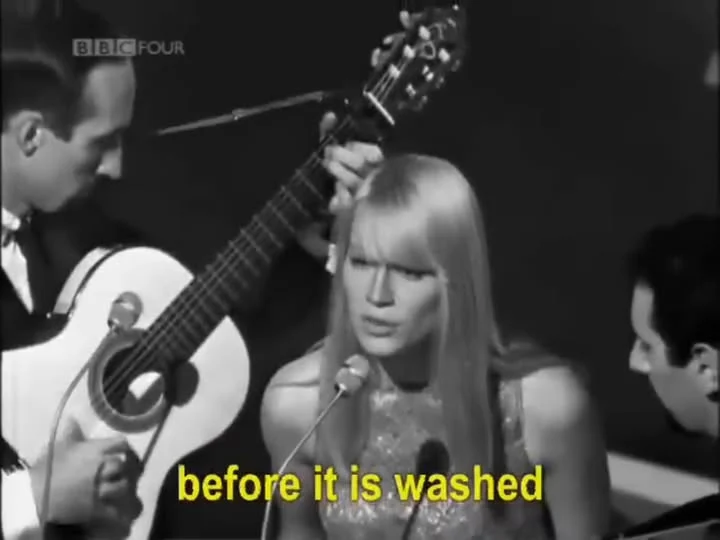

In the summer of 1963, a trio of voices merged with a gentle guitar strum to create a sound that would echo through decades. Peter Paul and Mary took Bob Dylan’s words and turned them into something almost sacred. Their rendition of “Blowing in the Wind” did not just ask questions. It gave a generation permission to hope. The answer, they sang, is blowin’ in the wind. And the world listened.
The track appears on their album In the Wind, released that same year. It became a cornerstone of the folk revival movement and a rallying cry for the civil rights era. Alongside songs like All My Trials and Tell It on the Mountain, this album carried the weight of a society in flux. Yet it is “Blowing in the Wind” that remains the eternal classic. Its themes of peace and justice continue to resonate.
The instrumental arrangement is a lesson in restraint. An acoustic guitar provides the steady backbone, its soft rhythm allowing the harmonies to shine. No piano. No orchestral sweeps. Just a bass note here and there to ground the piece. This simplicity is intentional. It lets the lyrics breathe. The listener is drawn into the message without distraction. Peter Paul and Mary understood that sometimes the most powerful statement is the quietest one.
Those lyrics are profound in their universality.
How many roads must a man walk down before they call him a man? How many seas must a white dove sail before she sleeps in the sand?
These are rhetorical questions that transcend time. They speak to freedom, dignity, and the human condition. Bob Dylan wrote them. Peter Paul and Mary gave them a collective voice. Their harmonies create a sense of community, as if the listener joins a choir of conscience.
The production, overseen by Albert Grossman and Milt Okun, polished the sound without stripping its authenticity. Grossman, who also managed Dylan, knew how to amplify a message. The album In the Wind captures the clean earnestness of folk music. It is a document of its time but also a beacon for the future. The song was performed at rallies and marches. It appeared in films and documentaries. Its legacy grows with each new generation that discovers it.
If you are drawn to this song’s melodic honesty, you might also enjoy “The Times They Are A-Changin’” by Bob Dylan. Or “If I Had a Hammer” by the same trio. Pete Seeger’s “Where Have All the Flowers Gone” carries a similar haunting beauty. The Byrds’ “Turn! Turn! Turn!” offers a folk rock take on life’s seasons. And “Puff the Magic Dragon” by Peter Paul and Mary shows their storytelling range. Each of these songs shares a core of simplicity and sincerity.
In the end, “Blowing in the Wind” is not just a protest song. It is a meditation on what it means to be human. The acoustic guitar and those three voices remind us that the greatest truths are often the simplest. The answers we seek may already be within us waiting for the moment we choose to act. And the wind carries them still.
Here are the lyrics that continue to inspire:
How many roads must a man walk down
Before they call him a man?
How many seas must a white dove sail
Before she sleeps in the sand?
How many times must the cannon balls fly
Before they are forever banned?The answer my friend is blowin’ in the wind
The answer is blowin’ in the wind.How many years must a mountain exist
Before it is washed to the sea?
How many years can some people exist
Before they are allowed to be free?
How many times can a man turn his head
And pretend that he just does not see?The answer my friend is blowin’ in the wind
The answer is blowin’ in the wind.How many times must a man look up
Before he can see the sky?
How many ears must one man have
Before he can hear people cry?
How many deaths will it take until he knows
That too many people have died?The answer my friend is blowin’ in the wind
The answer is blowin’ in the wind.
The answer is blowin’ in the wind.