
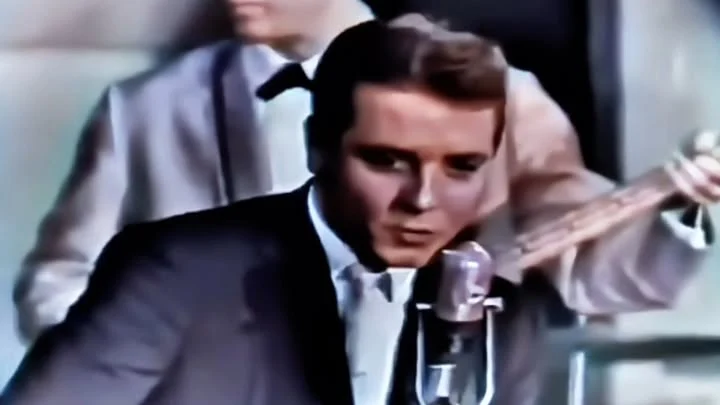
There is a moment buried in the opening bars of Eddie Cochran‘s 1959 single C’mon Everybody that feels less like a studio artifact and more like a door kicked open into a party already roaring at full tilt. That raw, compressed thud of a drum kit, the growling bassline, and the unmistakable chunk of a heavily-miked acoustic guitar all hit at once. It is the sound of a microphone pushed to its breaking point, capturing pure rock and roll energy in less than two minutes. For those who first heard it crackling from an old record player, the song carries the scent of vinyl dust and the ritual of dropping a worn needle onto black grooves. It is a sensory time capsule, a foundational groove that has lost none of its brittle, urgent edge across the decades.
To understand why this track still matters, we have to place it within the tragically brief but explosive arc of Eddie Cochran‘s career. Released as a B-side to Don’t Ever Let Me Go in late 1958, C’mon Everybody arrived on the heels of his breakout anthem Summertime Blues. Cochran was a rare triple threat: a charismatic teen idol, a gifted songwriter who often collaborated with manager Jerry Capehart, and a technical pioneer of the guitar. Unlike many contemporaries who leaned entirely on session musicians, Cochran was deeply involved in crafting his own sound in the studio. For this very track, he reportedly overdubbed his own drum parts, demonstrating a hands-on production approach that belied his youth.
By 1959, rock and roll was at a crossroads. Elvis was in the army, Little Richard had turned to gospel, and the tragic plane crash that killed Buddy Holly, Ritchie Valens, and the Big Bopper had just shaken the music world. The genre needed a confident, technically savvy standard-bearer to carry its raw energy into the next decade. Cochran stepped into that void, especially for the ravenous British audience, where his singles consistently outperformed their American chart positions. C’mon Everybody stands as one of the last great blasts of unadulterated, rockabilly-inflected rock and roll he would release in his lifetime.
The best rock and roll doesn’t describe the rebellion. It performs it.
The sonic blueprint of this track is deceptive in its simplicity. The arrangement is built on a compact, muscular rhythm section that provides unstoppable momentum. Session stalwarts like Earl Palmer on drums and Ray Johnson on piano provided a professional backbone, but the personality belongs entirely to Cochran. The song opens with that famous rattling drum pattern, a straight, driving 4/4 beat anchored by a bass drum thud and the sharp crack of a snare. Over it, bassist Connie “Guybo” Smith lays down a relentless walking line that is pure rhythmic pulse rather than flashy showmanship. The result is lean, precise, and calibrated for maximum kinetic impact.
Cochran’s primary acoustic guitar sound, played on his iconic Gretsch 6120, is heavily compressed and saturated, giving it an almost electric texture. His rhythm playing is aggressive, a rapid-fire strum that locks in with the drum kit to create a single driving unit. When he steps forward for his brief, brilliant solo, the clean, bright attack cuts through the mix without needing distortion. Ray Johnson’s piano pecks through in bursts, adding a subtle boogie-woogie texture that remains entirely subordinate to the central rockabilly framework. The entire track has a taut, live feel, as if the microphone captured a band hitting their peak moment in real time. The dynamics are simple: loud, then louder.
Why does this single, barely 113 seconds long, continue to resonate so profoundly? Cochran captured the core tension of teenage life with incredible accuracy. The lyrics are not deep poetry but pure function: a desperate plea to escape parental supervision and find freedom at a party. A fan letter once arrived at a radio station from a woman in her late seventies. She wrote that hearing C’mon Everybody on her home audio system still made her instinctively check over her shoulder for her father. That is the power of this song. It is not just a party soundtrack. It is the sound of a rule being broken, a curfew ignored, a fleeting moment of self-determination frozen in time.
For generations of young musicians, this track became a rite of passage. It is the song that guitar teachers use to teach the bedrock of rock and roll economy: simple chord changes, but rhythm that demands precision and conviction. Its brevity forces focus. The slightly frantic tempo, the shouted vocal delivery, the sheer impatience of the song all work together to demand an immediate, visceral response. It sidesteps introspection in favor of raw physical movement.
C’mon Everybody was more than a single. It was a blueprint. It demonstrated the power of a lean, energetic mix, the potency of a driving acoustic rhythm guitar, and the universal appeal of a simple idea: let’s escape and have fun. Though the American charts gave it a respectable run, its impact in the United Kingdom was foundational. It secured Cochran’s legacy in a way that would influence the entire British Invasion. Decades later, its punch remains undiminished. Go back and listen. Turn it up. Appreciate the sound of a genius working on his own terms. The invitation still stands.
Listening Recommendations
Gene Vincent – Be-Bop-A-Lula (1956): For comparable early rockabilly grit and a no-frills arrangement.
Buddy Holly – Peggy Sue (1957): Shares a similar focus on rhythmic attack, particularly in drum sound and simple guitar work.
Wanda Jackson – Let’s Have a Party (1960): Captures the same mood of joyous, unbridled party energy crossing rockabilly with rock and roll.
Jerry Lee Lewis – Great Balls of Fire (1957): For sheer, barely contained sonic aggression and high-octane tempo.
Chuck Berry – Johnny B. Goode (1958): Driving rhythm and narrative focus that makes a universal appeal for action and movement.
The Who – Summertime Blues (Live at Leeds, 1970): Hear how a later generation reinterpreted Cochran’s rhythmic power for a heavier, amplified context.