
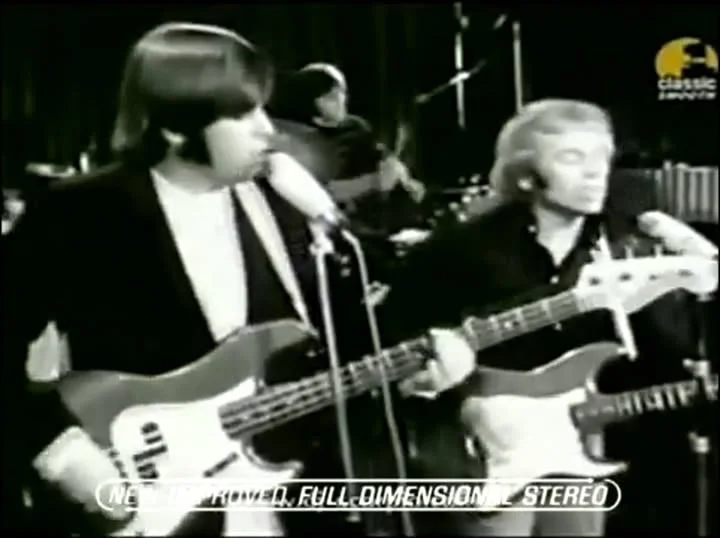
There are songs that simply play, and then there are songs that seem to breathe. “Good Vibrations” belongs to the latter category—a recording that feels less like a piece of music and more like a living organism, pulsing with its own strange, radiant heartbeat. I remember the first time I truly heard it, not as background noise but as a presence in the room. The tape hissed faintly before the voices emerged, the cellos shimmered like heat rising off asphalt, and that otherworldly theremin melody slid through the air like light through water. In that moment, I understood why this track has become a monument. It does not merely sound ambitious; it sounds as though someone closed their eyes and sculpted the atmosphere itself into sound.
Released in 1966 on Capitol Records, this standalone single came at a pivotal moment in pop history. Brian Wilson, working alongside Mike Love, had just finished reshaping harmony-driven pop with Pet Sounds, and this new creation pushed the boundaries even further. The song would later find a home on Smiley Smile after the grander SMiLE project was set aside, but as a single it stood alone—a beacon of what pop music could become when the recording studio itself became the primary instrument. Wilson had imagined a future where songs were built like films, assembled from pieces shot in different locations and spliced into seamless narratives.
The song isn’t describing happiness so much as teaching you how to open a door and let it in.
What makes this track so distinctive is its modular construction. Wilson recorded sections across multiple studio sessions, each with its own sonic palette, then edited them together into a single flowing piece. The result is a song that changes rooms as it progresses. One moment you are wrapped in organ and hushed voices, the rhythm section tiptoeing with restrained precision; the next, the tempo shifts, percussion flickers like candlelight, and a sudden rush of harmony pulls you into another space entirely. It is not a suite in any formal sense, but rather a dream that remembers its own edits and wears them like jewels.
The instrumentation is central to this alchemy. Cellos punctuate in percussive triplets, pushing the momentum forward with almost drum-like insistence. The famous electro-theremin line, reportedly performed by Paul Tanner, glides across the arrangement like a sunbeam skipping across water—alien yet intimate, beaming hope from somewhere both near and impossibly far. The rhythm bed feels hand-crafted, with bass that moves with intention and light percussion that refuses to hurry. Tucked inside the arrangement are small textures that seem to shift the room’s lighting mid-phrase, a trick that keeps the listener perpetually off-balance in the most delightful way.
The vocal arrangement demonstrates a painter’s patience. The Beach Boys harmonies are not merely stacked but staged, with voices appearing like characters entering a doorway, then retreating, then returning dressed in another color. Wilson often spoke of chasing “feels,” and you can hear that pursuit in every entrance and exit. The lead vocal rides the arrangement without dominating it, allowing the ensemble to function as the true narrator of the piece.
If you listen closely, you can hear the ghosts of the various studio spaces where different sections were captured. There is a room tone that broadens when the cellos arrive, a reverb tail on certain percussion hits that deepens and then clears as if the walls themselves are moving. Rather than smoothing over these differences, the final mix preserves the edges, and that is part of why the record feels so alive. The seams are visible, but they are golden seams—kintsugi fractures that make the vessel more beautiful for having been broken and reassembled.
I often think about this track in tactile terms. The theremin line is silk drawn across glass. The cellos are leather struck by an open hand. The tambourine, when it lands, sounds like brushed chrome. These metaphors matter because the recording is engineered to trigger a synesthetic response. It does not simply tell you about good vibrations; it models them in sound, translating emotion into frequency and timbre with an accuracy that still feels almost supernatural.
Within the Beach Boys career arc, this single sits at a threshold. They had been the great chroniclers of youthful sunlight—cars, summer, innocence, surf—but 1966 and 1967 opened a different door, one that led into high-stakes studio work, increasingly intricate arrangements, and the kind of cultural pressure that can either elevate or crush an artist. At this juncture, Wilson was no longer content to write verse-chorus pop and call it a day. He was building a new language in which musical sections functioned as paragraphs and timbres served as punctuation marks.
The arrangement’s tone-colors demonstrate that ambition with remarkable clarity. Notice how the bass does not simply support the rhythm but converses with it, how the organ passages set the barometric pressure for what follows, how that famous moment when everything falls away and the song takes a breath feels like a camera cutting from a crowded promenade to a single face in close-up. The harmonic design is exploratory without ever becoming opaque, the modulations playing like doors opening into adjacent rooms rather than leaps into empty space. You can hum along without ever feeling lost, even as the floor plan shifts around you. It is pop music that trusts its listeners to follow a thread, and in trusting us, it elevates us.
I keep returning to the rhythm concept. The pulse is not insistent but curious, behaving more like a guide than a commander, pointing out sights and then stepping aside. This flexibility allows the vocal phrasing to stretch and breathe, with notes held just past the point of stability so that the release feels earned. The production engineers the listener’s breath as surely as a conductor shapes an orchestra.
What makes the song enduring, however, is not merely its technical bravura but the sensation of benevolent uncertainty at its core. The track operates like a message in a bottle from a world where intuition is treated as data. It tells you that vibes matter, that the body registers what the mind cannot yet parse, that joy can arrive as a frequency before it resolves into a coherent thought. That is a remarkable proposition for a pop single in any era.
The record also works because it leaves narrative room for the listener. It sketches a point of view and then invites projection, which is an ideal recipe for longevity. Over the decades since its release, people have attached this song to car rides, first apartments, after-midnight conversations, grocery-store aisles where ceiling speakers suddenly make the mundane feel radiant. In each context, the recording seems to recalibrate the lighting of whatever space it enters. A friend once told me she first heard it through cheap earbuds on a crowded bus; when the theremin slid in, the gray of the afternoon shifted, and she swears the windows brightened even though the sun had not moved. Another acquaintance discovered it by accident on a late-night channel playing old videos and had to revise his entire musical taste as a result. In his telling, the song sounded like a vintage postcard that wrote back.
Then there is the image of Wilson hunched over a mixing console, chasing something that words cannot quite trap. That is the story I carry with me when I hear those cello triplets or the shift into the final jubilant section. Even if you know nothing of the backstory, the track communicates a builder’s faith: if you put the right pieces together, feeling will reveal itself.
It is useful to situate this single in its commercial and cultural moment. In 1966, American and British pop were accelerating toward more intricate textures and ambitious studio experiments. This track did not merely keep pace; it surged ahead. It reached the top of the U.S. charts and performed similarly well internationally, a rare case where radical technique and mainstream appetite found common ground. The record announced that the future of pop would be authored as much at the mixing desk as on the stage.
Technically, the combination of acoustic and electronic timbres is key. There are strings with a percussive bowing style, rhythm instruments that leave space rather than filling it, and a spectral lead voice whose vibrato brings human fragility into an ostensibly otherworldly sound. The human and the synthetic fuse without canceling each other. When the final section kicks in, stacked voices and rhythmic propulsion turn theory into euphoria.
Amid that orchestration, small details keep revealing themselves. The lightly strummed guitar, almost percussive in its restraint. The occasional keyboard texture that winks at a harpsichord brightness—sources note that different sessions introduced and retired colors like this. And there is a moment, brief but telling, when the vocal blend feels double-exposed, as if two images have been aligned by feel rather than by ruler. That slight tremor is the song’s heartbeat.
Because the architecture is so carefully built, the track rewards focused listening. Put on studio headphones and you will notice phantom details: a breath before a phrase, the way a tambourine hit flares and then ducks under a vocal line, the shifts in reverberation that map out changing rooms. Yet it also thrives in casual contexts. On a modest home audio setup at a Sunday gathering, it still carries. The melody remains a homing beacon, and the harmonies behave like sunlight falling across wood floors.
If there is a single sentence that captures the feeling, it is this: the song is simultaneously a postcard from its era and a blueprint for tomorrow. Pop history is full of records that felt groundbreaking at first and then dated quickly. This one escapes that fate because it prioritizes sensation over novelty. The devices are there, certainly, but they are in service of a feeling that does not expire.
As a piece of music, the track manages the rare trick of being both ornate and intuitive. Its sections are intricate without becoming fussy, and its melodies carry the listener across shifting terrain without resorting to melodrama. It is a reminder that craft and heart can shake hands, that sonic architecture and human pulse can be coauthors.
The recording dynamic also holds a lesson for contemporary producers. Loudness is not the point here; contrast is. The song whispers, then rings, then whispers again. It teaches that the path to catharsis often runs through restraint. You feel the chorus more because the verses keep their eyes half-closed.
The cultural afterlife has been robust. The track appears in documentaries about studio innovation, in playlists about California pop, in think pieces about modular composition. Yet its most persuasive argument is made in private moments. Rent a cabin in the off-season, make something simple for dinner, and play it at twilight. Suddenly the room boundaries soften. The world does not feel solved, but it does feel navigable.
The song also has an odd gift for revealing the listener’s mood. On agitated days, its glide feels aspirational—a model of forward motion without panic. On flat days, the sonics pour color into dull spaces. It is less a mood ring than a mood lens, focusing whatever light is available.
Credits deserve careful attention. Brian Wilson role as producer and architect is widely documented; Mike Love lyrical contributions shaped the song accessible voice. The group vocals are a masterclass in blend and arrangement. Various studio musicians contributed across different sessions, with the electro-theremin line regarded as a signature element that has never been adequately replicated.
One final note about the instrument balance: listen for the moment when the keyboard textures merge into the low strings. It is the sort of blend that makes you question where one timbre ends and another begins. That ambiguity is part of the magic, and it is why the song continues to inspire producers across genres, from indie pop experimentalists to film composers who hear in it a template for emotional clarity.
If you have managed to avoid the song cultural saturation, consider yourself lucky: you get to discover it fresh. If you know it by heart, you already understand how it repays attention. Turn down the lights, reduce the to-do list to a single page, and give it five minutes. There is a reason the track has worn its laurels lightly for decades. It does not ask to be revered. It asks to be heard.
And when it ends, when the harmonies gild the final seconds and the room returns to itself, you might feel an unexplainable steadiness. That is the record real trick. It organizes your inner weather without telling you what to feel. It brings you to the threshold of joy and then, very gently, lets you walk through.
Listening Recommendations:
The Beach Boys – God Only Knows — Chamber-pop intimacy where layered voices meet quietly radical harmonic turns.
The Beatles – A Day in the Life — Widescreen studio construction that marries everyday observation to orchestral surge.
The Byrds – Eight Miles High — Psychedelic propulsion and modal guitar lines that taste the same skyline from another angle.
The Ronettes – Be My Baby — Monumental production and heartbeat percussion that prefigure pop cinematic scale.
The Beach Boys – Wouldn It Be Nice — Bright youthful longing set to meticulous arrangement and buoyant rhythmic lift.
The Left Banke – Walk Away Renée — Baroque pop strings and tender melody for another blend of sophistication and ache.
I-I love the colorful clothes she wears
And the way the sunlight plays upon her hair
I hear the sound of a gentle word
On the wind that lifts her perfume through the air
I’m pickin’ up good vibrations
She’s giving me the excitations (oom bop bop)
I’m pickin’ up good vibrations (good vibrations, oom bop bop)
She’s giving me the excitations (excitations, oom bop bop)
I’m pickin’ up good vibrations (oom bop bop)
She’s giving me the excitations (excitations, oom bop bop)
I’m pickin’ up good vibrations (oom bop bop)
She’s giving me the excitations (excitations)
Close my eyes, she’s somehow closer now
Softly smile, I know she must be kind
When I look in her eyes
She goes with me to a blossom world
I’m pickin’ up good vibrations
She’s giving me excitations (oom bop bop)
I’m pickin’ up good vibrations (good vibrations, oom bop bop)
She’s giving me excitations (excitations, oom bop bop)
Good, good, good, good vibrations (oom bop bop)
She’s giving me excitations (excitations, oom bop bop)
Good, good, good, good vibrations (oom bop bop)
She’s giving me excitations (excitations)
Ah, ah, my my, what elation
I don’t know where but she sends me there
Oh, my my, what a sensation
Oh, my my, what elation
Oh, my my, what
Gotta keep those lovin’ good vibrations a-happenin’ with her
Gotta keep those lovin’ good vibrations a-happenin’ with her
Gotta keep those lovin’ good vibrations a-happenin’
Good, good, good, good vibrations (oom bop bop)
She’s giving me the excitations (excitations, oom bop bop)
I’m pickin’ up good vibrations
Na na na na na, na na na
Na na na na na, na na na (bop bop-bop-bop-bop, bop)
Do do do do do, do do do (bop bop-bop-bop-bop, bop)
Do do do do do, do do do (bop bop-bop-bop-bop, bop)