
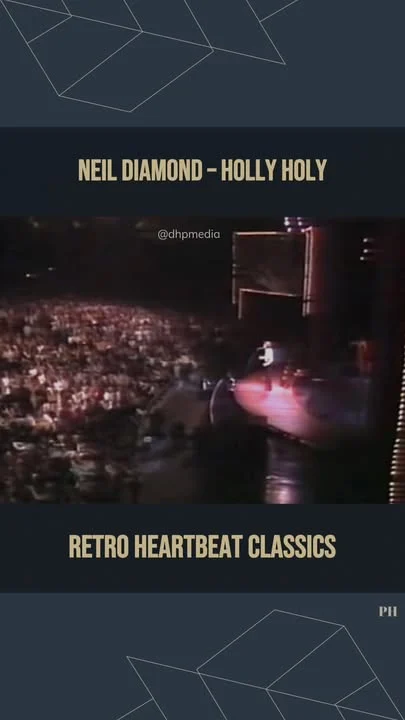
There’s a moment in Neil Diamond’s “Holly Holy” when the music swells and the words become a prayer—a raw, trembling declaration that love and faith can lift the lame to flight. That moment is not just a chorus; it is a spiritual climax, a promise whispered into the chaos of 1969. Listeners then and now find themselves caught in its gravity, transported from the noise of war and division into a space where hope feels tangible. This is the power of a song that refuses to be merely entertainment.
When “Holly Holy” arrived in 1969, the world was a bruise of conflicting forces—the Vietnam War tearing families apart, the civil rights movement demanding justice, and a generation questioning every institution they inherited. Diamond, already known for pop hits, reached deeper. He drew from gospel and rock, from the ancient cadences of Scripture and the urgent pulse of electric guitars. The result was a sound that felt both sacred and streetwise, a sanctuary for the restless soul.
The lyrics open like a vision: “Holly holy eyes, dream of only me.” Diamond’s narrator is both vulnerable and defiant, seeking a love that mirrors the divine. He weaves biblical imagery—the lame man who flies, the sun that rises in dead night—with intimate longing. These are not mere metaphors; they are invitations to believe that transformation is possible. The refrain, “Sing a song of songs,” echoes the Bible’s Song of Solomon, but Diamond makes it a personal plea. As he belts the line, his voice cracks with conviction, pulling the listener into a shared act of worship.
“Call the sun in the dead of the night / And the sun gonna rise in the sky / Touch a man who can’t walk upright / And that lame man, he gonna fly”
Musically, the track is a masterclass in tension and release. The piano chords anchor a slow, soulful groove while backing vocals—lifted straight from the gospel tradition—layer in like a congregation answering a preacher. The arrangement builds deliberately, each verse adding emotional weight, until the bridge erupts in a soaring crescendo. Diamond’s voice, by then, is not just singing; it is testifying. The effect is cathartic, a musical journey that mirrors the lyrical arc from despair to deliverance.
Beyond its craft, “Holly Holy” earned a legacy that spans decades. It has been covered by icons ranging from Elvis Presley to Elton John, each interpreter finding their own resonance in its universal message. But the song’s true endurance lies in its ability to meet people where they are—in grief, in confusion, in the quiet need for something steady. In a world that still feels chaotic, Diamond’s anthem remains a lighthouse. It does not offer easy answers, but it does offer something rarer: a moment of musical grace that reminds us of the strength we carry inside.
That is why “Holly Holy” continues to move listeners across generations. It is not trapped in the year it was born. Instead, it evolves with each new ear that hears it, each voice that sings along. And in that endless cycle of call and response, the song itself becomes holy.