
“It wasn’t God who made honky-tonk angels… Too many times married men think they’re still single.”
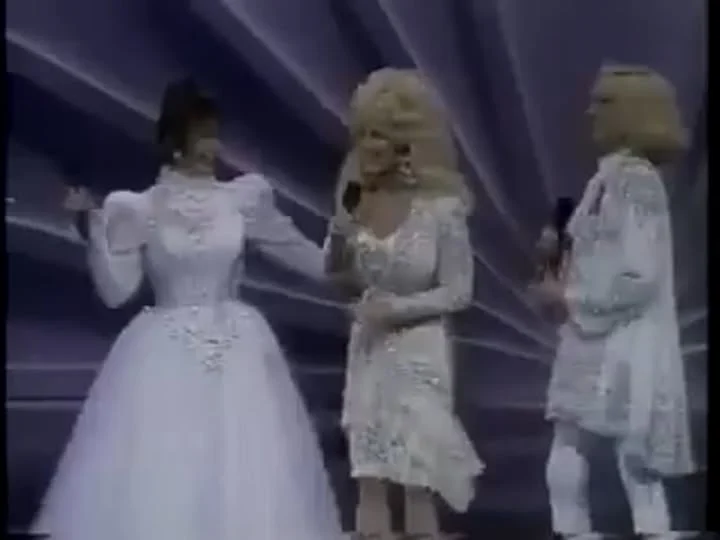
When three of country music’s most fearless women—Dolly Parton, Tammy Wynette, and Loretta Lynn—joined voices on a single track, they didn’t just harmonize; they unleashed a thunderclap of defiance. The song they chose, “It Wasn’t God Who Made Honky Tonk Angels,” had already made history two decades earlier as Kitty Wells’ groundbreaking 1952 anthem. In the hands of Parton, Wynette, and Lynn, it became something else entirely: a sisterhood forged in melody, a reckoning wrapped in steel guitar.
The original recording was Kitty Wells’ direct rebuttal to Hank Thompson’s “The Wild Side of Life,” a tune that painted women as temptresses luring men away from fidelity. Thompson’s narrator blamed a faithless lover for his broken heart; Wells, and later this super-trio, flipped the lens. They sang not as villains but as the accused, pointing out the double standard that lets married men roam while casting women as the sole architects of ruin. “It’s a shame that all the blame is on us women,” they sang, their voices carrying the weariness of generations.
When Parton, Wynette, and Lynn performed it together, the track took on new weight. Each singer brought her own story of survival in a male-dominated industry. Wynette’s raw ache, Parton’s honeyed conviction, and Lynn’s no‑nonsense grit merged into a sound that felt like testimony. The harmonies didn’t just blend; they braided, each strand reinforcing the message: no woman should bear the blame for a broken home alone.
The song’s power lies in its quiet fury. It never shouts, but every line lands like a truth from the kitchen table. The lyrics retell the story from the inside out—a wife remembering her trusting past, a woman confronting the jukebox’s tale. “Too many times married men think they’re still single / That has caused many a good girl to go wrong.” It’s a masterclass in turning accusation into empathy, a reminder that hearts break on both sides, but the blame falls heavier on one.
For anyone who has ever felt unjustly judged—especially women navigating the narrow expectations of love and loyalty—this song remains a balm and a battle cry. It doesn’t excuse mistakes; it demands fairness. And when three iconic voices unite to sing that truth, the message becomes impossible to ignore.
Below, listen to the timeless recording and read the full lyrics that still resonate across generations.