
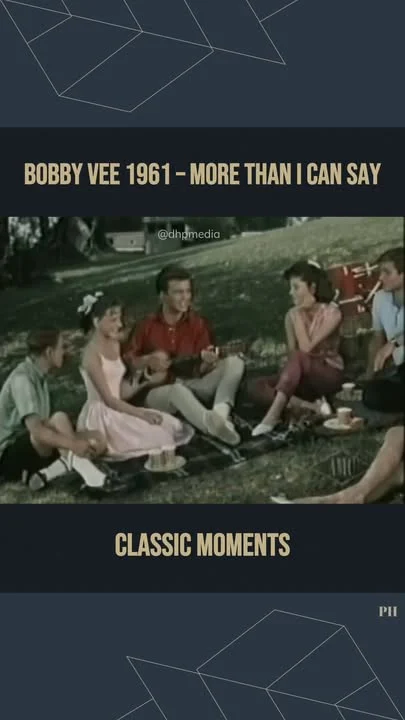
There is a moment in every life when a song arrives not as background noise but as a time machine. I remember sitting in a diner near the coast, the jukebox glowing like a relic from another world, when the opening strum of a guitar sliced through the chatter. A young voice floated in, vulnerable yet confident, and within seconds the room seemed to soften. That voice belonged to Bobby Vee.
The year was 1961. Rock and roll was shedding its raw, dangerous skin and slipping into something more polished, more produced. Teen idols were emerging with freshly scrubbed faces and carefully arranged melodies. Bobby Vee, born Robert Velline, was among them. But his story carried a weight that set him apart from the assembly line of heartthrobs. He was the local boy who stepped in after the plane crash that killed Buddy Holly, the one who helped a grieving audience find its footing again. That quiet act of stepping forward gave his clean-cut image a layer of unexpected depth.
Vee signed with Liberty Records, and the architect of his early sound was producer Tommy Snuff Garrett. Garrett understood the Brill Building formula better than most. He took simple, heartfelt melodies and polished them until they gleamed, then wrapped them in arrangements that felt sophisticated but never stiff. More Than I Can Say became a textbook example of that approach. It sounds instantly familiar, yet it carries the unmistakable fingerprint of its era and its creators.
The song itself was written by Jerry Allison and Sonny Curtis, both former members of Buddy Holly band The Crickets. That lineage gives Vee version a kind of spiritual inheritance, a torch passed from a fallen pioneer to the young man who briefly stood in his place. Vee recording filters that foundational energy through a West Coast lens of glossy refinement. The rhythm section is tight and syncopated, the drums bright and insistent without ever tipping into chaos.
The arrangement balances control with excitement. A robust acoustic guitar provides the rhythmic backbone, strumming an unwavering chord progression. Over it, a clean electric guitar adds subtle fills, brief bursts of twang and sustain that nod to the rockabilly past while pointing toward the future. Vee vocal delivery is earnest and youthful. He does not belt the tune. Instead he communicates a deep, innocent longing, his voice lightly coated with reverb to create an ethereal spaciousness.
The emotional core of the song lies in that unforgettable, wordless hook the wo yay yay chorus.
That hook functions as a pure emotional crescendo, a melodic phrase so universal it needs no lyrics. It feels less like a manufactured pop contrivance and more like a collective sigh of inexpressible feeling. The Brill Building sound demanded a certain maturity, and Garrett achieved it through subtle orchestration. Strings enter during the verses, brief soaring counter-melodies that lift the emotion without overwhelming the beat. The low register of the piano punctuates the rhythm with percussive warmth, grounding the entire track. This was pop music designed for both the teenager dancing in a living room and the adult listening on a premium hi-fi system.
The instrumental break is compact and energetic, showcasing session musicians who understood the balance between rock and roll propulsion and studio polish. Every element works in service of that wordless hook, that moment of pure melodic surrender.
The chart story of More Than I Can Say reveals a fascinating transatlantic divide. In the United States, Vee had already scored massive hits including Devil or Angel and the chart topping Take Good Care of My Baby. This song climbed into the lower half of the Billboard Hot 100 a respectable but modest showing. In the United Kingdom it became a sensation paired with the B side Stayin In to become a double sided hit that peaked within the Top 5 on the UK Singles Chart. That European embrace solidified Vee status as an international teen idol, a heartthrob whose clean image and catchy melodies resonated powerfully with British audiences craving an American sound slightly sweeter than Elvis.
The song continued to ripple through time. When Leo Sayer revived it in 1980 for a massive global hit, the original arrangement still informed the spirit of his recording. That is the mark of a melody forged with genuine craft a tune that transcends its moment and speaks across generations.
I watched a group of college students in a café recently, comparing notes for their piano lessons. When a cover of the song drifted from the speakers they stopped mid sentence. The simple joy was infectious and undeniable, bridging the gap between eras with a handful of chords and a swooning vocal. This is what the 1961 Bobby Vee version of More Than I Can Say offers more than a cover, more than a relic. It is a confident assertion of a new pop sound, a marriage of rock and roll energy and studio craftsmanship. It is a song about a love so vast that words fail a rare and beautiful instance where the music speaks what the lyrics cannot.
Turn it up and let the wo yay yay do the talking.