
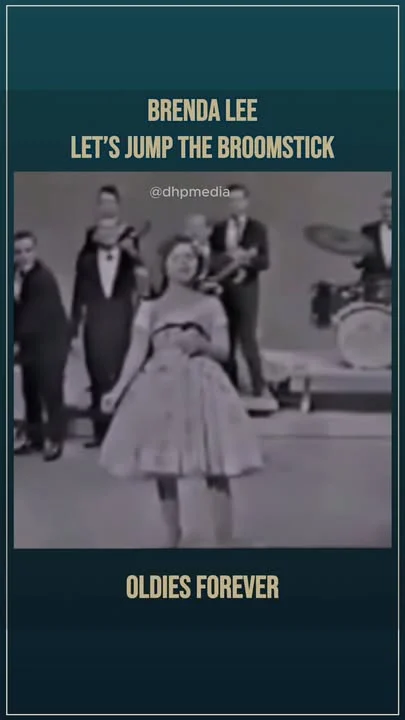
There is a moment in Brenda Lee’s 1959 live recording of Let’s Jump The Broomstick where everything threatens to fly apart. The piano hammers like a runaway train, the guitar slashes through with metallic urgency, and a fifteen year old girl unleashes a voice that sounds like it has been living for decades. This is not the polished sound that made her a global superstar. This is the sound before the polish. This is the sound of rock and roll still figuring out what it wanted to be.
The recording hits like a shot of raw energy straight from a small dance hall where the floor is sticky and the crowd is barely holding itself together. There is no safety net here. The rhythm section sounds like it is holding on by sheer instinct, pushing the song forward with a momentum that feels both reckless and perfectly controlled. For anyone who has ever wondered what it felt like to be in the room when rockabilly was still a dangerous new language, this track is the answer.
This live cut is a time machine to the sticky floored dance hall where rock and roll was still a promise not a package
Brenda Lee, barely fifteen years old when she stepped up to that microphone, had already spent years building a reputation that belied her age. Signed to Decca Records as a young teenager, she had earned the nickname Little Miss Dynamite through sheer vocal force. Her voice carried a weight and a weariness that seemed impossible for someone so young. It was a voice that could swing from playful to devastating in a single breath, and on this live track she lets it run wild.
The song itself was written by Charles Robins and originally released as a single in 1959. A studio version later appeared on her 1960 album Brenda Lee, and that version was shaped by the meticulous hand of producer Owen Bradley. Bradley was a master of the Nashville Sound and he knew how to smooth out the rough edges to make rockabilly palatable to a broader pop audience. But the live recording from the same year is a completely different creature. It is raw unpolished and full of the kind of reckless energy that no studio production could ever capture.
The piano drives the song with a boogie woogie frenzy that feels almost percussive. It is not just playing the melody. It is attacking the rhythm with hammering triplets and quick fire glissandos that give the track its forward momentum. The guitar cuts through with sharp treble heavy licks that recall the earliest electrified work of Scotty Moore and Cliff Gallup. It is not a melodic instrument here. It is a series of dazzling interjections that punctuate the vocal line like exclamation marks. The bass walks a muscular line underneath holding everything together even as the song threatens to spin out of control.
And then there is the voice. Brenda Lee delivers the lyric with a throaty vibrato that she layers over a shouted almost aggressive delivery that pushes the recording equipment to its limits. There is a slight distortion on her voice a sign of the era’s technical limitations but it only adds to the authenticity of the performance. She does not sing the words so much as throw them at the audience with perfectly timed shouts and guttural sighs. When she reaches the line We could buy a little home baby make it our own she stretches it with a knowing confidence before exploding back into the chorus with renewed energy.
The lyric itself is a charmingly rebellious take on the tradition of jumping the broom as a simplified marriage ceremony. We don’t need no license she sings We don’t need no ring. It is a celebration of youthful impatience and a rejection of formal ceremony. For a fifteen year old to sing these words with such conviction is remarkable. For her to deliver them with this level of vocal power is astonishing.
This recording captures Brenda Lee at a pivotal moment in her career. She was transitioning from a novelty act into a global force and this live performance shows exactly why she was considered one of the few American artists who could stand toe to toe with Elvis Presley in terms of sheer volatile energy. The tension between her sweet youthful image and the dangerously adult sound she produced was part of what made her so compelling. Parents worried. Teenagers thrilled. And Brenda Lee just kept singing.
The song fades out not with a deliberate studio conclusion but with a simple quick cut that leaves the listener gasping for more. It is the perfect ending to a spectacular short fuses performance. For anyone investing in premium audio equipment this live track is a must for testing how a system handles grit and detail. But the best way to hear it is not through a clinical listening session. The best way is to put it on and let yourself be pulled into that room to feel the heat and the noise and the sweat of 1959 rockabilly.
For those who want to explore further the same raw female vocal aggression can be found in Wanda Jackson’s Fujiyama Mama from 1958. The frenetic piano attack calls to mind Jerry Lee Lewis’s High School Confidential also from 1958. The clean driving rhythm of Eddie Cochran’s Summertime Blues shares the same era and energy. Connie Francis’s Stupid Cupid offers a comparable youthful pop rock delivery from a contemporary female star. Gene Vincent’s Be Bop A Lula captures that signature reverb heavy rockabilly feel. And LaVern Baker’s Tweedle Dee features a similarly brassy commanding vocal approach over a tight rhythmic arrangement.
What makes this Brenda Lee recording endure is not its perfection. It is its imperfection. It is a reminder that technical precision often comes at the expense of electric atmosphere. This live cut is a time machine to the sticky floored dance hall where rock and roll was still a promise not a package. And that is something no amount of studio polish can ever recreate.