
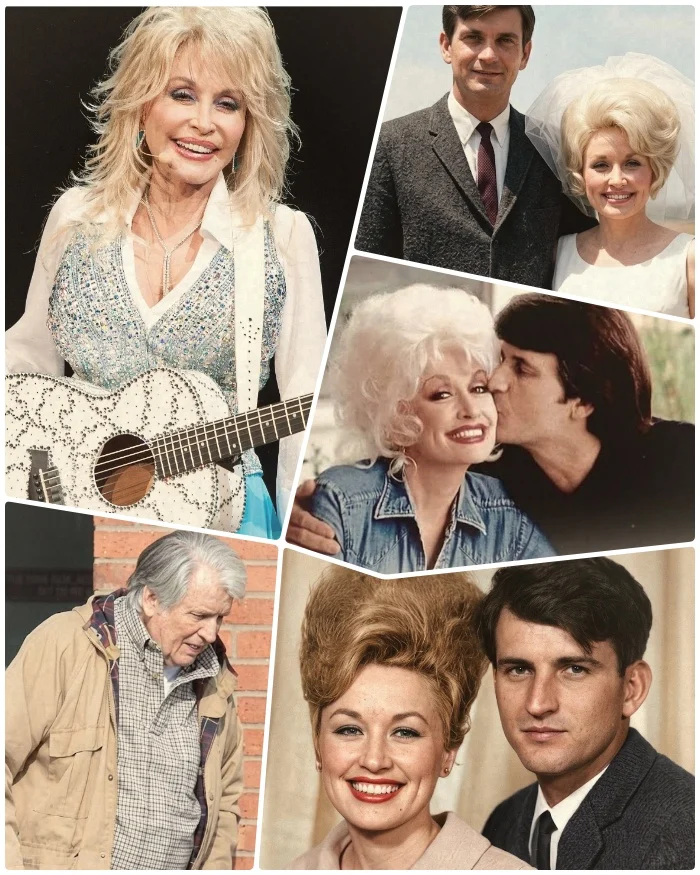
After nearly six decades of stadium crowds and golden records, Dolly Parton’s most grounding reality was always waiting behind a quiet Tennessee door.
That door belonged to Carl Thomas Dean, the private man she married on May 30, 1966, in a small Baptist church in Ringgold, Georgia. The ceremony was so private that only the preacher, his wife, and Dolly’s mother, Avie Lee Owens, were there. Owens had crossed the Tennessee state line so her daughter would not stand alone.
Two years earlier, on Dolly’s first day in Nashville, the couple met outside the Wishy Washy Laundromat on 16th Avenue South. She was 18. He was building an asphalt-paving business. Even then, their lives moved at different tempos.
As Parton’s voice carried her from local radio to national television, arena stages, and global fame, Dean stayed rooted in the routines of home. He made one public appearance at a formal music industry awards dinner in the late 1960s. The flashing cameras and red carpets were not for him. He never attended another public industry gala.
They did not try to remake each other. Dean ran his paving company and cared for their long-standing farm outside Brentwood, Tennessee. He found satisfaction in practical work, repairing equipment, and managing the property away from public view.
“We are probably just sick of each other,” Dolly joked during a recent podcast conversation about the secret behind their long marriage.
The line traveled quickly online because it carried the effortless humor of two people who had shared an entire lifetime. In another interview, she described the secret of 58 years together as simply staying out of each other’s way.
When Parton returned from international tours or film sets, the public persona was set aside at the front door. What remained were quiet routines, home-cooked dinners, and scenic drives through the Tennessee countryside in an old camper.
Their private sanctuary had simple ground rules. Dean never interfered with her creative ambitions or demanding travel schedule. Parton never forced him under the media spotlight. Their bond relied on mutual independence and easy humor.
Behind the laughter was a lifetime of unwavering support, anchored by the understanding that a public career did not have to dictate a private home. The stadium crowds and golden records shaped the public legacy of a country music icon. The true foundation of her life remained anchored in the quiet Tennessee home they built together from the very beginning.