
The first time I heard it, the radio was old and the static thick. But that sound cut through like a blade.
It was late, the world outside already dark, and then it came through the crackle: a guitar line so tight and urgent it felt like a car chase happening in my own living room. That was “F.B.I.” by The Shadows, a piece of music that didn’t just play—it demanded attention. In 1961, Britain was shaking off the last echoes of polite dance bands, and this song was the sonic equivalent of a streetlight flickering on in a noir film. It wasn’t the swagger of American rock; it was something cleaner, coiled, and more dangerous.
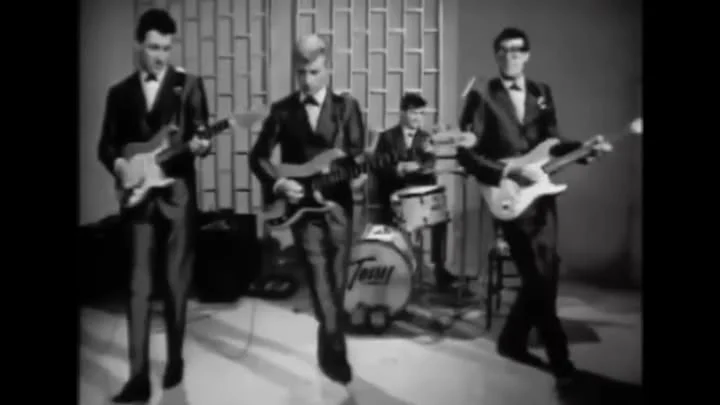
After the sweeping cinematic triumph of “Apache” in 1960, The Shadows faced a cruel question: how do you follow a masterpiece? Their answer wasn’t a retreat into the familiar. It was a compact, aggressive instrumental that seemed to vibrate with its own secret purpose. “F.B.I.” was released in February 1961, a standalone single that would later anchor their self-titled debut album and countless compilations. It was recorded at the legendary EMI Studios in London on September 13, 1960, with the core lineup: Hank Marvin on lead guitar, Bruce Welch on rhythm, Jet Harris on bass, and Tony Meehan on drums.
The production was in the hands of Norrie Paramor, a name that carries weight in the history of British rock. He understood that the star was not just the band, but the sound itself. Paramor’s approach on “F.B.I.” was one of surgical crispness. Each instrument occupies its own space. The drums snap with a dry, almost martial precision, lacking the wide reverb of later recordings. This tightness amplifies the sense of a clandestine mission unfolding under city lights. There is no room for excess. The tension comes from the interplay of four musicians working in perfect, restrained sync.
Hank Marvin’s lead guitar is the protagonist. His tone—sharp, articulate, shaped by his custom-wired guitar and the legendary Meazzi Echomatic tape delay—abandons the broad melodic sweep of “Apache” for something staccato and urgent. The melody comes in rapid-fire bursts, triplets cutting across a driving 6/8 rhythm. It is technically demanding, not just for the lead player, but for the entire rhythm section, which must hold a galloping shuffle. Bruce Welch’s rhythm guitar provides a relentless engine, locking tightly with Jet Harris’s bass line—a deep, round pulse that anchors the whole piece. The bass performance is an early masterclass in simplicity and drive.
The story of “F.B.I.” has a hidden twist. The song was composed by Marvin, Welch, and Harris, but the original label credit went solely to the band’s manager, Peter Gormley, due to convoluted publishing contracts of the era. It is a quiet irony: a defining instrumental track, a testament to the band’s compositional skill, had its true creators obscured by corporate paperwork. Such contractual sleight-of-hand was common in the nascent rock scene. Yet the song’s chart success—a peak position in the UK Top 10—confirmed The Shadows as superstars in their own right, separate from their work as Cliff Richard’s backing band. They proved that an album of pure instrumental rock could sell millions, paving the way for countless guitar groups to follow.
The true tension of ‘F.B.I.’ comes not from volume or distortion, but from the surgical precision of its rhythm section.
The song’s evocative title tapped into the era’s fascination with spy thrillers. It wasn’t just music; it was a soundtrack for the imagination. I once spoke to an older musician who described learning to play it in his childhood basement in Manchester. The challenge wasn’t just the notes, but replicating that clean, wet delay effect. He bought used tape players just to mimic the Meazzi sound—a testament to how Hank Marvin’s tone inspired a generation to understand their gear. For young guitarists today, mastering this track remains a proving ground, a crucial step before tackling modern virtuosity.
For my part, I played it on a cross-country drive last summer. Late afternoon, the sun low on the horizon, the drum tempo syncing perfectly with the car on the motorway. It suddenly became clear: the song is not just about pursuit, but about continuous, forward motion. It is the perfect sonic companion to high-speed travel, a feeling only truly appreciated through premium audio playback. A record producer once told me he uses the drum sound of “F.B.I.” as a calibration reference in the studio. The tight, un-muddied snare and kick, isolated from the guitar echo, showcase what great mono recording could achieve. Fidelity is not just about frequency range; it is about clarity of arrangement.
The brisk tempo and taut structure ensure the song never meanders. Marvin’s solo sections are exercises in restraint—no flamboyance, just perfectly placed triplets and glissandi that sound like squealing tires turning a tight corner. Today, the track stands as a historical marker, a pristine document of the early 1960s British sound. It is a sonic bridge between the polite dance-band era and the full-throttle rock explosion just around the corner. While many young players now seek guitar lessons to master modern techniques, it is the fundamental craftsmanship of a track like “F.B.I.” that truly hones a sense of melody and rhythm. The Shadows conveyed narrative and excitement without a single lyric. They were the first rock band to use the studio as a weapon, creating sounds that launched a thousand imitations and set a new bar for instrumental performance. It is a two-minute injection of pure, thrilling energy, demanding to be listened to not as nostalgia, but as a living document of musical invention.
Listening Recommendations
Pipeline – The Chantays: A later instrumental that captures a similar driving, high-stakes narrative.
Walk, Don’t Run – The Ventures: A companion piece that defined the clean, echo-heavy US guitar sound.
Rumble – Link Wray: A contrasting, grittier precursor, showing the spectrum of instrumental rock.
Peter Gunn Theme – Duane Eddy: Moody, noir-like atmosphere with twanging, lower-register guitar tones.
The Frightened City – The Shadows: A slightly more dramatic follow-up from later the same year.