
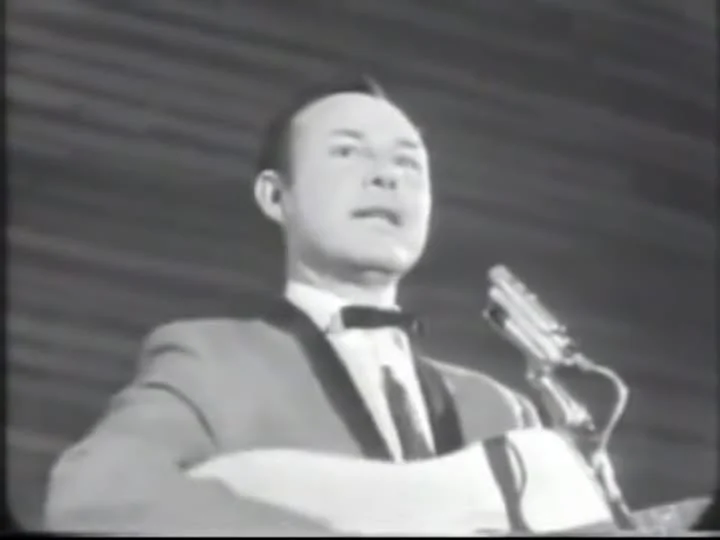
On a gray evening in 1964, the same year Jim Reeves’s voice fell silent forever, a tender recording called “I Love You Because” drifted into the world like a note posted from just before the storm. The plane crash that took Reeves was raw news then, and hearing his warm baritone on the radio only weeks later felt less like a release and more like a lingering handshake. Listeners in several countries turned the song into a shared moment of remembrance, and it began its long second life as one of the most cherished pieces in the Reeves catalog.
Reeves did not write the melody, and it already carried a history. Leon Payne, a Texas singer-songwriter, composed it in 1949, and its plainspoken tenderness drew many interpreters. By the time Reeves entered the studio, he had become the face of RCA Victor’s Nashville Sound, a movement that sanded the rougher corners of honky-tonk into a polished country pop blend. Chet Atkins, the producer and guitarist who shaped so much of that elegant chapter, believed in clarity and restraint. Reeves’s deep voice was the ideal brush for those careful strokes.
Reeves’s version came together in the early 1960s, while he was riding a wave of cross-genre success. His crossover hit “He’ll Have to Go” had already shown how easily he could move between country sincerity and pop sophistication. “I Love You Because” walked the same path, an invitation to imagine Nashville’s studio craft as something meant for a living room rather than a crowded honky-tonk.
The recording begins with a curtain of strings that melts open before Reeves starts to sing. What follows is not a grand projection. It is a late-night conversation carried by a small set of instruments. Brushed drums keep a soft heartbeat, upright bass holds the floor, acoustic guitar offers a gentle armrest, and electric lines stay low and supportive. Woodwinds blur into the shimmer of the violins, and a keyboard wanders through the upper corners with the kind of slip-note glow that recalls Floyd Cramer. The session details are often uncredited in broad discographies, but the atmosphere is unmistakable.
Listen closely to the first sixty seconds. The strings set the mood, then pull back to give Reeves room to speak. The rhythm section slips in like someone joining a conversation without interrupting. The first chorus opens only slightly, and the orchestra begins to carry more of the weight. By the second pass, the whole arrangement has become a cushion of controlled light. Nothing overflows. The drums are almost stingy with accents, and the bass walks are small and deliberate. This is not minimal music, but it is music built with a sense of restraint.
The intimacy begins at the microphone. Reeves stands close enough for the listener to feel the grain of each consonant. His timbre is warm without becoming woolly, exact without sounding stern. There is a subtle chest resonance that gives the voice its gravity, while the production team keeps sibilants in check through the studio’s reverb chamber. The final result rewards headphones and good speakers because the distance between voice and orchestra becomes something you can almost measure.
Payne’s lyric is a litany of affection, a list of everyday reasons attached to a simple spine. Reeves refuses to turn it into a loud declaration. He leaves a breath after the word “love,” as if to say that the feeling comes first and the reasons follow like small written footnotes. Each phrase feels like a line from a note slid across the kitchen table. He does not reach for the heavens. He sits across a lamp-lit room and tells the listener why, one unhurried breath at a time.
Reeves doesn’t raise the roof. He lowers the light, and in that gentler luminance the truth of the song becomes self-evident.
By 1964 Reeves was already a global presence, adored in Ireland and the United Kingdom, heard across the Commonwealth, and comfortable on tours, film sets, and radio broadcasts. “I Love You Because” traveled easily across those borders because it never felt like an argument. It felt like a confession. In the shadow of his death, it also sounds like a letter that outlived its author. That is not maudlin sentimentality. It is simply part of the residue a voice leaves behind.
Many sources note that the recording surfaced as a single in 1964, moved through different markets, and then kept reappearing on compilations and best-of sets for decades. Later budget labels used the title again and again to sell new packages. Exact chart positions depend on which country you consult, but longevity speaks louder than numbers. The track held its place at the heart of the Reeves legacy.
At its core, this is a perfect demonstration of the Nashville Sound’s persuasive balance between country instrumentation and pop polish. The orchestra is never spectacle. It is a frame. Violins stretch the vocal notes, violas smooth the middle, and cellos provide warmth instead of weight. Reeds function like perfume. The rhythm section guards the tempo with patience, and guitar and piano remain in service to the voice rather than fighting for attention. Atkins and the engineers at RCA Studio B knew how to expose the voice, shape the support, and tidy the edges. They made the song feel like a sculpture of proportion.
It is easy to picture this record in private moments. Someone stands in a kitchen early in the morning, stirring coffee while another person pulls on a jacket, and the song narrows the distance between them. A driver moves through dusk on a country road, fields turning into dark stripes, and the voice floats out of the dashboard with a quiet suggestion to keep going. A collector flips through sleeves, notices a familiar face, lowers the needle, and feels an old room reassemble around the speakers. Reeves does not drag that person backward. He walks beside them toward the next moment.
There is a cleanliness to this production that could be called premium in miniature. The mix logic resembles a carefully lit portrait, where the subject is beautiful and the background remains readable. Nothing feels cluttered. The mood is parlor-like, intimate rather than cavernous or churchy. If the song were played live, it might open into fuller bloom. In the studio, Reeves shaped it into a quiet archway that welcomes every listener.
The arrangement also avoids the temptation of a showy climax. The strings build to a modest glow near the end and then step back. The final note does not arrive with a victor’s flourish. It sounds more like a letter folded shut and placed on a desk. For someone who wants to learn the song, the chords are easy to find and the melody sits naturally under the fingers. The hard part is never the notes. It is the feeling.
When the last sustained note fades, the sensation is less of a performance concluded and more of a conversation paused. Reeves made records that leave room for the listener, and that is his enduring gift. He knew that love could be named quietly and still be heard completely.
Further listening begins with “He’ll Have to Go,” another masterclass in intimate baritone and soft-focus Nashville Sound. Patsy Cline’s “Crazy” offers the same blend of lush strings and conversational honesty. Eddy Arnold’s “Make the World Go Away” brings silken orchestration and gentle vocal gravity. Don Gibson’s “Sea of Heartbreak” finds the balance between ache and accessibility. Skeeter Davis’s “The End of the World” shares that string-limned stillness and plainspoken sorrow. These are the companions that belong on the same shelf as “I Love You Because,” sitting together in hush and warmth.