
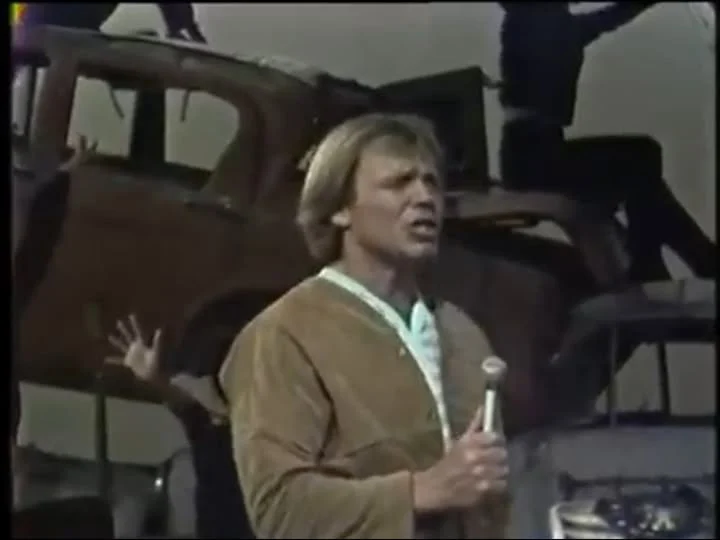
Sometimes progress sounds like a man gasping for air through the news bulletins of his time
Barry McGuire is not singing in 1965 so much as surviving it. Eve of Destruction arrives with one anxious acoustic guitar and a four chord pulse that feels less like folk rock and more like a heartbeat about to give out. The single was a summer surprise and a political landmine all at once. The radio treated it as a threat. The kids treated it as a mirror. The result is not polished music. It is urgent music.
McGuire had spent the early sixties inside the wholesome harmonies of The New Christy Minstrels. That clean cut world disappears completely the moment his solo debut explodes onto the airwaves. The song was the title track and lead single from his first album on Dunhill Records. Behind him stood P.F. Sloan, who wrote the lyrics with a frightening kind of clarity, and Steve Barri, who produced alongside the guidance of label founder Lou Adler. Together they framed a crisis list that read like tomorrow’s headlines about nuclear war, the draft, civil rights, and a globe on fire.
The recording was never supposed to survive
The vocal take was a rough guide, never meant for public ears. McGuire reportedly stood over a crumpled lyric sheet on the studio floor and delivered the entire song in one breathless pass. The final cut was leaked, then rushed into release with every ragged edge intact. This is the secret of its power. A producer could have polished the panic into something neat. The song would have died on the spot.
Musically, Eve of Destruction does not decorate itself. Hal Blaine keeps a steady, almost martial beat on drums while Larry Knechtel anchors the bass line with a low grade urgency. P.F. Sloan’s acoustic rhythm guitar carries the four chord pattern without ever crowding the vocal. There is no string section, no piano flourishes, no production comfort zone. The arrangement is a skeleton with a pulse. The mix keeps everything tight and uncomfortable. It fades out without offering a single answer.
Sloan avoided poetry. Bob Dylan could turn the same era into myth and metaphor. Sloan handed the world a list of injuries instead.
The Eastern world it is explodin’ / Violence flarin’, bullets loadin’ / You’re old enough to kill but not for votin’ / You don’t believe in war, but what’s that gun you’re totin’? / And even the Jordan River has bodies floatin’ / But you tell me over and over and over again my friend / You don’t believe we’re on the eve of destruction
The second verse turned to Red China, the space race, and Selma, Alabama. It was not a protest song. It was a witness statement.
The response was instant and ugly. Stations across the American South and military markets pulled it from the air. Critics called it unpatriotic and hope killing. Younger listeners heard the opposite. They heard someone finally say what the news reports implied. The controversy made the song impossible to ignore. It climbed to number one on the Billboard Hot 100, knocking aside The Beatles and their Help! for a week that felt like a generational changing of the guard.
For McGuire, that moment was the peak of a career that never reached the Top 40 again. He became one of music’s most memorable one hit wonders. But a one hit wonder with this much gravity is not a curiosity. It is a warning label that still fits our current moment.
The song’s echo swallowed the rest of 1965. Answer records appeared within months, including The Spokesmen with The Dawn of Correction. They tried to replace despair with optimism and failed to move the needle. The cultural door had already swung open. Rock music would never again pretend that teenage listeners only wanted to dance.
Listening to Eve of Destruction today is a strange act of time travel. The names on the news have changed. The shape of the fear has not. War still trains young bodies for distant soil. Racial injustice still stains the country that promised better. The same arguments that got the song banned in 1965 could be produced in any decade and still sound fresh. That is the song’s real curse.
The raw, immediate quality of that accidental vocal take is the single most important artistic choice in the history of protest rock
Those words are often used when critics try to explain why this song wins over cleaner versions. It is the sound of a human being drowning in information and refusing to look away. Eve of Destruction asks one question that never gets old after all these decades. What exactly’s the matter with me? The answer is supposed to be uncomfortable. That is the point.
Listening Recommendations
1. P.F. Sloan – Sins of a Family (1965) A companion piece from the same writer, full of cynical folk pop and social bite. Another window into the era’s dark side.
2. Bob Dylan – Masters of War (1963) The poetic ancestor of protest folk, delivered with a venom that only grew with time.
3. The Animals – We Gotta Get Out of This Place (1965) A rock and roll plea for escape with the same desperate heartbeat as McGuire’s hit.
4. Creedence Clearwater Revival – Fortunate Son (1969) Working class anger and anti-establishment frustration wrapped in a swamp rock stomp.
5. Edwin Starr – War (1970) The soul music answer to the protest tradition, shouted without a single ounce of subtlety.
6. Janis Ian – Society’s Child (1966) A personal and controversial story about interracial dating that earned its own share of radio bans.