
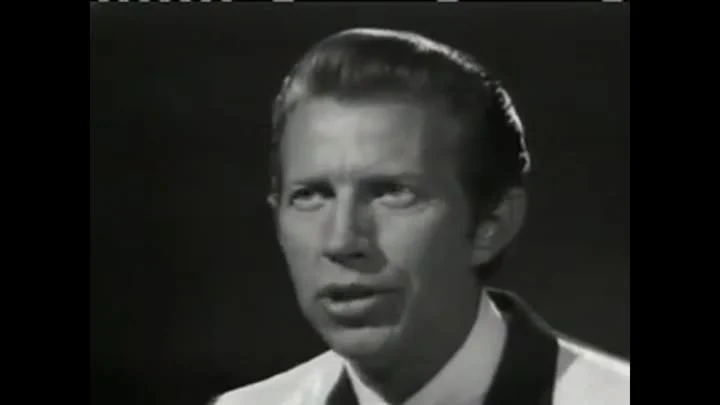
The moment hits like a cold blade. One instant you are standing in the warm sun, surrounded by family, the grass a vivid green beneath your feet. The next, you are staring at four gray walls, the sound of a guard’s footsteps echoing in the corridor. That is the brutal genius of Porter Wagoner’s 1965 recording of Green, Green Grass of Home. It is a song that builds a home in your heart only to tear it down with a single, devastating turn of phrase. This is not a nostalgic country ballad. It is a masterclass in cinematic despair, delivered by a man in a rhinestone suit who understood the power of a quiet storm.
In the mid‑sixties, Nashville was caught between two worlds. The honky‑tonk grit of Hank Williams still echoed in the smoky bars, while the smoother, string‑laden Nashville Sound was taking over the radio. Porter Wagoner, a pillar of the Grand Ole Opry and host of a wildly popular syndicated television show, carved out a unique space in that divide. He was a storyteller of the unflinching kind, drawn to narratives of poverty, crime, and moral reckoning. His voice, a rich baritone with a distinct rural Southern twang, could make even a cheerful reunion sound like a prelude to tragedy.
The song itself was written by the exceptional Curly Putman, but Wagoner made it his own. Recorded at RCA’s Studio B under the steady hand of producer Bob Ferguson, the single climbed to a respectable top‑five spot on the country charts. It later became the title track of his 1967 album, Green, Green Grass of Home. While many know the song through Tom Jones’s massive pop hit from the following year, that version traces its lineage back to Jerry Lee Lewis’s cover, which was itself directly inspired by Wagoner’s definitive country arrangement. This is the source code, the one that put the dirt under the fingernails of the narrative.
The sonic architecture of the recording is deceptively simple. From the first downbeat, the arrangement is hushed, almost reverential. The rhythm section moves with a quiet, military‑cadence precision. The piano, likely played by the brilliant Hargus “Pig” Robbins, offers simple, ringing chords that let the air breathe. This deliberate spaciousness creates the sound of an empty room, a quiet mind trying to cling to a precious memory. Around it, the steel guitar weeps like a thin silver thread of pure sorrow, answering Wagoner’s lines with a keening vibrato that never fully resolves. The production is so clean you feel you are sitting right next to the microphone, a testament to premium audio that prioritizes clarity over polish.
What makes the song unforgettable is how Wagoner sells the illusion. In the first verses, he describes the “old hometown,” the sight of his mama and papa, and his “sweet Mary.” His voice is saturated with genuine happiness. The old house still stands, though the paint is cracked and dry. The details are concrete, making the vision real. The tempo remains steady, the instrumentation warm and embracing. You, the listener, become complicit in his joy. And that is what makes the twist so brutally effective.
The greatest heartbreak in life is not having a dream fail, but having it proven to be nothing more than a momentary escape from a cold and unforgiving reality.
Then the third verse arrives. The steel guitar lingers a touch longer. The drum taps become heavier, like a foot dragging on concrete. Then I awake and look around me at these four gray walls that surround me. The shift from bright dreamscape to stark reality is immediate and terrifying. The piano chords become sharper, more percussive. The rhythm that had felt like the gait of a traveler coming home now feels like the relentless march toward an inevitable conclusion. The sweetness of the dream contrasts with the chill of the reality—the guard, the padre, the walls. It is a three‑act tragedy contained in two minutes and forty seconds.
The song’s power lies in its restraint. Wagoner does not belt. He narrates. The final verse, a heartbreaking repetition of the home visit now revealed as a final walk with the chaplain, is sung with devastating finality. This is not a song about returning home. It is about the deep human need for one last moment of comfort before an unthinkable end. For the duration of the song, Wagoner gives his character—and us—that moment, only to snatch it away. It is a testament to the fact that the most impactful drama often comes with the quietest warning.
In a world of perpetual motion and digital noise, a song that so powerfully roots itself in the simple, sensual details of “green, green grass” is an essential anchor. It speaks to a timeless universal ache: the longing for a safe, uncorrupted home. To hear it is to sit alone, turn down the lights, and simply listen. To the story. To the instrumentation. To the quiet truth of Porter’s voice. And to the cruel, beautiful twist that reminds us that even the most vivid dreams can be nothing more than a momentary escape.