
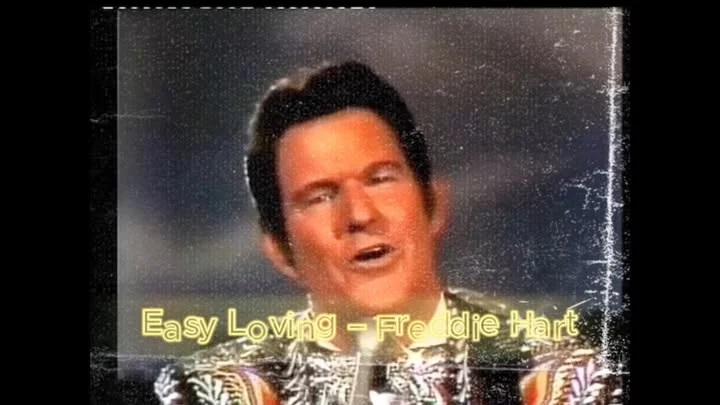
A simple flip of a vinyl record changed everything. In an Atlanta radio station, a disc jockey chose to play the B side of Freddie Hart‘s latest single “California Grapevine.” The response was immediate. Listeners called in, demanding to hear it again. That B side was “Easy Loving,” and it would become one of the most beloved country songs of the era. The year was 1971, and the song’s quiet, intimate confession seemed almost too simple to succeed in a landscape thick with Bakersfield grit and the last opulent gasps of the Nashville Sound. Yet it became a phenomenon, a chart topping triumph that resurrected a long time industry journeyman’s career.
Freddie Hart had been recording since the early 1950s, bouncing between labels like Columbia and Kapp. He was known mostly as a talented songwriter who occasionally chipped away at the charts with minor hits. By 1970, he had returned to Capitol Records, the label where he first signed nearly two decades earlier. After his previous single stalled, the chatter was that Capitol was ready to drop him. Then that disc jockey played the B side. “Easy Loving” was pulled from Hart’s 1971 album California Grapevine, but its runaway success forced Capitol to re title later pressings of the LP to Easy Loving and subsequently released a dedicated album under the same name. Produced by George Richey, the track marked the spectacular zenith of a journey that spanned nearly twenty years. Hart, at 44, became an overnight star, winning multiple CMA Awards and crossing over to the pop top forty.
The arrangement is a careful, architectural showcase of restraint. A soft bass drum and a clean bass line establish a walking tempo that never rushes. Strings rise in controlled, luxurious swells, filling the high frequencies with tender pathos. The reverb is generous, suggesting a warm, expansive room that envelopes Hart’s vocal. The piano plays quiet, arpeggiated figures that add harmonic movement without cluttering the mix. The electric guitar offers simple, melodic fills with a touch of vibrato, speaking in a reserved language of devotion. And at the center is Hart’s voice, smooth and unhurried, delivering his own lyrics with a lived in warmth. He doesn’t belt or strain. He sounds like a man who genuinely means every word about finding a commitment that is easy.
The song is a quiet radicalism. Country music at the time was often about struggle, loss, and the high price of love. Hart’s song is simply about the quiet, sustaining joy of a good, uncomplicated relationship.
Years later, I heard “Easy Loving” on a crackling transistor radio late at night. The hiss and static were part of its texture, yet the gentle swell of the strings still cut through. That low fidelity experience drove me to seek a higher quality version. When I upgraded to true premium audio, I discovered layers I had not known were there: the subtle brush on the snare, the distinct warmth of tube microphones reportedly used for the vocals. The song’s essential warmth is resilient. It invites introspection. In an age of endless digital noise, “Easy Loving” does not scream for attention. It simply waits. It becomes the soundtrack to quiet forgotten moments: a late night drive home, the reflection of streetlights passing across the dashboard. It reminds us that life’s greatest pleasures are often its easiest ones.
Listeners who appreciate “Easy Loving” might also enjoy Sammi Smith‘s “Help Me Make It Through the Night” from 1971, a song that shares its sophisticated intimate mood. Charley Pride‘s “Kiss an Angel Good Mornin” celebrates domestic devotion with a smooth friendly vocal delivery. Freddie Hart himself followed up with “My Hang Up Is You,” continuing the lush arrangement and theme of uncomplicated all consuming love. George Jones‘s 1974 track “Good Woman’s Love” uses a gentle string arrangement and a grateful direct lyric about the stabilizing force of a partner. And Charlie Rich‘s “Behind Closed Doors” offers similarly velvet smooth production focused on the private devoted side of a mature relationship.
Freddie Hart waited a lifetime for this hit. When it arrived, it arrived fully formed, perfectly pitched, and instantly timeless. “Easy Loving” was not a calculated commercial pivot. It was an honest articulation of the man, the writer, and the moment. It is the sound of hard won peace.