
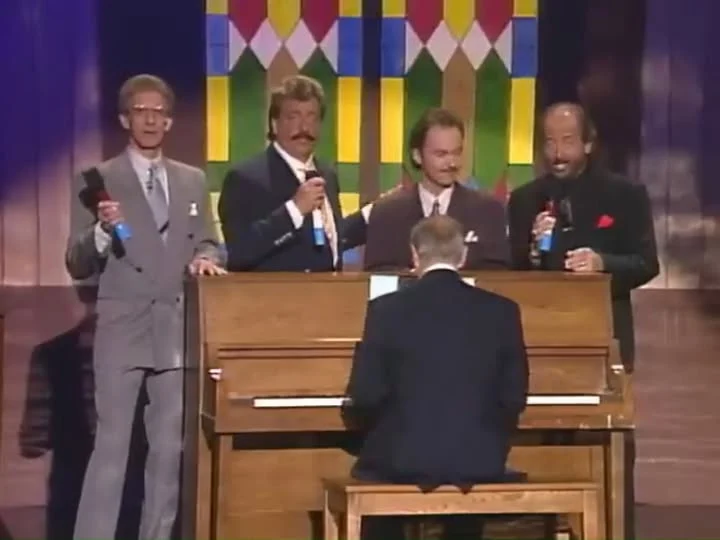
There is something profoundly moving about a song that has traveled through centuries, touching lives across generations, and the Statler Brothers knew exactly how to honor that legacy. When they stepped into the studio to record Sweet By and By, they weren’t just covering a hymn. They were breathing new life into a piece of American history, wrapping it in their signature harmonies that felt both fresh and timeless.
The journey of this hymn began in 1874, when two unlikely collaborators crossed paths. S. Fillmore Bennett, a pharmacist by trade, found his creative partner in Joseph P. Webster, a musician whose melodies would outlive them both. Together, they crafted something that transcended their era. Bennett’s lyrics spoke of perseverance through darkness, of holding onto faith when the road grew long. It was a message that resonated deeply with a nation still healing from the wounds of the Civil War.
What makes this hymn remarkable is how it refused to stay confined to Sunday mornings. The great American composer Charles Ives wove fragments of the melody into his orchestral tapestries, recognizing its musical sophistication. In the streets of New Orleans, jazz musicians adopted the hymn for funeral processions, transforming it into a slow, mournful dirge that somehow lifted spirits even as it honored the departed. The song had become something larger than its creators could have imagined.
The Statler Brothers brought their own chapter to this story. With roots firmly planted in country gospel, they approached the hymn with reverence but also with a willingness to let it breathe in new ways. Their close harmonies added warmth, their understated instrumentation created space for reflection, and suddenly a song that had been sung in small country churches was reaching audiences far beyond those wooden pews.
Music has this incredible ability to carry hope through time, and Sweet By and By has been doing exactly that for well over a century.
What remains most striking about this enduring piece is its universal quality. Whether played on a pipe organ in a cathedral, hummed by a grandmother in her kitchen, or performed with a country band’s sincerity, the hymn retains its emotional core. It speaks to something fundamental in the human experience. The need to believe that something better waits, just beyond the horizon.
For those discovering the Statler Brothers rendition today, there is a sense of stepping into a long conversation. Each note carries the weight of those who sang it before. The soldiers, the mourners, the faithful, the hopeful. And in that way, the song continues to do what it has always done. Offer comfort. Suggest that the struggle is temporary. Whisper that the sweet by and by is real.