
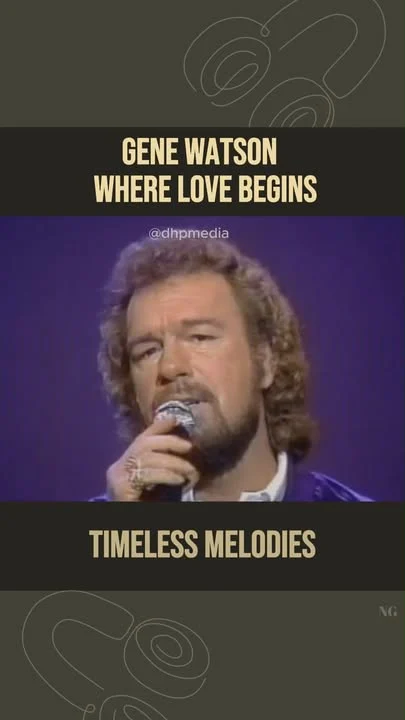
There is a moment in Gene Watson’s tender ballad “Where Love Begins” when the harmony of strings, piano, and his unmistakable voice seems to suspend time. It arrives with the chorus: “Where love begins, with just a touch of your hand, / Where love begins, when we don’t understand / All the reasons why it feels so right, / It’s where love begins tonight.” This is not merely a song about romance. It is an invitation to remember that fragile, beautiful instant when two hearts first align. Released in 1981 as the title track of an album that would cement his legacy, the track remains a masterclass in emotional storytelling.
Gene Watson has spent over six decades refining a voice that can convey the weight of love, loss, and resilience with equal grace. With hits like “Paper Rosie” and “Love in the Hot Afternoon,” he had already earned his place among country music’s most authentic voices. But “Where Love Begins” stands apart. It represents a perfect marriage of traditional honky‑tonk heart and lush, orchestrated sophistication. Produced by the esteemed Ray Pennington, the album does not chase trends. Instead, it leans into a timeless sound that appeals to both country purists and a broader audience. The title track, in particular, captures a sense of cautious optimism—a celebration of new love that acknowledges its uncertainty yet embraces its promise.
“I don’t know where it started / But I know that it’s true, / Every step that we’ve taken / Has led me here to you.”
These opening lines set the stage for a journey of vulnerability. Watson’s delivery is intimate, as though he is sharing a private confession. The lyrics trace the arc of discovering love unexpectedly, with a narrator who has weathered past complexities but now stands on the brink of something pure. There is a duality here: joy mingled with a quiet awareness of potential heartbreak. It is this tension that gives the song its emotional weight and makes it resonate across generations.
The instrumentation on “Where Love Begins” is a study in restraint and elegance. A fingerpicked guitar provides a gentle, steady pulse through the verses, its bright tone creating a warm, inviting space. When the chorus arrives, the guitar gains momentum, lifting the melody without overwhelming. The piano, played with a light touch, adds soft chords and melodic flourishes that enhance the feeling of tenderness. It never competes for attention; it simply supports Watson’s voice. Then there are the strings—violin and cello sections woven carefully into the arrangement. They do not dominate but rather provide a cinematic sweep, turning the ballad into an emotional journey that feels both personal and expansive. The rhythm section, using brushes on the drums and a subtle bass line, keeps the song grounded. And the harmonica, with its plaintive, nostalgic wail, recalls a longing that feels as familiar as it is poignant. Each instrument contributes to a soundscape that is lush yet never cluttered, allowing the song’s core emotion to shine.
“Where Love Begins” did not happen in isolation. It came at a pivotal moment in Watson’s career, following a string of successful albums in the 1970s. The album of the same name offered a blend of straight‑ahead country and soft ballads, with arrangements that felt contemporary but never strayed from tradition. The production, polished yet not slick, always keeps the focus on the song’s emotional truth. This balance of simplicity and sophistication is what makes the track a standout. It feels intimate enough for a quiet evening, yet its warmth can fill a room.
For listeners drawn to this kind of heartfelt craftsmanship, a few other songs capture a similar spirit. Jim Reeves’ “He’ll Have to Go” pairs a smooth baritone with a lush arrangement, exploring themes of longing and devotion. Ray Charles’ country‑soul classic “I Can’t Stop Loving You” channels vulnerability through an understated orchestration. For a more upbeat romantic bent, George Strait’s “I Just Want to Dance with You” delivers sincerity with a lighter touch. Hank Williams’ “I’m So Lonesome I Could Cry” mirrors the emotional depth with its use of strings and plaintive melody. And Hank Locklin’s “Please Help Me, I’m Falling” offers traditional heartbreak wrapped in smooth vocals and steel guitar. Each of these tracks shares the same commitment to storytelling and emotional resonance that defines Watson’s work.
What ultimately makes “Where Love Begins” timeless is its ability to make the listener feel seen. It captures a universal moment—the beginning of love—and honors it with a quiet, dignified beauty. Whether you have been a fan of Gene Watson for years or are discovering him for the first time, this song remains an essential listen. It is a reminder that country music, at its best, can turn a simple emotion into something extraordinary.