
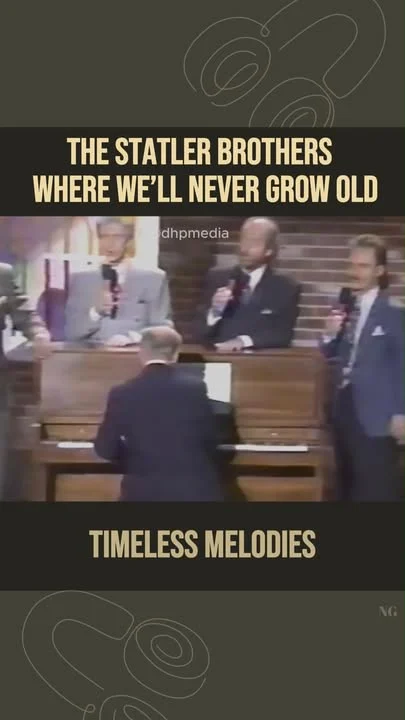
When four voices join together in perfect surrender to a hymn, time seems to stand still. That is the magic of The Statler Brothers and their beloved 1973 gospel treasure “Where We’ll Never Grow Old.” The song opens a quiet door to a peaceful eternity, and even decades after its release on the album “The Gospel Spirit,” it still carries the power to calm a restless heart.
Long before this tender recording appeared, the quartet had already claimed a special place in country music through hits like “Flowers on the Wall” and “Bed of Roses.” With “The Gospel Spirit,” though, they turned toward something more reflective. The record gathers traditional hymns and spiritual songs, each performed with the warm, close harmonies that had become their unmistakable signature. In that setting, “Where We’ll Never Grow Old” feels less like a performance and more like an offering.
The Statlers never needed heavy production to make an honest song land. On “Where We’ll Never Grow Old,” the arrangement is stripped down and graceful, letting every syllable and every harmony breathe. That clarity is exactly what makes the hymn so moving. Listeners are invited to focus on the promise of a world without loss, sickness, or time itself.
The Guitar and the Piano lie at the heart of this arrangement. The acoustic guitar begins with a gentle rhythmic warmth, the kind of sound that feels familiar and reassuring. It sets a steady foundation without ever competing with the voices. The piano then joins with soft chords and quiet flourishes, adding moments of light that mirror the song’s message of hope. Together, these two instruments create a delicate bridge between old-time gospel and the polished yet soulful country sound that defined the era.
Beneath the surface, the bass guitar does essential work. Its understated presence gives the song a quiet sense of direction, holding the melody in place as the voices climb and settle again. That grounding pulse is easy to miss on first listen, but it is one of the reasons the whole track feels so complete.
Of course, no discussion of this song would be complete without celebrating the group’s vocal artistry. Each member of the quartet contributes to the layered harmonies that make every Statler Brothers performance instantly recognizable. The lead voice carries the hymn with sincerity and tenderness, while the surrounding voices rise and fall in unison. In the brighter moments, the group swells into a fuller sound that speaks to resurrection and reunion. In quieter moments, they pull back to an intimate hush that feels almost personal.
The emotional heart of “Where We’ll Never Grow Old” has never faded. The lyrics paint a vivid image of a heavenly land where aging, sorrow, and separation no longer exist. For anyone who has lost a loved one, the song becomes a gentle reminder that parting is not the final word. It looks forward to a glad reunion, a time when every troubled heart will find peace. That universal promise is why the hymn continues to resonate with listeners of all ages, whether they grew up with gospel music or are discovering it for the first time.
There is an old-fashioned beauty in how this song trusts simplicity. It does not lean on dramatic production or clever instrumental breaks. Instead, it uses the timeless language of melody and harmony to speak directly to the soul. A straightforward arrangement, delivered with genuine feeling, can leave a lasting impression.
For those who treasure this particular hymn, a few similar recordings may offer the same comfort. The Carter Family remains essential listening with “Will the Circle Be Unbroken,” a classic that shares the same longing for reunion and the same honest style. Alan Jackson brings his traditional country warmth to “Precious Memories,” a gentle companion piece built around guitar and piano. Brad Paisley and Emmylou Harris deliver a moving modern interpretation of “Farther Along,” pairing lovely harmonies with timeless lyrics. And Carrie Underwood offers a more expansive take on “How Great Thou Art,” capturing the same sense of reverence that runs through the Statlers’ gospel recordings.
The legacy of the Statler Brothers rests on their ability to move between joyful country hits and sacred songs without ever losing their own identity. “Where We’ll Never Grow Old” remains one of the clearest examples of their mastery. It honors the past, uplifts the present, and points toward something greater. For longtime fans, it is a familiar friend. For new listeners, it is a doorway into a rich tradition of faith and harmony.
The video presentation accompanying the song offers a touching visual companion, letting viewers experience the quartet’s warmth in a more personal way. The expressions on their faces, the blend of their voices, and the simple staging all reinforce the hymn’s central theme. This is music that invites reflection rather than spectacle.
The complete lyrics unfold like a quiet meditation on homecoming
I have heard of a land
On the faraway strand
’Tis a beautiful home of the soul
Built by Jesus on high
There we never shall die
’Tis the land where we’ll never grow old
Never grow old, never grow old
In the land where we’ll never grow old
Never grow old, never grow old
In the land where we’ll never grow old
When our work here is done
And the life’s crown is won
And our troubles and trials are o’er
All our sorrow will end
And our voices will blend
With the loved ones who’ve gone on before
Never grow old, never grow old
In the land where we’ll never grow old
Never grow old, never grow old
In the land where we’ll never grow old
“Where We’ll Never Grow Old” is more than a gospel hymn. It is a glimpse of forever, carried on the shoulders of four voices that knew exactly how to serve a song. The Statler Brothers used their gifts to make faith feel accessible and beautiful, and this recording endures as proof of that calling. For anyone searching for a moment of stillness, this track remains a timeless companion.