
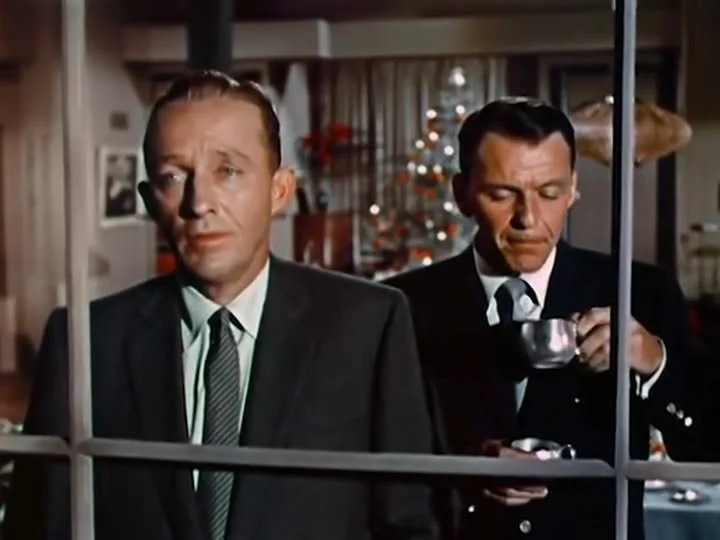
On a late November afternoon, as snow began to blanket the streets in silence, a small café became the unexpected stage for a musical collision. From the speakers above the espresso machine, two voices emerged in unhurried harmony—the velvet croon of Bing Crosby and the bright, elastic phrasing of Frank Sinatra, weaving through Irving Berlin’s perennial classic, “White Christmas.” The sound was not new, but the moment felt timeless, a quiet summit between two kings of American song.
This particular version comes from the 1964 album 12 Songs of Christmas, a project that brought together two titans at a pivotal crossroads in music history. Sinatra, then at the helm of his own Reprise Records, coaxed his idol and longtime rival Crosby into the studio for a collaborative holiday effort. The album was produced by Sonny Burke and featured arrangements by Harry Simeone and the legendary Nelson Riddle. The result was less a new interpretation and more a respectful passing of the crooning crown, captured in warm analog fidelity.
The arrangement is a full orchestral tapestry, dominated by shimmering strings and the gentle bloom of French horns. The piano provides lush chordal scaffolding in the background, never overpowering the voices but offering a rich harmonic foundation. The double bass walks a soothing, steady path, anchoring the time like a slow-moving river. There is no guitar here; the focus rests entirely on the sweeping strings and the two vocal masters. The stereo mix places their voices forward with a light, nostalgic reverb, a sonic signature designed for the hi‑fi enthusiasts of the early 1960s who wanted to hear every shimmering cymbal and the warm bloom of the cello section.
Crosby opens the first verse with his characteristic relaxed purr, a buttery tone that defined the crooning style of an era. His timbre is slightly darker, carrying the weight of decades of association with this melody, having sung it for troops in the Pacific during World War II. Sinatra steps in for the second verse, his voice brighter and more elastic, his phrasing carrying an undercurrent of swing even within this gentle ballad. The two do not compete; they complement each other like master craftsmen presenting different cuts of the same exquisite material. When their voices finally intertwine in the final refrain, the recording transcends performance and becomes a shared memory.
The great magic of this recording is how it manages to feel both monumental and utterly casual, a fireside chat between two kings.
The emotional core of “White Christmas” has always been a gentle, deeply felt longing—for a bygone time, a distant place, or an idealized memory. Crosby, having sung it for soldiers far from home during the war, understood this longing profoundly. When the two voices unite, the effect is not just nostalgic but historic, a moment that crystallizes the handover of a tradition built on mutual respect and genuine warmth. It is a lesson in vocal restraint and the power of shared experience, proving that even the most enduring classics can be revisited when talent and intention align.
This duet stands as a poignant historical document, capturing two legends at a point of mutual admiration. It reminds us that the greatest artists rely on one another to create something truly timeless. The enduring appeal of 12 Songs of Christmas lies in this rare collaboration, a summit meeting that delivers on its promise. For those who wish to explore further, the rich catalogue of holiday recordings offers many complementary gems. Bing Crosby’s “Silent Night” from 1935 shows his earlier, more pious side. Frank Sinatra’s “The Christmas Song” from 1957 features a similarly lush Nelson Riddle arrangement. Nat King Cole’s “The Christmas Song” shares the same warm, mid‑tempo ballad feel. Perry Como’s “It’s Beginning to Look a Lot Like Christmas” evokes the same effortless pop style of the 1950s. And Doris Day’s “I’ll Be Home for Christmas” offers a counterpoint of wartime yearning with an intimate vocal touch. Each track weaves a broader tapestry of holiday nostalgia, but the Sinatra‑Crosby duet remains its radiant centerpiece.