
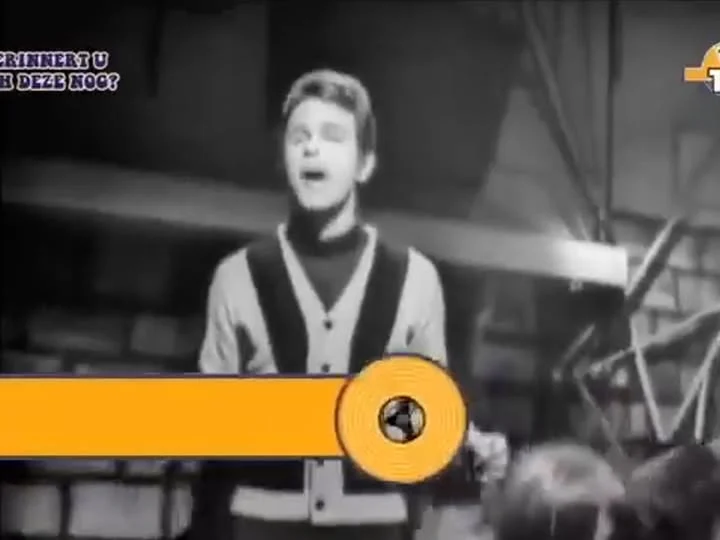
There are moments in pop music that don’t just play—they happen. Find yourself alone at night, a car radio catching static from a distant oldies station, and suddenly “Lightnin’ Strikes” by Lou Christie cuts through the air like a blade. A tom roll cracks the darkness, a chorus rises like neon on wet asphalt, and his falsetto knifes into the silence: urgent, dangerous, and utterly magnetic. It is not merely a song you hear. It is a miniature movie you inhabit—scenes cut on the snare drum, motives revealed in the arrangement, the whole sequence breathless and strangely inevitable.
Released on MGM Records in early 1966, the single is often listed as “Lightnin’ Strikes” without the final “g.” If you find a discography with the full spelling, you are still standing in the right storm. Co-written with longtime collaborator Twyla Herbert and arranged by Charlie Calello—the master of brass-and-string drama who shaped the sound of The Four Seasons—the track establishes Christie not just as a singer of astonishing notes, but as a dramatist using pop’s toolkit to trap tension like air in a bottle. It arrived as his defining moment, crystallizing a persona that earlier hits had only sketched.
“Pop at its most exhilarating is a negotiation with time—how long you can delay the fall, how sweet you can make the return.”
In the mid-sixties, the charts were crowded with acts chasing either harder R&B grooves or British Invasion cool. “Lightnin’ Strikes” threads a third path: a theatrical American pop lineage that taps doo-wop’s heart, Brill Building craft, and a sliver of operatic daring. It topped U.S. charts in early 1966 and made a notable showing in the U.K., a transatlantic proof that its voltage traveled far. Collected later on an MGM album of the same name, it was born first and foremost as a single—built to hit hard in three minutes and leave vapors.
Calello’s arrangement is a small miracle of scale. It begins with a rhythmic feint—drums flickering like mischief—then stacks female backing vocals that answer and provoke. A shimmer of strings doesn’t merely decorate; it tilts the frame toward melodrama. Brass lines puncture the mix at calculated angles, like exclamation points that underline a thought in red pencil. You can almost see the conductor’s hand, cueing crescendos and sudden brakes. The dynamic control is what makes the track singular. Verses gather like storm fronts; the rhythm section surges, then retreats, leaving space where you expect flood. These stop-start tensions are not gimmicks. They are structural set pieces that tell the story of temptation and restraint without a single image on screen. When the band slams back in, it feels earned: the thunder finally catching up to the lightning you have been watching flash at the horizon.
Listen closely to the texture of Christie’s vocal. The falsetto is bright but never thin, braced by a chestier lower register that keeps the character from turning cartoonish. He works phrasing like an actor hitting marks—short stabs, then ramping arcs, vibrato as a period rather than a flourish. The backing singers, often treated as girl-group commentary in shorthand, deserve their own credit line. They mirror the moral back-and-forth: calling out desire, sanctioning it, then sounding an alarm. The whole machine dramatizes the lyric’s push and pull before you process a single word.
Underneath that top layer, the band is doing surgical work. The rhythm guitars are percussive and clean, with a bright, almost metallic attack that cuts through the strings. The bass walks and darts, a conspirator in the drama. Drums favor sharp snare punctuation and tom accents that kick transitions like trapdoors. There is a glint of keys—brief, anchoring flourishes—that could be organ, though it often reads like a compacted, bell-like piano strike supporting harmonic pivot points. It is a tightly bound ensemble where every piece clicks and withdraws on cue.
Because the song was produced for mass radio, you get clarity that still feels tactile. The reverb on the voices is chambered and contained, a careful halo rather than a wash. You can sense the room in the string reflections—the decay is quick, but it tells you the walls were close enough to keep pressure in the mix. On modern playback, try it through a good pair of studio headphones. You will hear extra air around the vocal stacks where the chorus breathes in unison. Each instrument occupies a deliberate space. Strings climb in parallel motion, then fan out. Brass hits either underline vocal syllables or set up the next line with a lead-in so short you might miss it—except your body doesn’t.
Part of the enduring power of “Lightnin’ Strikes” is how it fuses pop economy with an almost operatic sense of stakes. The song toggles between first-person confession and external chorus, a structure that predates the modern cinematic universe of antiheroes but points directly to it. Christie does not tidy up the tension. He lets it hang in the air like ozone after a strike. This candor—the admission of risk, of appetite—creates an energy that a cleaner moral narrative would flatten. There is a lovely paradox in the arrangement’s elegance. Strings and woodwinds veil the edges, but the emotions are not disguised. If anything, the orchestration heightens the situation the way film scoring heightens a chase scene: by making you feel time in your chest. That idea of time—of suspended seconds just before the downbeat returns—is the secret architecture of the record. Pop is often about the big chorus, the release. Here, it is also about the measure just before, when you can hear the electricity waiting for a ground.
Consider how this piece of music stands in Christie’s career arc. He had already charted earlier in the decade, establishing the falsetto as his signature move. But “Lightnin’ Strikes” crystallized it—made the falsetto a narrative device rather than a trick. Working with Herbert again gave him lyrical clarity; she had a gift for framing romantic entanglement with bright, memorable turns. Calello’s presence—brought over from his deep bench of arranging for other pop heavyweights—was the final alignment. The MGM era sharpened Christie’s profile, packaging the drama in sleeves and singles that felt like artifacts from the same world.
As with many mid-sixties singles, stereo variations and remasters complicate the listening history. Some pressings present the vocals hotter; others pull the rhythm section slightly forward. I am partial to versions that keep the strings tucked just far enough back to act like atmosphere rather than canopy. If you are comparing releases, note how the stop-time sections are handled—too much limiting flattens the excitement, while a freer transient lets the return hit like weather again. Seek out a transfer that preserves dynamic contrast; it is the lifeblood here.
One can also hear “Lightnin’ Strikes” as a hinge between two appetites in American pop: the appetite for glamour and the appetite for grit. Glamour arrives in those immaculate female harmonies and the brushed shine of orchestration. Grit lives in the rhythm section, the finger-on-string squeaks that peek through, the human effort in Christie’s upper register when he pushes air through the narrowest opening in the melody. The song does not choose; it holds both, and that duality is why it still feels alive rather than merely nostalgic.
I think of a friend who swears the record helped her pass a long night drive on I-80 in winter. She told me the wheels were humming a narrow note, her breath fogging the windshield edges, and then this came on. The drama made her laugh—she could picture beehive hair, sharp suits, all that style—but in the chorus she felt less alone. A different friend, a DJ, uses it as a pivot track in all-vinyl sets: when the crowd drifts, the needle drops here and people look up, as if they have heard thunder out past the parking lot. Years ago I watched a teenager discover it on a curated playlist and ask, “Is this from some new retro movie?” The answer was no, but I understood the question; the track is cinematic without images.
“Lightnin’ Strikes” has the bones of a standard. You can imagine it on a music stand as cleanly notated as any Broadway cue. I have even seen vintage ads pointing budding singers to “vocal arrangements available,” the era’s version of today’s tutorial culture. If you go hunting for sheet music, you will notice how much of the effect rests not on complex chord changes but on arrangement and pacing. That is pop wisdom: the frame you build around a melody can make the melody feel ten feet tall. In a world where we stream everything, it is easy to forget how records were once objects and events. This single arrived with a label logo and a promise of a world: MGM’s lion’s share of polish, the thrill of needle-to-groove impact. Even as you hear it today through a subscription or on a reissue, the record still behaves like an event. Part of that is Christie—those vowels on the edge of flight—but part is craft. The pros knew where to place the brass hit, which measure to cut in half, when to let the chorus breathe.
There is also the matter of influence. You can hear this track’s DNA in later pop that treats the chorus like a cliff edge. You can trace it through glam’s sense of theater and into certain power-pop cuts that keep their eyes on the crowd while sneaking in orchestral frills. Not all of that lineage is direct, and not all of it is conscious, but “Lightnin’ Strikes” put a flag in the ground for how big feelings could be staged without turning the singer into a caricature.
Some records are “period pieces” in a limiting sense: you visit them like a museum room. This one is a period piece in the best sense; it brings its era forward, lets it warm the present, and then returns to its sleeve with the light still buzzing in your ears. It will always be 1966 when the chorus hits, but it will also be right now—traffic outside your window, a message left hanging on your phone, a decision you keep postponing because you enjoy the voltage of maybe.
There are other ways to approach this song. Try it quietly in a dim room on a steady system, where you can follow the breathing of the backing vocals between takes. Try it loud in the car where the snare turns to sheet metal and the chorus opens the sky. Try it in headphones walking past glass storefronts at night, your reflection drifting in and out of frame as the strings carry you from one sidewalk square to the next. Each context unlocks a slightly different film.
If you have come for a final verdict, here it is: “Lightnin’ Strikes” is not merely a catchy old hit. It is a design—of tension, of release, of carefully apportioned color—that keeps teaching lessons to anyone who cares to listen closely. Whether you are captivated by the choir-like backing, the trigger-sharp drums, or the way Christie balances sincerity and mischief, the record returns your attention with interest. And if you are a musician, there is a lesson in how small details—one extra beat held in the bridge, a specific string voicing—can turn a good idea into a signature.
Hear it again, and listen for the way the air changes in the stop-time passages. That is the song catching lightning in a jar, just long enough for you to see it.
Listening Recommendations:
- The Four Seasons – “Rag Doll” – Calello’s fingerprints and string-kissed drama align with Christie’s theatrical pop surge.
- Gene Pitney – “Town Without Pity” – Orchestral sweep and moral stakes handled with cinematic poise.
- The Shangri-Las – “Leader of the Pack” – Story-song intensity and girl-group commentary sharpen the sense of danger.
- Del Shannon – “Runaway” – Falsetto urgency and keyboard hooks that bolt across the night like neon.
- Jay & The Americans – “Cara Mia” – Operatic high notes meet stately arrangement for maximal romantic impact.
- Lesley Gore – “You Don’t Own Me” – Strings and vocal authority frame autonomy with mid-60s grandeur and bite.