
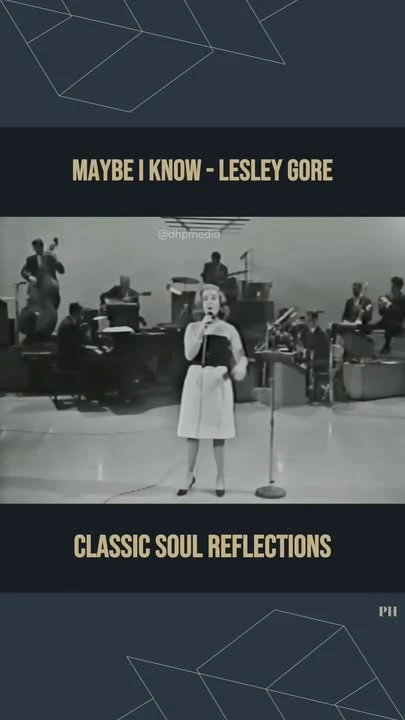
The first time a friend played Lesley Gore’s “Maybe I Know” for me, she was midway through a breakup she couldn’t bring herself to finish. She knew the truth about her partner’s infidelity, but she kept hitting repeat on this single, letting that minor key and Gore’s trembling vibrato fill her apartment. “She wasn’t singing about if he was cheating,” my friend said, eyes fixed on the ceiling. “She was singing about the terrible, necessary moment of deciding to accept what she already knew.” That hush-hush confession is the key to understanding why this 1964 track still cuts so deep sixty years later.
She wasn’t singing about if he was cheating. She was singing about the terrible, necessary moment of deciding to accept what she already knew.
The café where I often sit to write was that late-winter afternoon when the air held nothing but the scent of old coffee and the soft dust from spinning vinyl. A familiar, scratchy melody drifted from the corner speaker—a sound so immediately 1964, so heavy with the sorrow of a minor key and a girl’s voice trying to sound brave. It was Lesley Gore, and the room fell away.
This is not the Gore of “It’s My Party,” the chart-topper immortalized by adolescent melodrama. Maybe I Know was released as a non-album single in the autumn of 1964, a pivotal moment in pop history. The British Invasion was cresting, seemingly poised to sweep away the string-laden arrangements that had defined American pop. Yet Mercury Records and Gore’s producer, Quincy Jones, understood that a great song, expertly produced, could always cut through the noise. This piece of music proves that point definitively.
The track’s sophisticated blend of rock-and-roll drive and Brill Building orchestration cemented Gore’s transition from mere teenage sensation to a serious vocalist. Jones, already showcasing his ability to balance commercial appeal with depth, built a soundworld that provided glamour without sacrificing the grit of the song’s emotional core.
The arrangement is a masterclass in dynamic tension. It begins with a deceptively simple yet propulsive rhythm section—the drums carrying a light backbeat, the bassline moving with understated, almost jazzy fluidity. Then the orchestra enters. The strings are not merely decorative; they act as a Greek chorus to Gore’s internal monologue. The brass section, especially the trumpets, adds sharp, angular commentary in the fills, injecting dramatic energy precisely when the arrangement risks becoming too lush.
Listen closely to the brief, stabbing brass figures that appear just before the chorus. They sound like a sudden intake of breath, a moment of sharp realization breaking through denial. Beneath the sweep, the rhythm section is anchored by a distinctly audible acoustic piano and an electric guitar. The piano plays a straightforward, driving chord progression, almost lost in the mix save for its percussive quality. The guitar work offers clean, lightly-reverbed arpeggios that fill the middle frequency range, adding texture without a solo. It is a fine example of supportive, rhythmic playing for anyone starting guitar lessons. Jones’s production ensures every element, from the shimmer of the high-hat to the low thrum of the cello, occupies its own space. Playing this track through a quality home audio system reveals layers of instrumental detail often missed on a casual listen.
Gore’s vocal performance elevates the song into the canon of great 60s pop. The central theme is cognitive dissonance: the singer knows her love is cheating, but she tries desperately to convince herself that it is just rumor, that she maybe knows but won’t fully admit it. Her delivery embodies this conflict. There is a noticeable vibrato at the end of key phrases—not a flourish, but a slight tremble that reveals the cracks in her composure. The lyric is simple yet profound: “Maybe I know what you’re trying to tell me / Maybe I know that you’re not for me.” The maybe is the protective linguistic barrier against the crushing reality of certainty.
The restraint in the performance is devastating. No histrionic shouting, no grand declaration of independence (that would come later with “You Don’t Own Me”). Instead, there is a quiet, weary resolution in her voice by the final chorus, a shift from pleading to resignation. This song exists not in the giddy light of a first crush but in the serious, shadowed space of a first profound loss. It requires the listener to sit with ambiguity and internal struggle. It is the sound of a private moment of reckoning, broadcast with orchestral grandeur.
While Maybe I Know was a moderate chart success—certainly a hit, but not the generation-defining smash of “It’s My Party”—it remains a vital piece of the Lesley Gore narrative. It demonstrated her range and her capability to handle sophisticated material, and Quincy Jones’s vision for her as an artist who could bridge classic pop and the burgeoning rock era. The track is not merely an artifact of the 60s; it is a meticulously constructed emotional drama captured in under three minutes. It is perhaps the most underrated single in her catalogue, a testament that sometimes the quietest pieces of music speak the loudest truths. The way Gore modulates her voice, the almost imperceptible hesitation before the chorus—these details ensure that Maybe I Know remains an enduring, emotionally resonant piece of music fifty years later.
For listeners seeking more of that dramatic orchestral heartbreak, a few other tracks live in the same sonic neighborhood. Dusty Springfield’s “I Just Don’t Know What to Do with Myself” (1964) shares the same blend of dramatic strings and grounded emotion. The Ronettes’ “(Walking) In the Rain” (1964) features an upfront female vocal with massive, reverberating production. Dionne Warwick’s “Anyone Who Had a Heart” (1963) offers a brilliant, nuanced vocal over an ornate Bacharach/David arrangement. For a slightly earlier comparison, Connie Francis’s “Where the Boys Are” (1960) shows the pop-vocalist control that Gore inherited and updated. And The Shangri-Las’ “I Can Never Go Home Anymore” (1965) carries the same narrative drama and high-stakes emotional weight, though with a grittier production style. Each of these songs, like Gore’s masterpiece, captures a moment when the heart knows more than the mind will allow.