
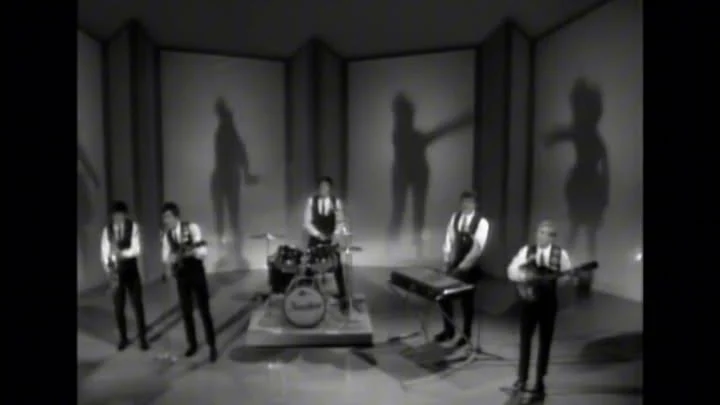
Imagine a crowded dance floor late at night. The lights are low and conversations have faded into a low murmur. Then a two note bass pattern rises from the speakers like a secret being told. A snare drum cracks down on the beat, a kick drum follows, and the crowd responds as one body. It is 1965 all over again and no one can help the smile that takes over.
That song is Over and Over and the band behind it is The Dave Clark Five. It became their only number one single in the United States, an extraordinary achievement for a group that had been part of the first wave of the British Invasion. The track was a cover of a 1958 R&B tune by Robert James Byrd, better known to music fans as Bobby Day. The DC5 took the gentle original and turned it into something entirely their own, a compressed explosion of rhythm and shouts.
The band had already made a name for itself with hits like Glad All Over and Bits and Pieces in 1964. By late 1965 the musical world was beginning to shift toward psychedelia and folk rock. The Beatles were exploring new textures on Rubber Soul and the Rolling Stones were moving into darker blues territory. Yet The Dave Clark Five refused to chase those trends. They stayed locked into their hard charging maximalist sound, a thumping anchor from Tottenham.
Much of that consistency came from the man at the center of the operation. Dave Clark was not just the drummer and the official face of the group. He was also the manager, the publisher, and the producer. That level of control was almost unheard of in the mid sixties. It allowed Clark to negotiate favorable royalty rates and, perhaps just as important, to protect the band’s sonic identity across every release. The group released its American recordings on Epic and the label moved quickly to put out singles and albums while the DC5 were still climbing.
Over and Over arrived as a standalone single in November 1965 and also appeared on the US album I Like It Like That that same month. It was a full circle moment, a nod back to the American R&B that had inspired the British Invasion in the first place, but filtered through a very specific London sound. That sound was created at Lansdowne Studios with engineer Adrian Kerridge. In the early days Clark took the recording credit as Adrian Clark, a small trick that kept him in the control room without drawing attention to just how hands on he really was.
The strength of Over and Over lives in its arrangement more than its melody. The original song had a gentle doo-wop lilt. The DC5 stripped that away and replaced it with a relentless rhythmic attack. Clark’s drumming is often described as blunt, but here it is magnificent. The snare hits are thick and heavy, almost like a plank of wood being slammed against a floor. The kick drum keeps a straight four on the floor pulse while the bass guitar locks into a simple two note pattern. The result feels physical, like a push you can lean into.
Mike Smith, the late great singer, was the man tasked with riding that wave of sound. His voice was a leathery and powerful baritone, capable of surviving the full force of Clark’s production. On Over and Over he delivers each line with clipped efficiency and open joy. The rest of the band responds with shouted backing vocals, creating a call and response energy that makes the record feel live. It captures the theme of repeated romantic attempts at a party, a simple idea delivered with total conviction.
The instrumentation stays lean throughout. Lenny Davidson plays sharp and choppy guitar rhythms while Rick Huxley anchors the bass line. The secret weapon is Denis Payton’s saxophone. It does not glide like a jazz horn or honk like early rock and roll. It whirs and buzzes, doubled with Smith’s bright and clangorous piano. Together they form a secondary melodic hook that darts around the vocal and gives the record its frantic energy.
To truly appreciate Over and Over today, you need a sound system that can handle dynamics. The compression on the record is extreme and everything is pushed right up against the red. On a modern home audio setup with some serious power, the song still sounds revolutionary. It is a two minute thriller designed for maximum volume and maximum impact.
The Dave Clark Five are sometimes written off as the safe alternative to the Beatles and the Stones. They were indeed clean cut and they did appear on The Ed Sullivan Show twelve times. But that reading forgets how much tension and noise they packed into their records. Over and Over gave them their only number one in the United States, a moment that validated their stubborn belief in their own sound. Back home in the UK the song did not top the chart but that did not seem to matter. It became a lasting proof that directness and energy could still win the day.
This is the sound of pure unpretentious velocity, captured and compressed for maximum dance floor impact.
I remember being a teenager and spending hours in record stores, hunting for singles that had not been played to death on the radio. Finding an original Epic 45 of Over and Over felt like digging up a treasure. The paper sleeve was worn and the vinyl had a few scuffs, but the music exploded out of the speakers with the same force it must have had in 1965. It connected me to the raw energy of the British Invasion in a way that no greatest hits collection could. Even now, cueing it up on a streaming service clears the room of boredom in the first few seconds.
This is rock and roll as kinetic energy, simple and irresistible. The song reduces life’s complications to a shouted chorus, a bouncing sax line, and a beat that never gives up. The Dave Clark Five understood exactly what they were good at and they delivered it without apology. More than half a century later, Over and Over still has the power to make a crowded bar move as one. That is the definition of a timeless record.
For anyone who loves that sound, a few related tracks come to mind.
Bits and Pieces from 1964 by The Dave Clark Five. This track features the same iconic stomping drum sound and Mike Smith’s powerful vocal delivery.
Do You Love Me by The Contours from 1962. An American R&B song that the DC5 also covered, sharing that driving and party ready energy.
I’m Telling You Now by Freddie and the Dreamers from 1965. A high energy and infectious British Invasion track with a less aggressive but equally upbeat tempo.
She’s Not There by The Zombies from 1964. A more sophisticated and keyboard driven contrast that shows the movement’s diversity.
Little Deuce Coupe by The Beach Boys from 1963. It shares the same straightforward short form structure and youthful exuberance.
Gloria by Them from 1964. A primal repeating riff and garage rock grit that defines mid sixties beat music.