
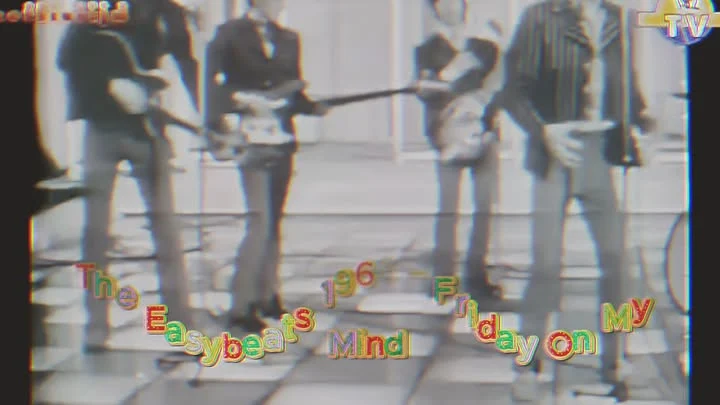
The moment the needle drops, time itself seems to hold its breath. A cymbal crash slices through the silence, and then a dry, almost angry guitar figure begins its relentless march. It is the sound of every Monday morning, every tedious commute, every fluorescent-lit office. But within seconds, that tension explodes into a riff so liberating it feels like a jailbreak. This is “Friday On My Mind,” the 1966 anthem that turned the mundane promise of a weekend into a global declaration of freedom.
The Easybeats were no strangers to success. They had already conquered Australia, a band of immigrant teenagers from Europe and England who had found a new home in Sydney and a sound that captured the restless energy of a generation. But as 1966 dawned, they found themselves in London, trading their status as hometown heroes for a desperate gamble in the world’s most competitive music scene. Their entire future rested on a single record, a two-and-a-half-minute burst of pure, anticipatory joy.
That record was born from a partnership that would define Australian rock for decades. Harry Vanda and George Young, the elder brother of AC/DC’s Angus and Malcolm, had just begun their songwriting collaboration. Working with producer Shel Talmy, the man who had sharpened the edges of The Kinks and The Who, they crafted a song that was both raw and polished, a perfect fusion of garage rock aggression and British Invasion melody.
The greatest escape song ever written is not about running away, but simply waiting for the clock to strike five.
The track opens with a sparse, almost claustrophobic arrangement. Singer Stevie Wright delivers his lines with a clipped, muttering resentment, cataloguing the days of the week like a prisoner marking time. “Monday morning, feels so bad,” he sings, his voice tight with frustration. The rhythm section, anchored by bassist Dick Diamonde and drummer Gordon “Snowy” Fleet, provides a solid, unyielding foundation. There’s no piano here, no soft textures. This is grit, propulsion, and the sound of a man counting down the hours.
Then, at the perfect moment, the main riff crashes in. Vanda’s guitar unleashes a series of staccato, minor-key bursts that are both explosive and melodic. It is the sound of the clouds breaking, the promise of freedom. The dynamics shift dramatically as the chorus arrives, a cascade of harmony vocals that transforms the song into a collective, joyous shout. The contrast is masterful: the verse is confined and intimate, while the chorus explodes with bright, reverb-soaked energy. This is Talmy’s genius—an arrangement that mirrors the emotional journey from drudgery to euphoria.
Structurally, the song is a lesson in economy. The first verse covers Monday through Friday, while the second leaps directly to the glorious anticipation of Friday night. A brief, baroque-inspired bridge adds a touch of psychedelic color before the final rush to the end. Every bar serves a purpose, every note pushes forward. It is a textbook example of a perfect pop single, a succinct and thrilling narrative arc delivered with maximum impact.
The recording itself is a marvel of clarity and power. When heard through high-quality audio equipment, the tightness of the rhythm section becomes astonishingly clear, a granite foundation beneath the strikingly aggressive lead guitar. The song bridges two worlds—the raw energy of garage rock and the melodic sophistication of the British Invasion—creating a sound that felt both universal and distinctly Australian.
Released in the UK in October 1966, “Friday On My Mind” was an immediate success, reaching the top ten. In the United States, it climbed into the top twenty on the Billboard Hot 100, becoming the band’s only major American hit. The song’s theme—the universal desire to clock out and reclaim one’s life—transcended borders, languages, and cultural scenes. It spoke to factory workers, office drones, students, and dreamers everywhere.
The legacy of this single extends far beyond its initial chart performance. Vanda and Young would go on to shape the sound of Australian rock, producing and writing for a generation of bands, including AC/DC. But “Friday On My Mind” was their first international statement, proof that music from the other side of the world could compete on equal terms with the best of London and New York. It remains a timeless celebration of that shared, impatient joy that comes with the end of the working week.
The song’s final crescendo, with Wright’s voice straining in exultation, gives way to a crashing fade-out that leaves you breathless. The tension is spent, the promise fulfilled. Like the Friday night it celebrates, the experience is swift, thrilling, and over far too soon. It begs for immediate repetition—a quick drop of the needle back to Monday morning, just to experience the sheer thrill of Friday’s arrival all over again.
For those eager to explore the world that gave birth to this masterpiece, consider these essential listens:
The Who – “My Generation” (1965) shares producer Shel Talmy and a similarly rebellious, driving energy. The Kinks – “Where Have All the Good Times Gone” (1965) captures a comparable mood of working-class longing with a touch more melancholy. The Small Faces – “Sha-La-La-La-Lee” (1966) delivers the same high-octane mod-pop urgency. The Move – “I Can Hear The Grass Grow” (1967) offers a psychedelic twist on the hard-edged sound, while Stevie Wright – “Evie (Part 1)” (1974) shows the direct lineage of Vanda and Young’s immense, propulsive rock production years later.
Decades on, “Friday On My Mind” still pulses with the electricity of its creation. It is a reminder that sometimes the most profound human emotions are found not in grand gestures, but in the simple, shared experience of waiting for the weekend. And for those few minutes, as the riff ignites and the chorus soars, we are all together in that glorious, breathless anticipation.