
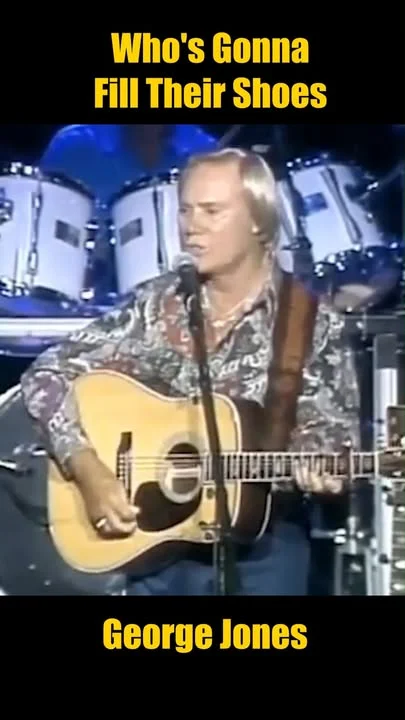
Who’s gonna fill their shoes? Who’s gonna stand that back down? Who’s gonna play the Opry and the Wabash Cannonball?
In the fading twilight of 1985, country music faced a question that echoed far beyond the Grand Ole Opry stage. George Jones, a voice weathered by heartbreak and honky-tonk wisdom, released a song that stopped the industry in its tracks. “Who’s Gonna Fill Their Shoes” wasn’t just another track on an album—it was a haunting meditation on mortality, legacy, and the soul of an entire genre.
The story begins with two songwriters from Nashville’s hallowed Hall of Fame: Troy Seals and Max D. Barnes. They penned a lyric that reads like a eulogy for the greats—Hank Williams Sr., Lefty Frizzell, Elvis Presley—and a challenge to anyone who would follow. Jones, then at the peak of his own legendary status, took those words and made them his own. The result was the title track for his 45th studio album, a record that would become a cornerstone of his celebrated career.
The song opens with a guitar riff that feels both simple and profound—a lone instrument carrying the weight of memory. Traditional country instrumentation blends with a crisp, contemporary production style, creating a soundscape that honors the past while looking forward. Jones’ baritone enters with a sincerity that only decades of singing could bring. Every note feels earned.
Lyrically, the piece is a roll call of the departed legends. Jones doesn’t just name them; he paints vivid scenes: the Opry stage, the faint echo of the Wabash Cannonball, the gap left when a giant steps off the earth. But the song isn’t stuck in nostalgia. The final verse offers a quiet resilience: “The heart of country music still beats on.” It’s a statement of hope, a belief that the spirit of the genre is too strong to fade.
For fans across generations—from those who grew up with the golden age of country to young listeners discovering its roots—“Who’s Gonna Fill Their Shoes” became a touchstone. It addressed a universal fear: that the authenticity and grit of traditional country might be lost in a changing world. Yet it also affirmed that the torch would always find new hands.
Today, the song remains a powerful testament. It is a tribute to the giants who shaped country music, and a reminder that George Jones himself is among them. More than three decades later, we still listen—and we still ask the question.