
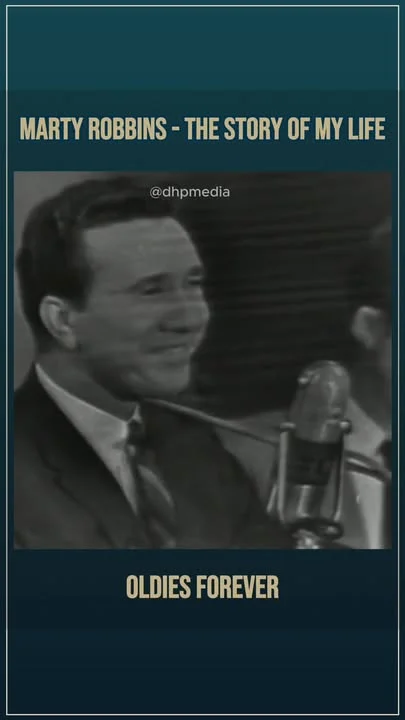
There are moments when a song becomes more than melody and lyric, turning into a window on a life fully lived. Marty Robbins understood this. In 1957 he released a single that captured that very feeling, a track so deceptively simple yet so deeply resonant that it still transports listeners to a time when heartbreak and hope walked hand in hand. The Story Of My Life is not just a country song. It is a confession, a love letter, and a masterclass in musical storytelling.
The story of my life is very simple, the story of my life is love
That line, delivered with absolute conviction over a lush orchestral bed, holds the entire weight of the tune. Robbins was already a proven star, but this release from Columbia Records cemented his ability to cross boundaries. Just months earlier he had scored his first true pop crossover hit with A White Sport Coat and a Pink Carnation. The label, guided by legendary A and R man Mitch Miller, saw a path to broader audiences. This single became number one on the Country charts and reached the US Pop Top 15. It proved that Robbins could wear the white sport coat as comfortably in a Nashville honky tonk as on a New York stage.
The most remarkable element of The Story Of My Life, however, is not Robbins silky understated vocal. It is the pedigree of the song itself. This track represents one of the first successful collaborations between the legendary songwriting duo of Burt Bacharach and Hal David. Before the era of Dionne Warwick and countless sophisticated pop masterpieces, they delivered this earnest, deceptively simple countrypolitan gem. It is a stunning example of how great songwriting can transcend its intended genre.
From the first notes it is clear this is not simple three chord country music. Arranged by the inimitable Ray Conniff and his orchestra, the sound is huge yet carefully controlled. Even now, the production makes the listener lean closer, trying to decipher every shimmering layer. The core of the arrangement is Robbins voice, direct and unvarnished, almost conversational, against an astonishing sonic tapestry. The rhythm section lays down a gentle walking beat, but the space around it is filled with texture. A subdued, almost jazzy piano offers subtle harmonic complexity, providing a foundation that is more pop than pure country. This is immediately contrasted by the sweeping dynamic presence of the strings. They do not just accompany; they narrate, swelling and receding like emotional tides.
Then there is the element that lifts the entire recording into the ether: the whistling. Provided by the Ray Conniff Singers, this unexpected vocal texture is pure mid century cool. It is an airy, almost carefree counterpoint to the seriousness of the orchestral backing. A brilliant moment of contrast that keeps the potentially saccharine arrangement grounded and genuinely charming.
The song does not simply tell a story. It feels like the intimate, retrospective narration of an old movie, scored for maximal emotional impact.
The arrangement is a masterclass in dynamic contrast. When Robbins sings of sorrow, the strings are hushed, a minor key veil drawn over the proceedings. When he hits the bridge, the orchestra hits a gentle magnificent climax. It showcases the breadth of Robbins vocal talent, allowing him to be both the vulnerable troubadour and the sophisticated balladeer.
The Story Of My Life is often included on greatest hits compilations, but it was originally a standalone single, a pivotal stepping stone in Robbins long and successful career. That career would eventually lead to the panoramic story songs of the Gunfighter Ballads album. This particular recording shows an artist perfectly poised between two worlds: the authentic country of his Nashville base and the glossy pop production of the New York Brill Building era.
Modern listeners who discover this track might expect a lo fi country song. Instead they get a lush panoramic soundscape. It is an exercise in sonic rediscovery, a reminder that the late 1950s were a time of rapid fascinating hybridization in popular music. Marty Robbins was not just a singer. He was a sonic diplomat, capable of delivering a tender personal message through the grandest possible orchestral vessel.
The instrumental contributions are subtle yet vital. Robbins was a prodigious guitar player, and though the driving rhythm is muted here in favor of the ensemble, the careful strumming provides a pulse. Several uncredited guitarists on the session avoided the sharp electric twang of rock and roll, favoring a warm rounded timbre that blends seamlessly with the Conniff string section.
The durability of this song lies in its earnestness. It is a song about taking stock, about identifying the singular thread that connects all life disparate moments: love. It is an uncomplicated emotional statement delivered with absolute conviction. It serves as an excellent example for anyone taking guitar lessons in how restraint can be more powerful than flash. The melody is catchy, memorable, and deceptively simple, the kind of classic composition that can be played with just a handful of chords but gains immeasurable depth when placed in the hands of an arranger like Ray Conniff.
Today, when those opening softly pulsing chords begin, it is not just a hit single from 1957 that is heard. It is a moment of collaboration, a fusion of genres, and the sound of a major artist bravely stepping across a dividing line to claim new territory. It stands as a testament to the fact that great songwriting, like that of the young Bacharach and David, can transcend its intended genre and find its voice through the perfect interpreter. In this case, the velvet lined heartbreak of Marty Robbins.
To fully appreciate this moment in music history, consider listening to these companion tracks. Marty Robbins own A White Sport Coat and a Pink Carnation is the direct antecedent, a slightly more rockabilly tinged country pop smash that paved the way. Guy Mitchell Singing the Blues is another Mitch Miller produced Columbia hit featuring Ray Conniff orchestration. Conway Twitty It Only Make Believe shares the dramatic earnest vocal passion and orchestral backing. Bobby Vee Take Good Care of My Baby is a pure Bacharach David pop song showing their signature melodic style in a polished arrangement. Jim Reeves Hell Have To Go exemplifies the smooth deep voiced Nashville sound that became dominant for crossover country ballads in the early sixties.