
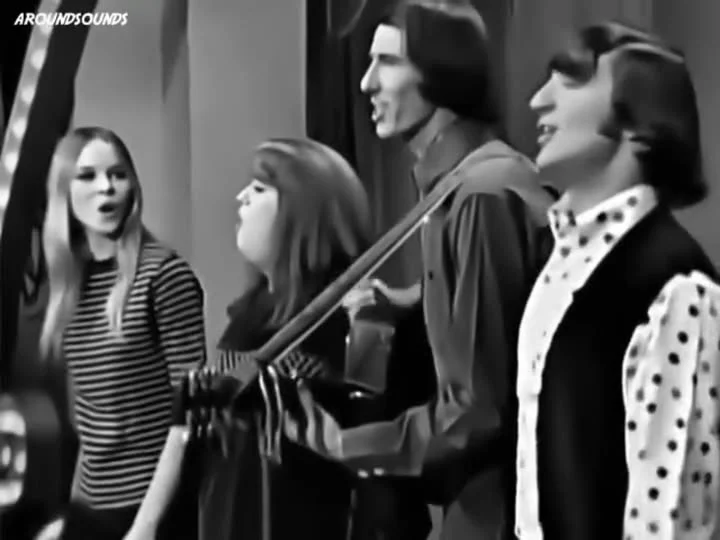
There is a moment in every life when the sky turns gray and the heart aches for something warmer, something brighter, something that feels like home. For millions of listeners across generations, that feeling has a soundtrack: the haunting harmonies of a song born on a freezing New York night in the mid-1960s. What began as a whispered longing between two musicians would become an eternal anthem of hope and escape.
In the winter of 1965, Michelle Phillips turned to her husband John Phillips during a bitter cold spell in Manhattan and confessed how desperately she missed the golden light of California. That simple confession, shared on a frigid evening, became the seed of a cultural landmark. John began sketching lyrics that same night, transforming his wife’s shivers into poetry. The result was a song that would transcend its origins to become something far greater than a weather complaint.
The Mamas & The Papas emerged from this creative moment with a sound that defied easy categorization. John and Michelle Phillips, alongside Denny Doherty and Cass Elliot, had roots in the earnest folk scenes of the East Coast, where Bob Dylan and Joan Baez reigned supreme. But this group wanted something different. They craved a musical language that could carry folk’s emotional depth while embracing pop’s accessibility and rock’s restless energy. Their harmonies became the vehicle for that vision.
All the leaves are brown and the sky is gray. I’ve been for a walk on a winter’s day.
These opening lines paint a scene so vivid it feels like a memory. The desolation is almost cinematic: a cold world stripped of color and warmth. But the song quickly reveals its deeper purpose. This is not merely about seasonal discontent. The longing for sunlight becomes a metaphor for something far more profound: the universal human craving for transformation, for a place where dreams can actually take root.
The line If I didn’t tell her, I could leave today introduces a tension that gives the song its emotional power. Here is a soul caught between obligation and adventure, between the safety of what is known and the magnetic pull of possibility. This is the eternal struggle of the human spirit, wrapped in a melody that makes surrender inevitable.
Musically, the arrangement works like a spell. A somber acoustic guitar sets the stage, its melancholy tones establishing an atmosphere of quiet yearning. Then comes the tambourine, subtle and insistent. And then, the flute. In an era when pop songs rarely featured such an instrument, California Dreamin’ dared to be different. The flute solo floats through the track like a whispered promise, creating a soundscape that feels both haunted and hopeful, as if calling listeners toward an enchanted world just beyond the horizon.
The vocal harmonies remain the song’s crowning achievement. Denny Doherty’s lead vocals provide a grounded foundation, full-bodied and earnest. Cass Elliot’s rich alto wraps around the melody like a warm blanket. Michelle and John Phillips weave their voices in perfect synchronization, creating a texture that is simultaneously intimate and expansive. These harmonies became the collective voice of everyone who has ever dreamed of something more.
In the cultural landscape of the 1960s, California represented something almost mythical. The state was more than geography; it was a symbol of freedom, of countercultural rebellion, of creative possibility. From the surf beaches to Haight-Ashbury, from the Hollywood hills to Laurel Canyon, California drew artists, dreamers, and rebels from across America. It became the destination for a generation seeking peace and purpose amid the chaos of the Vietnam War, civil rights struggles, and the collapse of old certainties.
The Mamas & The Papas captured this cultural moment perfectly. Their song became the soundtrack for a generation’s pilgrimage toward hope. It reached No. 4 on the Billboard Hot 100, but its influence extended far beyond chart positions. The track has been reinterpreted by countless artists spanning genres from rock to jazz, each version revealing new dimensions of its enduring appeal.
Cover versions by The Beach Boys, Wes Montgomery, and countless others demonstrate the song’s remarkable versatility. It has appeared in films, television shows, and commercials, often serving as shorthand for nostalgia, rebellion, or the bittersweet beauty of chasing an ideal. Each appearance reinforces its status as a cultural touchstone, a piece of music that instantly evokes a particular kind of longing.
California Dreamin’ endures because it speaks to something fundamental in the human experience: the belief that somewhere else, life might be warmer, freer, better.
That is why the song still resonates today, decades after its creation. When the leaves turn brown and the sky goes gray, millions of people still find themselves dreaming of California. Not necessarily the physical place, but the idea of it: a state of mind where possibility remains alive, where escape is always within reach, where the heart can finally feel whole.
California Dreamin’ was never just about missing sunshine. It is a song about the endless human search for belonging, for transformation, for a place that feels like destiny. It is the sound of hope itself, wrapped in harmony and carried on a flute melody that seems to float forever toward the sun.
And that is why, more than half a century later, we are still dreaming.