
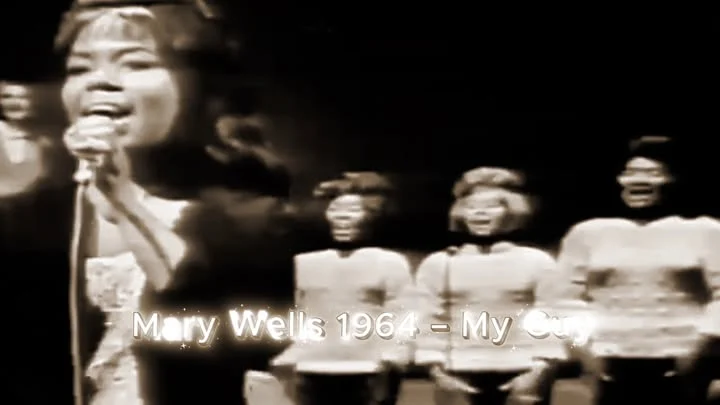
The greatest tragedy of Mary Wells’ departure from Motown is that she left behind the one creative infrastructure built perfectly for her extraordinary voice. And the vehicle for that voice, a buoyant and irresistible piece of music, was about to become her glorious final bow for the label.
The air in the Detroit studio was thick with possibility. It was early 1964, and Hitsville U.S.A. was already a hit factory, but something was different with this session. Mary Wells, Motown’s undisputed Queen, had been the label’s first solo superstar, the sophisticated, slightly smoky voice behind a string of immaculate singles. But there were whispers, the kind that travel fast through Detroit’s cold streets and even faster through the close-knit family of Motown artists. She was approaching twenty-one, and a clause in her contract allowed her to walk away.
My Guy, released in March 1964, is more than just a song; it is a pivot point in the Motown narrative. Written and produced by Mary’s longtime collaborator, Smokey Robinson, the partnership had yielded a breathtaking run of successes that practically built the Motown sound as we know it. The track rocketed to the top of the Billboard Hot 100, becoming her biggest-ever solo hit and even managing to dislodge the iron grip the Beatles had on the charts at the time.
The song’s genius lies in its deceptive simplicity. It opens not with a roar, but with a playful, almost intimate melodic borrowing, a nod to the 1956 instrumental hit Canadian Sunset. This borrowed phrase, played by the session’s piano, sets a tone of wistful, knowing romance before the groove even begins to snap. Then, the Funk Brothers, the label’s legendary in-house band, drop in. The rhythmic foundation is pure brilliance. James Jamerson’s bass line, a nimble, calypso-flavored pulse, is the song’s lifeblood, a masterclass in melodic low-end that never settles for a simple root note. It is the rhythmic anchor around which the entire, effervescent structure dances.
Lyrically, Robinson captures an eternal truth of young love with the utmost economy. The woman in the song is not oblivious to other men, the cutest boys and rich as could be suitors are all acknowledged. But they are dismissed with a dismissive wave of the hand, because she has her guy. Mary Wells delivers these lines with an air of absolute certainty, a knowing confidence that elevates the sentiment from teenage crush to genuine, mature devotion.
Nothing you could buy could tempt me.
Her vocal timbre here is sublime. It is less the dramatic soul-scream of some contemporaries and more a warm, crystalline murmur, effortlessly agile as it skips across the beat. The song showcases her impeccable phrasing, a signature trait of her collaboration with Robinson. When she asks, the conviction in her voice is palpable, creating a powerful contrast between the external material world and the singular value of her bond.
The arrangement is a study in texture and restraint, a hallmark of Robinson’s production. The drums, played by Benny Benjamin, provide a crisp, slightly martial backbeat, allowing the syncopation in the bass and rhythm guitar to provide the swing. The backing vocals, likely provided by the marvelous Andantes, offer playful, call-and-response declarations that are interwoven perfectly with Mary’s lead. They frame her confession, turning a solo thought into a shared, universal truth. It is a dense but never cluttered sonic space, utilizing every instrument economically.
The overall dynamic is bright and forward, a perfect slice of mid-sixties premium audio that sounds fantastic even streaming from a phone decades later. The recording captures a remarkable sense of presence, almost putting the listener right in Studio A at Hitsville, Detroit. The horns, punchy, confident, and perfectly scored, emerge in staccato bursts during the instrumental break, giving the track its final layer of pop gloss. It is this precise blend of gritty soul rhythm and polished, orchestral pop that defined the burgeoning Motown Sound for the world.
The album, Mary Wells Sings My Guy, was released shortly after the single, and while the rest of the tracklist might have leaned on standards and other filler, the title track stands alone as the summation of her brilliance at Motown. It is the glorious zenith before the sudden, sad arc of her career shift. She was invited to join The Beatles on their 1964 UK tour, a testament to the song’s international reach, making her the first Motown artist to tour with the Fab Four. She was at her absolute peak.
Her decision to leave Motown, motivated by a desire for more control and higher royalties, marked the beginning of her commercial decline. The fact that her biggest hit, a song about unwavering loyalty, became the catalyst for the end of her most successful partnership with the label is a piece of cosmic irony that still stings.
It is easy to hear the song today as pure nostalgia, a track tailor-made for weddings and movie montages. But a deeper listen reveals the tension and triumph within it. The track’s rhythmic complexity offers an endless depth for analysis, the kind that might prompt an aspiring musician to consider diving into dedicated guitar lessons just to decode the Funk Brothers’ tight interlock. It remains a blueprint for how to craft a perfect pop single using the language of rhythm and blues. It is a flawless artifact of a perfect creative union, captured just before the bond dissolved. Wells would never again replicate the chart success or the cultural impact she achieved with Smokey Robinson and the Motown machine. But in My Guy, she left us with an absolute standard.