
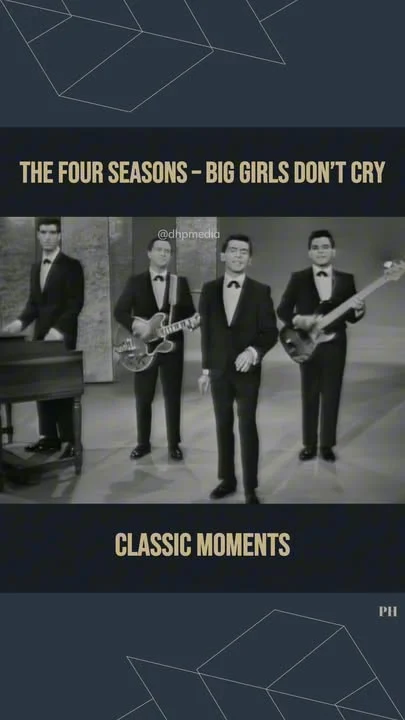
“Big girls don’t cry… They don’t cry.”
That haunting, defiant refrain wasn’t just a lyric—it became a generational mantra. Born from an unlikely Hollywood moment, “Big Girls Don’t Cry” transformed The Four Seasons into legends and reshaped the sound of an era. In 1962, as America stood on the cusp of cultural revolution, a song that dared to celebrate strength over sorrow stormed the charts, anchoring itself at number one for five straight weeks.
The spark came from a 1955 film Tennessee’s Partner. Bob Gaudio, the group’s brilliant songwriter, was watching when a character casually uttered the line, “Big girls don’t cry.” He recognized its raw, magnetic power. Teaming with producer Bob Crewe, Gaudio turned a simple movie quote into a timeless anthem. The lyrics narrate a tale of heartbreak—but twist it toward self-empowerment. The protagonist urges himself to move on, repeating the phrase as both a command and a comfort. It was a message that echoed deeply in the early 1960s and has only grown more layered with time.
Frankie Valli’s falsetto—soaring, crystalline, yet human—was the song’s secret weapon. That voice, backed by the band’s tight harmonies, created an instantly recognizable sound. The production itself was a masterclass in minimalism: multilayered vocals over sparse instrumentation, letting Valli’s emotional delivery carry every note. This innovation set The Four Seasons apart during the British Invasion, proving American pop could hold its own against even The Beatles.
The cultural influence of “Big Girls Don’t Cry” reaches far beyond its initial chart run. Its catchy chorus and nostalgic beat made it a staple in films, television, and commercials. It became the heart of the jukebox musical Jersey Boys, which introduced the song’s story to new generations. Covers and tributes continue to spring up, each one proving the track’s hook is as durable as its theme.
What gives the song its lasting power is its emotional honesty. It doesn’t wallow in despair. Instead, it offers a quiet, resilient nod to the strength required to move forward. In an age where mental health and emotional intelligence are openly discussed, the phrase “big girls don’t cry” can be re-read as a call to personal fortitude—not suppression, but endurance. For anyone navigating heartache, it remains a gentle reminder that strength and vulnerability can coexist.
Financially, the song cemented The Four Seasons as icons. Its success gave them the resources to experiment, tour, and produce more hits, allowing them to push creative boundaries without sacrificing their signature sound. This stability let them evolve while keeping the core qualities that fans adored.
Streaming platforms today have given “Big Girls Don’t Cry” a second life. Younger audiences discover it on playlists that celebrate classic pop and rock and roll, while older listeners revisit it as a warm echo of a golden age. Its message of resilience and its infectious melody transcend generations, making it as relevant now as it was over sixty years ago.
The Four Seasons didn’t just create a hit; they crafted a musical artifact. “Big Girls Don’t Cry” remains an anthem of quiet strength, a reminder that the most powerful songs don’t fade—they evolve with the times, always ready to comfort, inspire, and endure.