
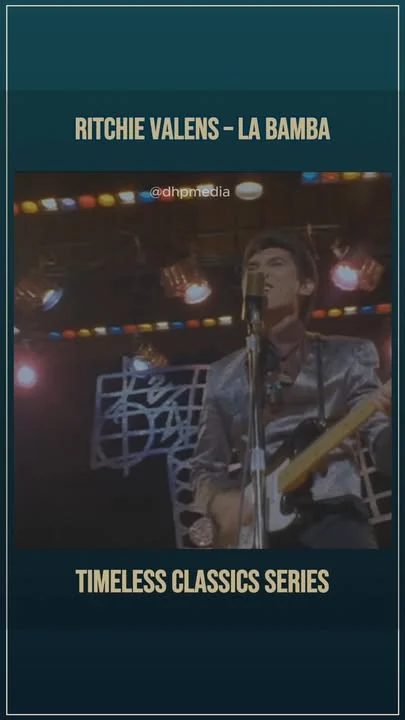
February 3, 1959, remains etched in the collective memory of music lovers as the day the world lost three rising stars in a single plane crash. Among them was a 17-year-old Chicano teenager from Pacoima, California, whose name would become synonymous with cultural fusion and rock and roll innovation. That young man was Ritchie Valens, and his groundbreaking rendition of “La Bamba” had already begun to rewrite the rules of popular music before his life was tragically cut short. Yet even in that brief moment under the spotlight, Valens managed to plant a seed that would grow into a legacy of enduring influence, bridging worlds that were once separated by language, heritage, and genre.
At its core, Valens’ “La Bamba” was not merely a song but a revolutionary act of reimagining tradition. The origins of this iconic track stretch back centuries, born as a lively son jarocho from the Veracruz region of Mexico. That folk melody, with its playful and often improvised lyrics, was a dance tune carried by the rhythms of Spanish, indigenous, and African influences. Originally performed with instruments like the jarana and requinto, it thrived in the context of communal celebration. But Valens saw something different in it—a raw energy that could be harnessed with electric guitar and a rockabilly beat. He took the essence of an ancient folk song and infused it with the pulse of a new era, creating a sound that had never been heard before.
In the 1950s, the American music landscape was largely dominated by white and African-American artists, with Latino voices almost invisible on mainstream charts. Ritchie Valens, born Richard Steven Valenzuela, broke through that barrier with a quiet confidence and an unmistakable talent. While he did not speak fluent Spanish, his connection to his Mexican heritage ran deep. That bond found expression in his music, and his adaptation of “La Bamba” was a bold declaration of cultural pride. With every strum of his guitar and every passionate vocal line, Valens introduced a wider audience to the richness of Mexican folk traditions, proving that a song’s meaning could transcend literal understanding. His work laid the foundation for what would later be celebrated as Chicano rock, inspiring pioneers like Carlos Santana and Los Lobos.
“Para bailar La Bamba, se necesita una poca de gracia…”
The version we know today opens with a guitar riff that immediately hooks the listener, a rhythmic jolt that pulls you into the dance. Valens transformed the traditional melody into a high-energy rock number while retaining the infectious groove of its son jarocho roots. When it hit the airwaves in 1958, “La Bamba” climbed to number 22 on the Billboard Hot 100, a remarkable achievement for a Spanish-language track in an era when such songs were rarely given airtime. Its cross-cultural appeal was undeniable—the beat, the melody, and Valens’ charismatic delivery spoke a universal language that resonated with audiences from all walks of life. The song’s success sent a powerful message: music truly has no bounds.
For the Mexican-American community, Valens’ rise was a source of immense pride. His television appearances and live performances were not just musical showcases but celebrations of a heritage that had been too often marginalized. Young Latinos saw themselves reflected in his story—a teenager who embraced his roots while navigating the American dream. That pride was amplified by the song’s enduring popularity, which remains a dancefloor staple and a symbol of unity. “La Bamba” became an anthem that connected generations, proving that authenticity and cultural expression could find a place in the mainstream without compromise.
The legacy of Valens’ work extends far beyond the charts. His bold blend of folk and rock anticipated the genre-crossing experiments of later decades, opening doors for non-English songs to flourish in American pop. The influence of “La Bamba” can be felt in countless covers and reinterpretations, most notably the 1987 version by Los Lobos, which reached number one and introduced the song to a new generation. But even that cover, brilliant as it is, only amplifies the original’s brilliance—a testament to Valens’ vision and the timeless quality of his creation.
Tragically, Ritchie Valens’ career was as brief as it was impactful. His untimely death alongside Buddy Holly and The Big Bopper on that fateful day in Iowa marked the end of a journey that had barely begun. Yet his music refused to fade. “La Bamba” lives on as a bridge—between cultures, languages, and ages—reminding us that the most powerful art often emerges from the intersection of heritage and innovation. Valens may have left this world at just 17, but his spirit, and the rhythm he immortalized, continue to pulse through the very heartbeat of rock and roll.
Today, when we hear the opening riff or sing along to the familiar words, we are not merely listening to a song. We are witnessing a cultural milestone, a moment when a teenager from Pacoima dared to dream beyond borders and redefine what a hit could be. “La Bamba” remains a timeless anthem of pride and possibility, a melodic reminder that the world is richer when we embrace our differences and dance together.
Lyrics
Para bailar La Bamba
Para bailar La Bamba
Se necesita una poca de gracia
Una poca de gracia
Pa’ mí, pa’ ti, ay arriba, ay arriba
Y arriba, y arriba
Por ti seré, por ti seré, por ti seré
Yo no soy marinero
Yo no soy marinero, soy capitán
Soy capitán, soy capitán
Bamba, bamba
Bamba, bamba
Bamba, bamba, bam
Para bailar La Bamba
Para bailar La Bamba
Se necesita una poca de gracia
Una poca de gracia
Pa’ mí, pa’ ti, ay arriba, ay arriba
Para bailar La Bamba
Para bailar La Bamba
Se necesita una poca de gracia
Una poca de gracia
Pa’ mí, pa’ ti, ay arriba, ay arriba
Y arriba, y arriba
Por ti seré, por ti seré, por ti seré
Bamba, bamba
Bamba, bamba
Bamba, bamba