
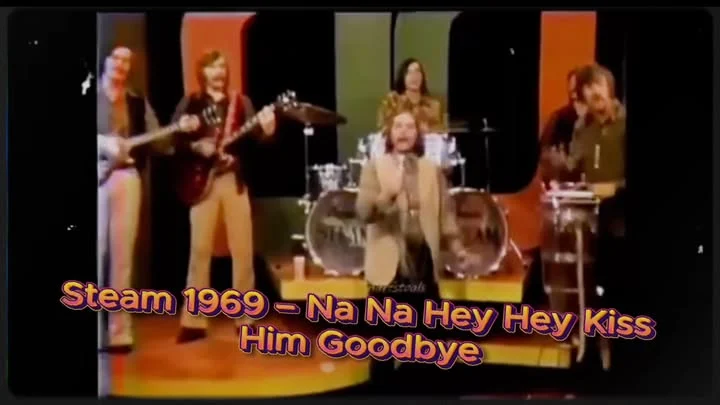
The song that would become a global anthem of dismissal and celebration was never supposed to exist. In a dimly lit New York studio during the autumn of 1969, three exhausted music professionals scrambled to create something disposable. Paul Leka, Gary DeCarlo, and Dale Frashuer had four finished tracks ready for Mercury Records—songs they believed in deeply. But the label demanded a B-side for one of the singles, and the deadline was immediate. What emerged from that pressure-filled night would haunt its creators and delight millions for decades to come.
The irony of the track credited to the phantom band Steam is almost cinematic in its cruelty and beauty. These professional musicians deliberately tried to bury a song beneath layers of studio improvisation, hoping it would sink without a trace. Instead, it became their immortality.
It is a piece of music whose sheer, unadulterated simplicity is its own powerful form of genius.
The recording soared to number one on the Billboard Hot 100 in late 1969, displacing even The Beatles‘ “Come Together” for a two-week reign at the summit.
The foundation of this pop phenomenon was an abandoned blues-shuffle fragment from the trio’s earlier days in a Connecticut doo-wop group called The Chateaus. Titled simply “Kiss Him Goodbye,” the piece needed radical expansion. Leka became the architect of what can only be described as a pop contraption—a mosaic of studio ingenuity rather than a live performance. There was no dedicated drummer on the final recording. Instead, Leka and engineer Warren Dewey spliced together a drum track from an entirely different session, adding a conga solo that feels transported from a tropical dimension far removed from the song’s bubblegum soul.
The resulting groove is deceptively simple—a relaxed, insistent chug that provides the head-nodding pulse for all the melodic action. DeCarlo‘s vocal, delivered under the alias Garrett Scott on the intended A-sides, became the emotional anchor. His voice balances pleading vulnerability with defiant swagger, narrating a classic pop scenario: a spurned lover consoling a woman whose new man has betrayed her trust. “He’ll never love you the way that I love you / ‘Cause if he did, no no, he wouldn’t make you cry.”
The melodic texture rests on Leka‘s keyboard work—bright, almost tinny, driven by a simple chord progression that supports the vocal without competing for attention. Occasional guitar phrases surface, brief blues-inflected licks that add a rock edge to the smooth pop confection. The track thrives on contrast: a heartfelt vocal floating above a purely synthetic, jerry-rigged arrangement.
The legendary chorus emerged from pure necessity. Leka needed to extend the song to a commercially viable length. He sat at the piano, began vocalizing placeholder syllables, and out tumbled the eight-bar phrase that would define an era. “Na na na na, na na na na, hey hey, goodbye.” DeCarlo joined in with the “hey heys,” and the dummy lyrics became the entire point of the exercise. Mercury Records recognized the hook’s potency immediately, flipping the single and placing the disposable track on the A-side. The band received the name Steam, inspired by the vapors rising from manhole covers near the studio.
The song’s true second life began years later in an unexpected arena. Nancy Faust, an organist for the Chicago White Sox, began playing the chorus as an anthem of dismissal for defeated teams. The crowd caught on instantly, and the simple melody transformed into a stadium chant. This translation from pop single to communal ritual represents the ultimate testament to the chorus’s primal appeal—a moment of shared, wordless catharsis, a cheeky wave to departing opponents.
For listeners seeking deeper appreciation of this track’s production details, quality premium audio equipment reveals subtle layers: the echo on DeCarlo‘s vocal, the almost-breakdown of the spliced drum track, the thin but persistent organ swell. Hearing the song through that lens transforms it from radio staple into a meticulously constructed pop oddity. Today, when we listen, we hear not just a tune but a cultural echo—the ghost of a late-night session, the sound of a cynical move backfiring beautifully, and the raw power of a chorus so simple it can only be called universal.
For those craving more of this accidental brilliance, consider these companion tracks. “Green Tambourine” by The Lemon Pipers (1967) shares producer Paul Leka and captures the same bubblegum-psychedelic spirit of studio-band serendipity. “Spirit in the Sky” by Norman Greenbaum (1969) delivers another massive late-60s hit driven by an instantly recognizable guitar riff and reverb-laden vocal. “Sugar, Sugar” by The Archies (1969) demonstrates how simple melody and studio polish ruled the charts regardless of the artist being fictional. “In the Summertime” by Mungo Jerry (1970) features a similar loose feel and sing-along chorus designed for crowd participation. “My Baby Loves Lovin'” by White Plains (1970) captures the upbeat, enthusiastic delivery and bright arrangement that defined the era.
While music critics may debate its depth, millions of people worldwide know exactly what to shout when it’s time to say goodbye. The song endures because it belongs to everyone—a piece of shared vocabulary that transcends its humble origins.