
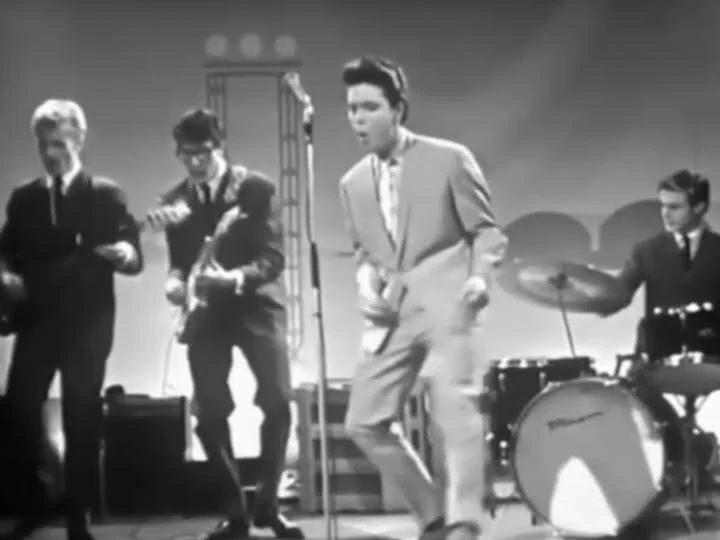
Imagine a kitchen on a Saturday morning. A father makes coffee while his teenaged daughter practices power chords on a guitar. A familiar riff cuts through the room, the opening of Move It by Cliff Richard and the Drifters. She recognizes the shape immediately, something she could play by noon. That is the power of a record that, decades after its release, still feels immediate and playable. But in August 1958, when it first spun on turntables, Move It was an unlikely hero.
It arrived as the B-side to a forgettable A-side called Schoolboy Crush. Yet this lean, local track would become a defining moment for British rock and roll. Cliff Richard and his band, then billed as the Drifters (soon to become the Shadows), recorded the song at EMI Studios in London under producer Norrie Paramor. The session was already in motion for the American import on the A-side, but the B-side felt lived in and right now. When it hit, it gave Richard his first UK top five and arguably gave Britain its first truly homegrown rock and roll moment.
Move It turned a B-side into a beginning.
The creativity behind the track came from guitarist Ian Sammy Samwell. He reportedly wrote the riff and lyrics while traveling to rehearsal, a quick idea hardened into a song by urgency and attitude. The story suggests he sketched it on the bus, a rebuttal to the idea that rock and roll had already said its piece. In the studio, Paramor hedged his bets, bringing in session players Ernie Shear on additional guitar and Frank Clarke on bass to complement the Drifters raw drive. What emerged was a collision between a band learning to write its own fate and a label keen to make a hit.
The music itself is almost schematic in its economy. Everything revolves around that opening guitar line, a figure that snaps like a flag in crosswind. The tone is bright but not brittle, the kind of amplifier timbre that suggests small cones pushed to the edge. The drums sit with dance band exactness yet are played with a rockers impatience. The bass locks to the kick in a simple thump and walk pattern. There is no ornamental piano line competing for space. The record stands lean and mean.
Cliff Richard vocal is the final instrument. His phrasing is tidy, consonants clicking into the beat, but he shades vowels with a tremor of threat. You hear him finding a stance, less the Southern fried growl of his American contemporaries and more a clipped London cool. The microphone capture is intimate, with almost no audible room beyond a quick tail that lets the voice depart without smearing. On revealing gear, the tape hiss is a fine mist under the performance, a reminder that heat was being driven into physical media in a cramped control room.
Television matters here. When Jack Good booked Richard on the music show Oh Boy!, a fast cut teen facing blast that premiered that September, the songs fortunes tilted toward legend. Good reportedly insisted that Cliff perform the British written B-side instead of the American A-side. The cameras gaze, the urgency of a live audience, and a national platform transformed a strong studio cut into a cultural moment. Suddenly this was not just a record but a statement of possibility for British rock.
What is striking, sixty plus years on, is how current the production values feel on modern systems. The record is dry by period standards, which means transient detail, pick attack, stick tip on cymbal edge, that slight rasp when the voice leans, pops through with clarity. Played through good studio headphones, you can sense a faint proximity effect when Richard closes distance to the mic, a nearness that would become a trademark of British pop singing in the decade to come.
Author Ian Samwell reportedly did not complete a second verse for the original 1958 cut, which gives the record a looping insistence, verse as mantra, chorus as act. Paradoxically, that absence of a fully fleshed lyric makes the tracks physical groove carry more semantic weight. It asks the band to say more through arrangement, and they do with little pulls in the rhythm, a slight brightening of tone on repeats, the kind of micro dynamics that musicians learn on bandstands.
Historically, the songs chart performance stamped legitimacy on a British band doing American music their own way. It peaked in the top tier of the UK listings and anchored Richards earliest tours and TV spots. Critics often point to it as a first, if not the first authentically British rock and roll single, a phrase that invites debate but captures the records felt truth. You can hear the country stepping from imitation toward authorship, from the cover version to the statement of intent.
If you leave this article with one action, let it be simple cue up Move It again. Listen for the breath before the first line, the way the snare pops, the way the bass refuses to fidget. It is not nostalgia that makes it work, it is construction. Sometimes the shortest distance between intention and impact is a single take played by a band that did not yet know the future it was starting.
For further listening, consider Johnny Kidd and the Pirates Shakin All Over, a British rock and roll classic from 1960 with a tremolo shiver guitar line that mirrors Move Its taut menace. Eddie Cochran Summertime Blues offers lean arrangement and teenage thunder, an American blueprint that helps frame the British response Move It embodies. Vince Taylor Brand New Cadillac brings UK rockabilly swagger with a motor idling groove, sharing the same urban edge and tight band discipline. Billy Fury Wondrous Place is moodier and slower but its intimacy and vocal focus show another early UK path from croon to conviction. The Shadows Apache demonstrates instrumental mastery from the very band that grew out of the Drifters, hearing how their guitar voice expands beyond the raw spark of 1958.