
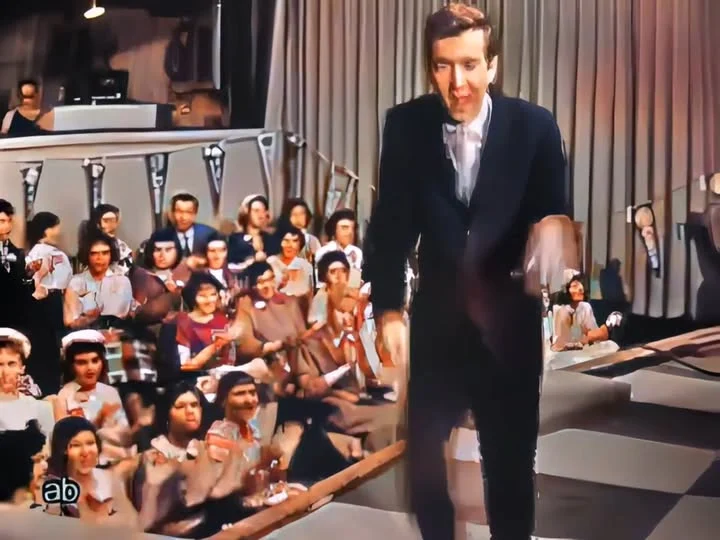
There are moments in music history that feel less like a debut and more like a declaration. Bobby Darin’s 1958 smash, “Splish Splash,” is one of them. Recorded at the legendary Atlantic Studios and released on the Atco label, it was a two-minute, twenty-second sprint that transformed a 22-year-old unknown into a household name.
To call it merely a “novelty” song is to miss the point entirely. It is a masterclass in rhythmic drive, a clever fusion of R&B energy and teen-idol charisma, delivered with a wink and a grin. More than just a hit, it was the cornerstone of Darin’s self-titled debut album, a record that announced an artist who, within the year, would swap his sock-hop swagger for a tuxedo and win a Grammy.
The facts are simple but staggering. “Splish Splash” (Atco single 6117) was cut on April 10, 1958, climbing to No. 3 on the U.S. pop charts and No. 2 on the R&B Best Sellers list. It even cracked the U.K. Top 20 and staged a rare crossover into the country charts. These weren’t just statistics; they were a roadmap for a career that labels scrambled to define.
“Splish splash, I was takin’ a bath.”
That unforgettable opening line was born from a dare. New York DJ Murray the K, encouraged by his mother Jean, challenged Darin to write a song starting with those very words. Darin accepted, and the resulting tune was credited to “Bobby Darin and Jean Murray,” a clever nod that honored the source without a hint of payola. The genius, however, lies not in the gimmick, but in what Darin built around it. The lyric is a tiny, brilliantly paced comic strip, name-dropping contemporaries like “Lollipop,” “Peggy Sue,” and “Good Golly, Miss Molly,” placing Darin in the very center of the pop culture conversation.
The Sound of a Crack Studio Band
Musically, “Splish Splash” flies on an impeccably executed performance. The session personnel, a who’s-who of New York’s studio elite, included Jesse Powell on tenor sax, Al Caiola and Billy Mure on guitar, Wendell Marshall on bass, and Panama Francis on drums. Their approach is a textbook lesson in 1958 rock and roll: an insistent backbeat, a walking bassline that never grandstands, and a “honking” tenor sax that punctuates every phrase like an audible grin.
Producers Ahmet Ertegun and Herb Abramson keep the sound dry and forward, minimizing reverb to let the transients—the snap of Francis’s snare, the bite of a guitar pick—sit on top of the mix. The arrangement is a small theater troupe: every entrance counts, and the exits are crisp. From a musician’s perspective, the feel is everything. Francis leans the backbeat forward, creating a sense of momentum that mirrors the lyric’s rush from the bathroom to a house party.
Darin’s vocal is a masterclass in comedic timing and pop phrasing. He attacks consonants to drive the narrative forward and softens vowels to make the hooks linger. He doesn’t just sing about having fun; he is having fun, and the band is right there with him. The tenor sax doesn’t solo so much as it converses with the vocal, creating a kind of pop counterpoint. It’s a record that rewards close listening, where you can isolate each instrument and admire the collective restraint.
More Than a Novelty
The label of “novelty” can be misleading because it describes an effect (it makes you laugh) rather than a technique (how the music is built). Darin and the Atlantic team did not treat this session as a throwaway. They hired top-flight players, cut the track with the same attention to pacing and pocket as any serious R&B side, and mixed it to command radio airplay. The proof of its quality is its longevity. DJs still reach for it to brighten a set, and music supervisors use it in films and television to conjure uncomplicated joy.
Understanding “Splish Splash” is also key to understanding Darin’s seemingly radical pivot in 1959 to “Mack the Knife.” The same precision he brings to rhythmic delivery here became his interpretive superpower on more sophisticated material. The connective tissue is absolute control—over time, tone, and narrative. The debut album, Bobby Darin, released in September 1958 on Atco, serves as a core sample of those early instincts, with “Splish Splash” as the sparkling layer that caught the daylight first.
Listening Tips and the Legacy
If you want to hear what engineers mean by “punch,” cue the opening bars and note how the drum and bass lock before the vocal enters. The record’s economy is striking; there’s just enough room around the sax to let the hook breathe. On vintage vinyl, the track has a bit of upper-mid bark that suits car radios and jukeboxes. In an age of over-compressed loudness, its transient detail is refreshing.
“Splish Splash” is more than a bright cartoon. It is a concise demonstration of studio craft, pop dramaturgy, and the power of a dare. It launched a career and anchored a debut album that distilled the sound of 1958 youth culture while hinting at the interpretive breadth to come. Play it loud, and you’ll hear how a cheeky bath-time bet became the first chapter in one of American pop’s most improbable trajectories. Over six decades later, the splash still ripples.