
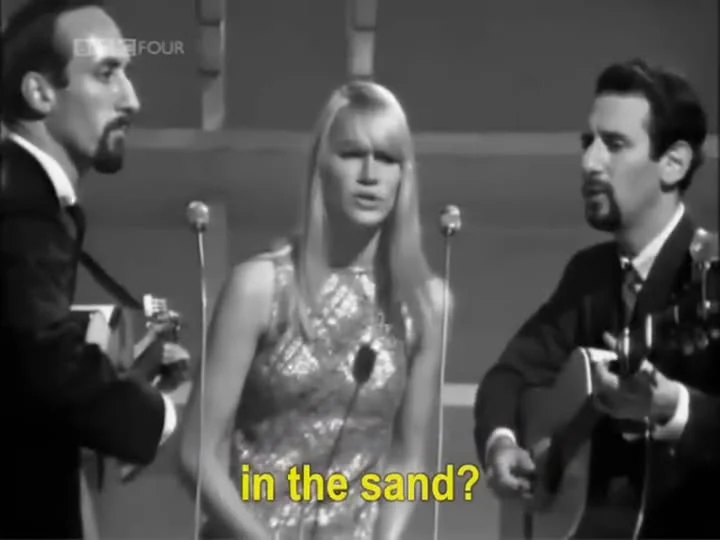

The first chords of an acoustic guitar, a soft strum that seems to echo across decades, and then three voices rise together in a question that has never stopped resonating. How many roads must a man walk down before you call him a man? That moment, captured by Peter, Paul & Mary in their 1963 rendition of Bob Dylan’s “Blowing in the Wind,” became more than a song. It became a soundtrack for change, a whispered prayer at civil rights marches, and a quiet anthem for anyone who has ever looked at the world and wondered when justice would arrive.
Embedded within their landmark album In the Wind, this track launched the trio into an orbit of cultural influence that few folk acts have ever achieved. The album itself weaves together traditional melodies and socially charged lyrics, with standout pieces like All My Trials and Tell It on the Mountain. Yet it is the song built on simple, profound questions that remains the eternal heart of the record — a testament to the idea that the most powerful statements are often the most direct.
Musically, Peter, Paul & Mary chose a path of elegant minimalism. The arrangement relies almost exclusively on a steady, gentle acoustic guitar, its rhythm soft yet unwavering. A subtle bass line occasionally grounds the track, but there are no pianos, no orchestral sweeps, no elaborate layers. This stripped-back approach is deliberate, allowing the trio’s harmonies to breathe and the lyrics to land with full force. In an era of increasingly complex production, the song stands as a masterclass in restraint — a reminder that sometimes the quietest voices carry the farthest.
Bob Dylan’s original words form a series of rhetorical questions that transcend any single moment or movement. How many years can a mountain exist before it is washed to the sea? How many times can a man turn his head and pretend he does not see? Peter, Paul & Mary’s harmonies transform these lines into a collective experience. The interplay of their voices creates a textured soundscape that feels intimate yet communal, as if the listener is part of a choir asking the universe for answers. The emotional weight lies not in any single voice but in the unity of three, a sound that embodies hope and solidarity.
Produced by Albert Grossman and Milt Okun, In the Wind exemplifies the polished yet authentic folk aesthetic of the early 1960s. Grossman, who also managed Bob Dylan, understood the power of letting the message stand without frills. The song quickly became a rallying cry for the civil rights movement, performed at protests and gatherings where people demanded freedom and dignity. Over the decades, its reach has only widened, appearing in films, documentaries, and countless covers that pay homage to its timeless plea.
What endures about “Blowing in the Wind” is its ability to connect on a deeply human level. It asks questions that do not belong to any single generation or cause. The answers, the song suggests, are already around us — carried on the wind, waiting for us to have the courage to hear them. In a world that often feels fractured, this song remains a fragile yet unbreakable thread, binding listeners in the search for something better.
If this song resonates with you, consider exploring these kindred tracks that share its spirit of activism and introspection:
- “The Times They Are A-Changin’” by Bob Dylan — A companion piece that captures the restless energy of social transformation.
- “If I Had a Hammer” by Peter, Paul & Mary — An uplifting call to action, brimming with the same unity and hope.
- “Where Have All the Flowers Gone” by Pete Seeger — A haunting meditation on peace and the cycles of history.
- “Turn! Turn! Turn!” by The Byrds — A folk-rock adaptation of Ecclesiastes that finds wisdom in life’s seasons.
- “Puff, the Magic Dragon” by Peter, Paul & Mary — A lighter tale that showcases the trio’s storytelling magic and harmonic grace.
For those who wish to sing along with the iconic words that have moved millions, the lyrics are printed below, as relevant today as they were in 1963.
How many roads must a man walk down
Before they call him a man?
How many seas must a white dove sail
Before she sleeps in the sand?
How many times must the cannon balls fly
Before they’re forever banned?The answer, my friend, is blowin’ in the wind
The answer is blowin’ in the wind.How many years must a mountain exist
Before it is washed to the sea?
How many years can some people exist
Before they’re allowed to be free?
How many times can a man turn his head
And pretend that he just doesn’t see?The answer, my friend, is blowin’ in the wind
The answer is blowin’ in the wind.How many times must a man look up
Before he can see the sky?
How many ears must one man have
Before he can hear people cry?
How many deaths will it take ’til he knows
That too many people have died?The answer, my friend, is blowin’ in the wind
The answer is blowin’ in the wind.
The answer is blowin’ in the wind.