
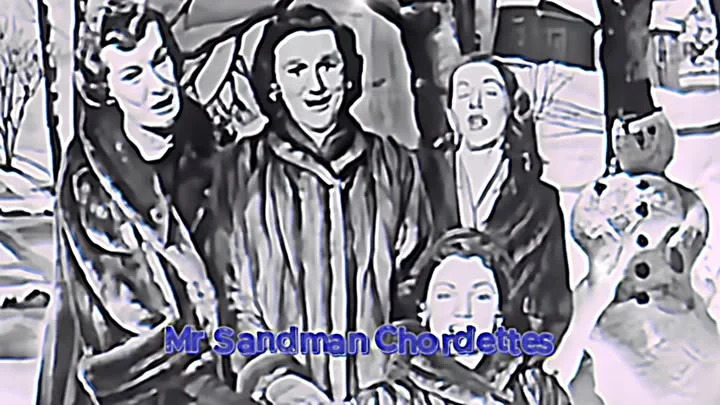
There are songs that feel like they exist outside of time, hovering in a golden pocket of pure joy. Mr. Sandman by The Chordettes is one of those rare recordings. From the very first chiming syllable, it sparkles for exactly two and a half minutes, leaving the world brighter than it found it. Written by Pat Ballard and released in October 1954 on Cadence Records, this track became a signature for the Wisconsin vocal quartet and a bellwether for how radio-ready close-harmony singing could be married to a playful, almost cinematic concept. It is a small masterpiece of arranging, mic technique, and group blend—music engineered to sound utterly effortless.
Behind that weightless surface lies a story of meticulous craft. Producer Archie Bleyer, who also founded Cadence, conducted the session and added a delightfully homespun percussive effect: he kept time by patting his own knees. In the mix, that gentle tap-snare rides low beneath the vowels and consonants, creating a rhythm section out of thin air. Pianist Moe Wechsler provided the only persistent “real” instrument, sketching out diatonic patterns and sweet little fills that reinforce the melody without stealing focus. And then there is a moment of meta-comedy: when the lyric name-checks Liberace’s “wavy hair,” a quick keyboard glissando flickers by like a musical wink. In the third verse, a low male voice replies “Yes?”—that is Bleyer again, the producer stepping into the frame as a character in his own audio play.
The record’s magic is often attributed to its near-weightless vocal arrangement, and rightly so. The Chordettes stack their voices in tight, barbershop-rooted harmony, with a clear lead on top and the lower parts weaving guide-tones and chromatic approach notes that give each cadence a soft, glowing edge.
Mr. Sandman began life as a single rather than an album cut. Cadence pressed it on both 78 and 45 RPM formats with I Don’t Wanna See You Cryin’ on the flip, and the single quickly became a national phenomenon. When LPs became the preferred way to repackage hits, the Chordettes opened their 1957 Cadence LP The Chordettes with the song as the very first track—telegraphing just how much it had come to define their sound and era. That album serves as a historically tidy entry point, situating the breakthrough single amid other high points like Eddie My Love and Born to Be With You.
The single loomed large in real time. The Chordettes’ version hit No. 1 across all three of Billboard’s major popular charts of the moment: Best Sellers in Stores, Most Played by Jockeys, and Most Played in Juke Boxes. It sold, it spun, and it rang from diner jukes coast to coast. Those wins sit alongside its No. 1 showings in Cash Box’s composite rankings, making clear that Mr. Sandman was not merely a novelty—it was a consensus sensation. In 2002, it was inducted into the Grammy Hall of Fame, cementing its cultural footprint.
From a theory perspective, the Chordettes’ arrangement borrows liberally from barbershop practice while sanding down its rougher edges for a radio pop aesthetic. Close, upper-structure clusters and frequent secondary dominants usher the ear from tonic to subdominant and back with postcard clarity. Suspensions—especially ninths resolving to chord-tones—provide that “smile in the chord” feeling, while the bass-line, sung rather than played, steps gracefully rather than leaping. The quartet’s breath releases, consonant endings, and matched vibrato behave like a chamber ensemble. This is where barbershop’s ringing chords meet classical choral precision and the narrative directness of 1950s Tin Pan Alley.
The lyric is both simple and sly. The narrator petitions the folkloric Sandman to “bring me a dream,” but the dream is an ideal partner: tall, charming, with a defined face and, in this version’s playful jab, hair styled like Liberace. A small historical curiosity: the published sheet music offered male and female lyric variants, an early nod to how different ensembles could tailor the pronouns to fit their stage persona. That adaptability is partly why the song traveled so widely—groups could slot it into their act without contorting their identity.
If you are a country listener, Mr. Sandman has extra resonance. Chet Atkins recorded a celebrated instrumental take in November 1954, employing his EchoSonic amplifier to lay down a gleaming, tape-slap halo around the melody. His version, with celesta, piano, bass, and drums surrounding that buttery guitar, charted on the country lists and remains a staple for fingerstyle players. Emmylou Harris later folded the song into her own repertoire, first on the 1981 album Evangeline in a trio with Dolly Parton and Linda Ronstadt, and then as a single where Harris overdubbed all three lines herself. It reached No. 10 on Hot Country Singles and crossed to No. 37 on the Hot 100—evidence of the tune’s cross-format pull.
Longevity in pop depends on a compelling hook, a distinctive sound-world, and a persona the listener wants to revisit. Mr. Sandman checks all three. The hook is instantaneous, built on a call-and-response that functions like a brand logo. The sound-world is crystalline but warm—mono, yet dimensioned by judicious reverb and the play of breath and consonant. The persona—charming, slightly cheeky, warmly romantic—feels inviting in any decade. It is no accident that supervisors keep syncing the track for movies and TV from Halloween II to Deadpool: the record conjures “1950s” in a single bar, or casts a sly, sugar-coated contrast against onscreen chaos.
For collectors, original Cadence pressings carry a particular mystique, and the 1957 LP placement offers a convenient capsule of the era. The song remains a favorite for vocal groups, with arrangements spanning high-school choirs to professional quartets, helped along by widely available sheet music that preserves both the male and female lyric options.
In a catalog that includes unforgettable singles like Lollipop, Born to Be With You, and Just Between You and Me, Mr. Sandman stands as the Chordettes’ purest expression of voice-as-orchestra. It has the sweetness of a lullaby, the wit of a Broadway aside, and the engineering precision of a great studio chart.
If you are approaching the song for the first time, hear it in three frames: the original Chordettes single for the canonical sparkle; Chet Atkins’ instrumental for how the tune sings through the fretboard; and Emmylou Harris’ cut for a country-pop lens with impeccable vocal blend. Heard together, they reveal a song robust enough to hold different stylistic spotlights and light enough to float through them all.
For those who love this track, here are five more to cue up next:
- The Chordettes – “Lollipop” (1958). Same group, different flavor—hand-clap hooks, playful arrangement, and airtight harmonies.
- The McGuire Sisters – “Sincerely” (1954). A close-harmony classic, slower and silkier, with a similar mastery of blend.
- The Four Aces – “(It’s No) Sin” (1951) or “Dream” (1954). Male-quartet warmth and urbane voicings that pair nicely with the Chordettes’ sound.
- The Fleetwoods – “Come Softly to Me” (1959). Whisper-close vocals and delicate textures, a later-decade echo of the Chordettes’ intimacy.
- The Platters – “Only You (And You Alone)” (1955). Rich lead with luminous backing, perfect for a slow-dance follow-up.
Mr. Sandman may be forever coded as 1954, but it refuses to gather dust. The performance feels alive—winking, weightless, and tuned to human breath. Whether you come for the nostalgia, the harmony geekery, or the sheer pleasure of voices locked in orbit, this is mid-century pop at its most durable and delightful.