
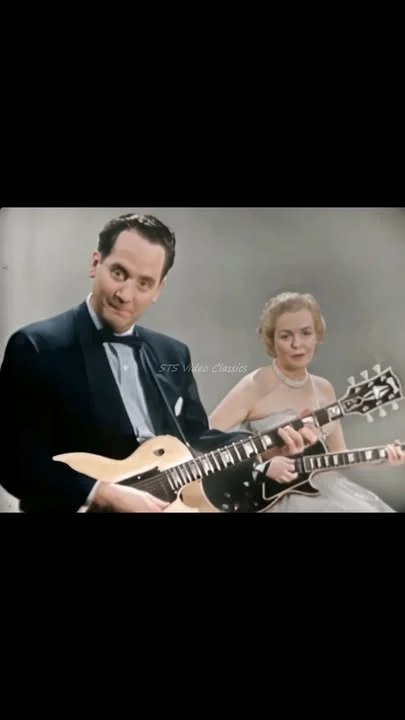
The air in a mid-century living room carried a special kind of stillness. Radios with walnut veneer stood like altars, and from them sometimes came a sound so intimate it felt like a secret whispered only for you. That sound was the genius of Les Paul and Mary Ford, and it reached its purest form in 1953 with their single “Vaya con Dios (May God Be with You).”
This was not an album track at first. It arrived as a standalone single on Capitol Records and became a phenomenon that defined the decade’s most beloved husband and wife duo. Following earlier hits like “How High the Moon” and “Mockin’ Bird Hill,” this song marked a career high point. It was more than a hit. It was a glimpse of the future wrapped in a tender goodbye.
Written by Larry Russell, Inez James, and Buddy Pepper, “Vaya con Dios” is a simple ballad. A gentle prayer for a departing loved one. But Les Paul, the brilliant tinkerer and sonic architect, took that simplicity and transformed it. He used his pioneering sound on sound recording technique, a way of layering multiple tracks that previewed modern overdubbing. The arrangement is spare. There is no orchestra, no brassy fanfare, no piano carrying the melody. Instead, all focus falls on Mary Ford’s layered vocals and Les Paul’s electric guitar.
Mary Ford’s voice is the emotional heart. She sang close to the microphone, and through multitracking she built a choir of herself, two or three voices deep. The sound is dry and immediate. You can feel the air moving from her lips. There is no cavernous reverb. This makes the phrase “Go with God” feel like a bedside whisper, not a stage pronouncement. It is vulnerability multiplied.
Les Paul’s guitar work is a masterclass in restraint. The instrument never grandstands. It cradles the vocal. He uses a clean, slightly compressed tone with no aggressive distortion. His fills are brief and elegant, miniature countermelodies that sound like lessons in phrasing. He uses his signature speed not for flash but for density. Quick runs appear, the product of multiple carefully recorded parts. The result is a texture that feels simple yet impossibly complex. It is a technical miracle disguised as mood music.
It is the sound of perfect, machine-like precision applied to the most human of emotions.
The dynamics never swell. The track maintains a soft, persistent warmth, a restrained intensity. This was intentional. It maximized the impact of their technology on the small 78 RPM records of the time.
“Vaya con Dios” dominated the charts in 1953. It spent eleven non consecutive weeks at number one on the Billboard Best Sellers chart and ended the year as one of the biggest hits. Its enduring appeal lies in a duality. The universal heartbreak of farewell wrapped in the state of the art packaging of a musical futurist. It was pop music that hinted at rock and roll’s recording complexity while holding tight to the melodic grace of Tin Pan Alley.
The innovations of close miking and multitracking did not fade away. They reshaped how music was made. From The Beatles’ vocal stacks to Queen’s operatic rock, the blueprint was laid here. Mary Ford’s intimate delivery, achieved with an early Altec microphone and obsessive attention to sound separation, became the template for pop radio for decades.
Today, the song is not a dusty relic. It stands as proof that technology can serve pure feeling. Whether heard through vintage equipment or high fidelity studio headphones, the clarity of Ford’s voice and the surgical precision of Paul’s fretwork still astonish. It reminds us that the true work of an artist is not always inventing a new emotion, but finding a completely new way to express an old one.