
The banjo didn’t just play notes that night. It fired shots heard across a nation still unsure what to make of its own mountain music.
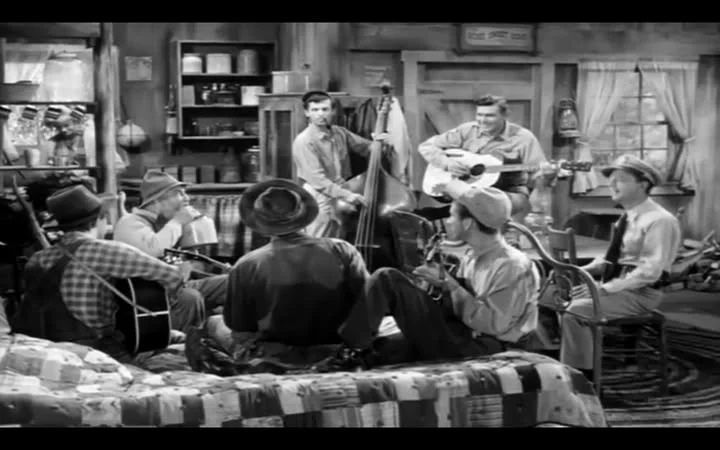
Picture this: a television studio in the early 1960s, lights soft and diffused, cameras trained on a fictional family called The Darlings. The patriarch, Briscoe, stood surrounded by his banjo-wielding, clean-shaven sons. To the casual viewer, this was mere comic relief—a hillbilly novelty act designed to make Sheriff Andy Taylor look even more folksy. But buried inside that performance, disguised as entertainment, was a musical earthquake. The Dillards, master bluegrass musicians from the Missouri Ozarks, had smuggled something pure and explosive onto network television.
Their signature song, “Dooley,” became the spark. And the fuse ran straight through the heart of 1960s America.
Rodney Dillard still remembers the day the band first walked onto that soundstage. He and his brother Doug, alongside Mitch Jayne and Dean Webb, had brought a sound honed on Ozark porches and in Missouri barn dances. They had no idea they were about to become ambassadors for an entire musical tradition. When “Dooley” hit the airwaves in 1963 on their debut album Back Porch Bluegrass—released on the Elektra label and produced by Jim Dickson—it carried the weight of something both ancient and brand new.
What the television audience thought was a joke was actually a master class in high-speed bluegrass virtuosity. The joke was on the nation—and America couldn’t get enough.
The Dillards appeared on The Andy Griffith Show as The Darlings from 1963 to 1966. During those three years, they accomplished something no marketing campaign could have engineered. A song about a friendly moonshiner—a lovable rogue named Dooley who lived below the mill with two daughters and a forty-gallon still—became the soundtrack to millions of American living rooms. It was glamour meeting grit, the hollow meeting Hollywood, and the result was pure alchemy.
The Mechanics of a Musical Detonation
Press play on “Dooley” and the first thing that hits you is the velocity. Doug Dillard’s five-string banjo, played in the Scruggs three-finger style, doesn’t simply accompany the song. It attacks it. The tone is bright, percussive, almost metallic—notes that don’t just register but ping against the listener’s senses like hail on a tin roof. His runs cascade at a speed that would challenge even seasoned players looking for guitar lessons in bluegrass technique.
But the banjo is only part of the architecture. Mitch Jayne’s upright bass delivers deep, resonant thumps on the downbeats, a physical anchor for the swirling melody above. Dean Webb’s mandolin chops—those quick, rhythmic chords often described as “chink-chink”—fill the high-mid range and act as percussive glue. There is no drum kit here. The rhythm is entirely internal, created by the interlocking of strings moving at breakneck pace.
The recording captures all of this with remarkable clarity. Listening on quality home audio equipment reveals the textures: the slight fret buzz on the banjo, the woody sustain of the bass, the breath of the vocalist near the microphone. It sounds live, intimate, immediate. There is room feel in the recording, a sense that what you’re hearing happened once, in a real space, with minimal post-production polish.
The Voice That Grinned While It Sang
Rodney Dillard’s lead vocal delivery is the song’s secret weapon. He sings with a light-hearted, mischievous grin woven into his phrasing. The lyrics tell of Dooley—”a good old man” who lived below the mill—and his illicit distilling operation. But there’s no judgment in the telling. Only warmth, only affection for a character who represents the rugged individualism and hidden economies of the rural South.
The vocals sit high and tight, delivered in classic bluegrass harmony style. They employ the “high lonesome sound” that defines the genre, but without the mourning. Instead, The Dillards infuse it with buoyant, playful mischief. This contrast—a vocal tradition born in hardship and isolation, executed with cathartic joy—is what made their television appearances so compelling. Audiences saw hillbillies and heard virtuosos.
The River That Runs Through Bluegrass History
The true significance of “Dooley” lies in its double legacy. On one side, it stands as a near-perfect example of traditional bluegrass performance, honoring the rapid-fire instrumental virtuosity of pioneers like Bill Monroe and Flatt & Scruggs. On the other, it became a stepping stone toward the future. The Dillards would go on to pioneer the country-rock movement with their 1968 album Wheatstraw Suite, incorporating drums, electric instruments, and sophisticated arrangements that broke every genre boundary.
But it was Back Porch Bluegrass and those Darling family episodes that provided the foundation. The television work created a market. It proved that this music—often dismissed as “hillbilly”—could command a mass audience outside the established country circuit.
Years later, I watched a seasoned session piano player try to chart the chord changes to “Dooley.” The harmonic structure was deceptively simple—a classic I-IV-V progression. But the sheer speed and harmonic density created by those interlocking instrumental lines made the piano seem out of place, unable to mimic the percussive, jagged attack of bluegrass strings. It was a reminder of how unique this instrumentation truly is. In a bluegrass string band, every element is both rhythmic and melodic.
Their music didn’t just reflect the American heartland. It amplified it until the rest of the country had no choice but to listen.
The track endures because it operates on two levels simultaneously. It is both a high-fidelity historical document and an invitation to dance. It tells a micro-story about a specific time and place—the hidden economies of the rural South, the rugged individualism of moonshiners—while delivering it with universal, exuberant energy. When those instruments take off, you have no choice but to follow.
Where to Go From Here
For listeners who want to follow the river that “Dooley” opened, the journey leads in several directions. Lester Flatt & Earl Scruggs with “Foggy Mountain Breakdown” offers the essential instrumental template, the raw sound of the banjo style that Doug Dillard inherited and advanced. The Stanley Brothers with “Man of Constant Sorrow” shares the high lonesome vocal harmony and Appalachian storytelling tradition. Bill Monroe & His Blue Grass Boys with “Blue Moon of Kentucky” goes straight to the source—the father of bluegrass himself.
For fans of the narrative folk-ballad tradition, The Kingston Trio with “Tom Dooley” shares both a name and a similar dark-hued subject matter. And for those curious about where The Dillards’ innovations led, New Grass Revival with “Great Balls of Fire” represents the progressive bluegrass movement they helped launch. Grateful Dead with “Cumberland Blues” captures a similar rustic folk-rock groove rooted in the same musical soil.
“Dooley” carries the dust of the road and the polished sheen of the television screen. It sounds simultaneously old and eternally fresh. It is a moment preserved in amber—the sound of four men from Missouri who walked onto a soundstage playing hillbillies and walked out as revolutionaries.