
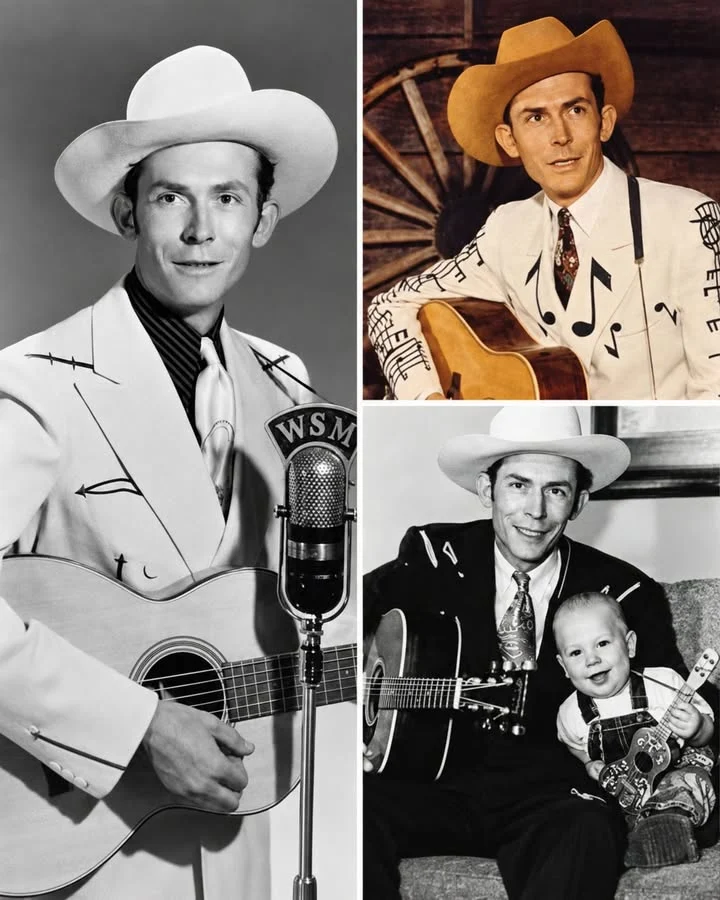

A man sleeps beneath newspapers while a voice asks who will stretch out a hand to him. The voice is easily recognized, but the name on the record says Luke the Drifter. Hank Williams had to step behind another name before the jukebox would let him talk about broken men and abandoned women.
By 1950 Williams had already signed with MGM in 1947, reached the country chart with “Move It On Over” and made “Lovesick Blues” his first No. 1 in 1949, the same year he joined the Grand Ole Opry. Jukebox operators kept standing orders for every new release. Songs such as “Lovesick Blues” and “Long Gone Lonesome Blues” reliably pulled coins from honky-tonk customers. A record bearing his name carried a promise of familiar pleasure.
Then Williams handed MGM a strange set of recordings. They dealt in funerals, moral teachings and portraits of people left at the margins of polite society. Williams chanted some of them. He spoke most of them. Over steel guitar, organ and bass, his voice sounded less like the ruler of honky-tonk and more like a preacher who had stayed up far too long. If a customer pulled a Williams record from the jukebox and heard a spoken sermon about mortality, poverty or moral failure, the operator might believe MGM had sent the wrong product. The issue was not scandal. It was the jukebox.
Producer Fred Rose found a practical split. The honky-tonk singer kept the name Hank Williams. The man reciting parables became Luke the Drifter. MGM never worked hard to hide the connection. Williams sometimes introduced Luke on radio as a close relative or half brother. The alternate name worked less like a mask and more like a separate room placed inside the same person.
Under that name Williams cut “Pictures from Life’s Other Side,” “Be Careful of Stones That You Throw,” “Men with Broken Hearts” and other pieces assembled from spoken verses, gospel imagery and small instrumental frames. These records never asked dancers to stay on the floor. They asked people to stand still long enough to think about a funeral, an abandoned woman, a man sleeping beneath newspapers or the ease with which respectable citizens condemned someone else.
The split carried an uncomfortable irony. Luke taught restraint and moral wisdom while Hank’s own life was falling apart through pain, alcohol, pills and a brutal travel schedule. The Luke records cannot be treated as a confession Williams always obeyed. They hold up the standards he could name even when he could not live by them.
Not every Luke performance carried a graveyard mood. “I’ve Been Down That Road Before” turned talking-blues humor toward romantic trouble. “Everything’s Okay” let a man insist his family was fine while every new detail exposed the opposite. “No, No, Joe,” written by Fred Rose, used early Cold War pop language to address Soviet leader Joseph Stalin. Luke could be wry, current or regretful. “Ramblin’ Man” crossed the line so easily that it later appeared under Williams’s own name.
The Luke records needed less musical movement than the honky-tonk sides. Williams’s voice floated above restrained steel guitar, bass and organ. Silence shaped the arrangement. Without drums or a dance beat there was no forward motion, so every image had room to land.
Williams died on January 1, 1953, while traveling to scheduled performances. He was twenty-nine. Later that year MGM released a ten-inch LP titled Hank Williams as Luke the Drifter. The famous name now appeared first, with Luke presented as one of its forms. Death had changed the marketing math. No future single needed protection from an unexpected sermon. His catalogue was complete, and every scrap left behind carried value because it held some part of him listeners could no longer receive in person.
The label had created Luke to guard the commercial promises attached to Hank. What survived proved those promises had never been wide enough to contain his entire voice. Luke simply gave that extra voice somewhere to go.
Williams never made a perfect disguise. His nasal edge remained. The rhythm came from speech, not melody. He leaned into consonants, paused before judgments and dropped his voice into the tone of a man passing along hard-earned experience.
The disguise lasts only as long as it takes Hank Williams to speak the first line.