
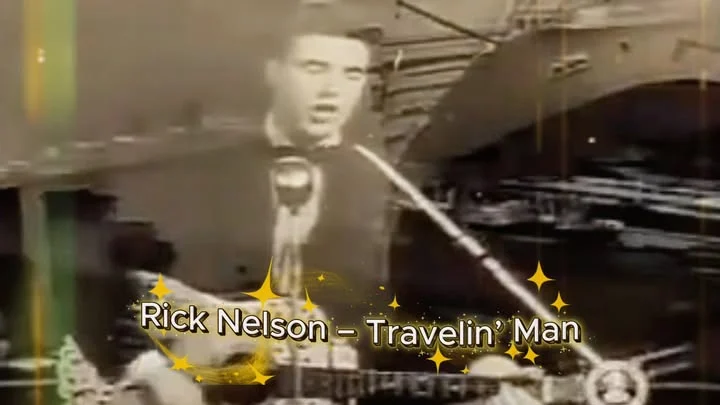
Rick Nelson might have been born into a television dynasty, but it was his music that truly made him a legend. The opening notes of “Travelin’ Man” still carry a magic that transcends generations—a warm, jangling guitar riff that instantly evokes the thrill of the open road. Released in April 1961, the song became not just a number-one hit on the Billboard Hot 100 but also a cultural artifact that captured the heart of a generation poised for adventure. Decades later, it remains a deeply human anthem, a reminder that the joy of discovery never fades.
The most unforgettable moment of “Travelin’ Man” came not from a record player but from a television screen. On The Adventures of Ozzie and Harriet, Rick Nelson performed the song against a backdrop of exotic locales—Mexico, Hong Kong, Hawaii—a visual journey that mirrored the lyrics. The segment turned a simple pop tune into a vivid travelogue, cementing the song as part of his on-screen identity. For millions of viewers, that performance was the emotional climax of the song, a moment when the dream of exploration felt tangible.
“I’m a travelin’ man, I’ve made a lot of stops along the way,” Nelson sang, but the journey behind the song was just as fascinating. The track was written by Jerry Fuller, a prolific songwriter who first offered it to Sam Cooke. When Cooke’s manager passed, the song found its way to Nelson’s team—a stroke of fortune that altered the course of pop history. Nelson’s laid-back, smooth vocal delivery made the lyrics feel effortless, as if he were recounting his own globe-trotting romances.
The production of “Travelin’ Man” was a masterclass in understated sophistication. Guitarist James Burton, a long-time collaborator, wove in subtle twangy licks that balanced rockabilly energy with a polished pop sheen. Backing vocals and a soft shuffle beat gave the track a buoyant, carefree atmosphere. It was a sound perfectly tailored for early-1960s radio—smooth enough for mainstream listeners, yet raw enough to retain rock and roll’s rebellious edge.
Lyrically, the song painted a picture of wanderlust and romantic escapism. Each verse introduced a new city and a new love—a girl in Mexico, a woman in Hong Kong, a sweetheart in Hawaii. This structure gave the song a cinematic quality, turning the listener into a companion on Nelson’s imaginary travels. In the early 1960s, air travel was becoming more accessible, and the idea of exploring distant cultures excited the American imagination. “Travelin’ Man” captured that optimism perfectly, offering a soundtrack for a world that felt both vast and full of possibility.
Nelson himself was a product of the very medium that broadcast his performance. Born Eric Hilliard Nelson in 1940, he grew up in front of cameras on the family sitcom The Adventures of Ozzie and Harriet. The show blurred the line between fiction and reality, and as Nelson matured, he used the platform to launch a music career. By 1961, he was already a heartthrob, blending rock, country, and pop into a signature sound that helped define early rockabilly. His success on television and on the charts seemed effortless, but Nelson was deeply committed to evolving as an artist.
The cultural impact of “Travelin’ Man” extended beyond its chart performance. It became an anthem for young people eager to break free from small-town life and explore the wider world. Nelson’s portrayal of a carefree traveler resonated with the American spirit of independence and curiosity. At a time when global awareness was expanding, the song’s openness to different cultures felt progressive and relatable. It was more than a hit—it was a cultural touchstone that celebrated a connected world.
As the 1960s progressed and rock music evolved, Nelson’s popularity eventually waned. But “Travelin’ Man” never faded. It remains a beloved classic, often cited as a defining moment in his career. For listeners today, the song offers both nostalgia and a timeless reminder: the journey itself is the ultimate adventure. Its easygoing charm and optimistic spirit continue to inspire new generations to pack a bag, hit the road, and meet the world with open arms.
In the end, Rick Nelson did more than sing about travel—he gave voice to a universal longing for discovery. Whether heard through vintage vinyl or a streaming playlist, “Travelin’ Man” still carries that promise: that somewhere out there, a new adventure awaits.