
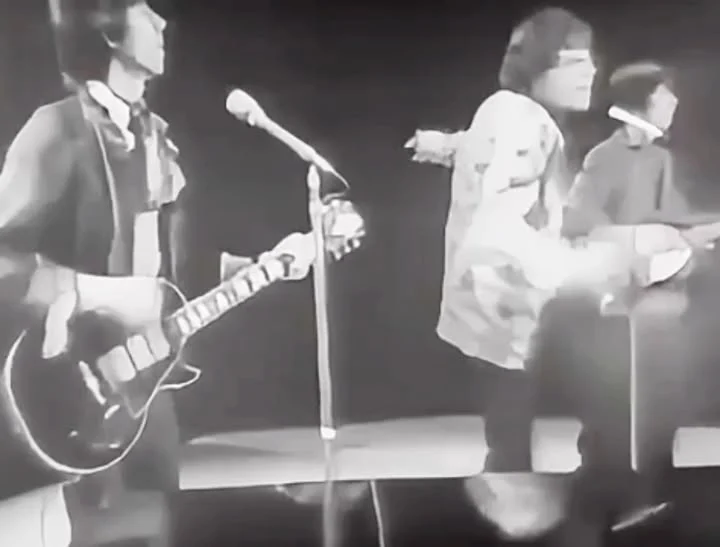
The opening drum fill of “Let’s Spend The Night Together” remains one of rock’s most unmistakable alarms. Charlie Watts struck his kit with a furious echoing burst that cleared the air before Mick Jagger launched into a breathless vocal attack. It was January 1967 and The Rolling Stones were about to release a song that would terrify the establishment and delight nearly everyone else.
That song arrived as a single paired with the whimsical psychedelic tune “Ruby Tuesday.” The double A side captured the band’s split personality in a single record. One track was pure primal grit while the other drifted through melancholic baroque pop. In the United States the single also led off the American edition of the band’s fifth British album Between the Buttons. The UK version excluded it entirely. Producer Andrew Loog Oldham guided the session just before his creative partnership with the group came to an end. The album itself now feels like a fascinating bridge between the Stones’ R&B roots and the mod and pop experiments of the moment.
Musically the track is deceptively simple. Keith Richards built a two chord guitar riff that hammers into the skull with hypnotic repetition. Brian Jones added a swirling organ tone high in the mix, giving the song a psychedelic tint that fit the era perfectly. Richards also played piano alongside the essential contributor Jack Nitzsche, layering bright high notes and boogie woogie shades over the rhythmic engine. Watts held everything together with controlled frenzy, leaning hard on his cymbals for brightness and acceleration. The resulting density feels less like a wall of sound and more like a tightly coiled spring. For anyone studying the sheet music of this period, the chord structure looks almost too easy, but the magic hides in the interlocking rhythm between guitar and keys.
Jagger’s voice was tightly micked, close and urgent, which made the famous four words land with the force of a physical blow. In an era of veiled euphemism he simply said it directly. That frankness led to the legendary Ed Sullivan Show compromise, where he was forced to mumble “Let’s spend some time together.” The moment became television history and only strengthened the band’s image as authentic rebels.
I believe the raw, unvarnished urgency of this recording captures a truth about The Rolling Stones that no ballad or psychedelic experiment ever could.
This song never aimed for finesse. Its production carries a gritty compressed edge, miles away from the pristine pop sheen of 1967. That rough texture made it perfect for cheap radios and car speakers turned up too loud. It still sounds eternal to a young couple driving home after a show in the small hours. The windows are down and the track shuffles on. It does not feel dated, it feels alive. The relentless drumming, the swaggering vocal, the sheer momentum all combine into a soundtrack for crossing borders and chasing forbidden promises.
Decades later “Let’s Spend The Night Together” remains a cornerstone of the Stones catalogue. It reached the top five on the UK charts but faced severe airplay restrictions in America, so its US chart peak stayed modest next to its flip side. Yet the cultural impact far outweighs those initial numbers. This was a world waking up to its own desires, voiced by the least apologetic band on the planet. The contrast with their polished contemporaries defined this era of the group. The Stones offered glamour with dirt under its nails and whiskey on its breath. This was rock and roll in its most elemental role.
Listening recommendations
The Rolling Stones – “Jumpin’ Jack Flash” (1968) shares the hard driving riff structure and primal energy of the same era.
The Kinks – “All Day and All of the Night” (1964) delivers a similar two chord hyper aggressive momentum that never lets up.
The Who – “I Can’t Explain” (1965) captures the same urgent and concise pop rock attack of the British Invasion.
The Beatles – “Taxman” (1966) offers a complex driving bass line and sharply focused rhythm guitar work.
David Bowie – “Panic in Detroit” (1973) exhibits a frantic rhythmic energy and a close mic’d vocal delivery that echo the Stones’ approach.
The Small Faces – “Tin Soldier” (1967) features powerful soul infused vocals and a dramatic arrangement with layered instrumentation.