
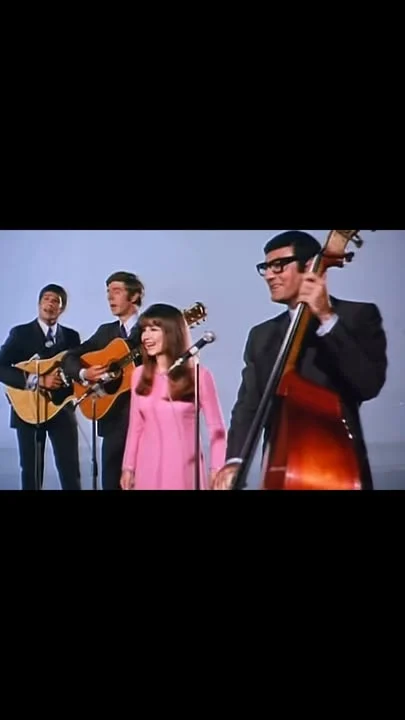
It starts with a voice that feels like a warm embrace. Judith Durham’s crystalline vocals drift over gentle acoustic strumming, and suddenly the noise of the world fades away. The Seekers did not just sing a song when they released A World of Our Own in 1965. They offered a blueprint for escape, a promise that love could build a fortress against chaos. More than half a century later, that promise still holds. In an age of constant connectivity and relentless news cycles, the track remains a quiet refuge, a reminder that sometimes the most radical act is shutting the door and lighting the light.
These four Australians—Judith Durham, Athol Guy, Keith Potger, and Bruce Woodley—never intended to be revolutionaries. They simply wanted to blend folk sincerity with pop accessibility. Yet in doing so, they carved a path that no one else had walked. While the British Invasion roared with electric guitars and rebellious yelps, The Seekers offered something softer. Their harmonies were lush, their melodies unhurried, and their lyrics direct. They became the first Australian act to crack both the UK and US charts, proving that gentle music could travel just as far as loud music.
The song itself was written by Tom Springfield, brother of Dusty Springfield, and it captures the band’s essence with startling clarity. From the opening lines, the listener is invited into a private sanctuary.
Close the door, light the light, we’re staying home tonight. Far away from the bustle and the bright city lights.
This is not a love song about possession or passion. It is a love song about shelter. The lyrics speak of building a world where sorrows are left behind, where two people create their own reality. In the 1960s, a decade defined by protests and upheaval, that message landed with extraordinary force. It still does today, when the world feels just as loud and just as uncertain.
Musically, the track is deceptively simple. A bright acoustic guitar sets the rhythm. The bass walks softly beneath Durham’s voice, and the harmonies fold around her like a blanket. There is no dramatic crescendo, no orchestral swell. The beauty lies in restraint. Durham’s voice carries both vulnerability and resilience, making the listener believe that such a world is possible. The folk-pop arrangement never overpowers; it invites. That is why the song has endured. It does not demand attention—it earns it.
Upon its release, A World of Our Own reached number 3 in the UK and number 19 in the US. But numbers only tell part of the story. The real measure of its impact is the way it has embedded itself in the collective memory. It played at weddings, on car radios, in quiet living rooms where people needed a moment of peace. It crossed generational lines. Parents played it for children, and those children later played it for their own families. The song became a hand-me-down treasure, its message never growing stale.
What makes it timeless is not nostalgia alone. It is the universality of the central idea. Everyone needs a world of their own—a place where the outside ceases to matter, where connection overrides chaos. The Seekers understood that longing intuitively. Judith Durham once said that the song felt like coming home, and that feeling translates to every listener. It is why the track continues to surface in film soundtracks, covers by new artists, and playlists designed for comfort.
In the end, A World of Our Own is more than a piece of pop history. It is a quiet manifesto for intimacy in a noisy world. Its melody lingers, its invitation remains open. Close the door. Light the light. Build something that no one else can touch. The Seekers gave us that gift in 1965, and it has not diminished with age.